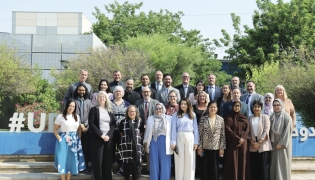
DOHA: A regional conference for legal experts which opened at the Qatar University yesterday is discussing ways to develop clinical legal programmes, a relatively new concept in the Middle East, that provide free legal services to marginalised sections in the community.
The second Middle East Regional Symposium on Clinical Legal Education, which concludes today, saw legal experts sharing their experiences in running community clinics which help vulnerable people access legal advice and encourages more universities in the region to expand existing clinical programmes or develop new ones.
The conference is hosted by the University’s College of Law, in collaboration with the Protection Project at The John Hopkins University School of Advanced International Studies (SAIS) in the US and Qatar Foundation for Combating Human Trafficking (QFCHT).
The Protection Project and QFCHT have worked closely with QU’s College of Law to establish a legal clinic programme last year.
The Human Rights Clinic, led by Lecturer Myrna Tuttle, focuses on human trafficking, particularly of domestic workers in Qatar. While they cannot represent clients in courts in Qatar, students have interviewed workers and submitted reports on their situation. They are now involved in drafting a Domestic Workers Model Law and an employment contract (between an employer and a foreign worker).
Clinical legal programmes use a law firm-like setting to train students to provide pro-bono (free) legal services to underprivileged or marginalised people who would otherwise have little or no access to legal advice, and to work to monitor the status of human rights and advocate for legal reform.
The conference has raised issues including how to build successful legal clinics, legal ethics, clinical methodologies, accreditation, the role of students and supervisors in legal clinics, and curricula and emerging models of clinics.
Delegates also discussed in detail their own experiences of running clinics, the challenges and benefits and proposed how to expand the network of clinics across the Middle East.
Opening the symposium was QU College of Law Dean Dr Hassan Okour; Senior Research Professor of International Law & Executive Director, The Protection Project at SAIS Professor Mohamed Mattar and QFCHT Director Maryam Al Malki.
Al Malki said: “The importance of the second Middle East Regional Symposium on Clinical Legal Education comes from the fact that it provides an opportunity for the exchange of expertise and successful experiences in this field. It encourages various Arab educational institutions to develop existing legal clinics and expand in the establishment of legal clinics. These have a great impact in qualifying future legal cadres, developing their knowledge and enabling them to help and protect victims of human trafficking and provide legal advice to them.”
Dr Okour said: “The concept of legal clinics is a relatively new but expanding field in the Middle East. This symposium is an excellent opportunity for those already involved to share their expertise, and to develop the network of such clinics across the region, which provide an invaluable resource to vulnerable people and excellent and inspiring experience for law students. We are grateful to John Hopkins University and QFCHT for their ongoing collaboration and for sharing their wealth of experience which will benefit society in Qatar and the wider Middle East.”
The Peninsula