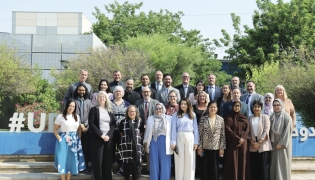
The students with an SFS-Q official.
DOHA: Three students at Georgetown University School of Foreign Service in Qatar (SFS-Q) have been awarded Undergraduate Research Experience Programme (UREP) grants from Qatar Foundation’s (QF) Qatar National Research Fund (QNRF) in support of research projects.
As for the real world, ever wonder how many positive tweets Qatar gets on Twitter each day? Ever think about the causes of a spike in negative tweets? This is part of the research that SFS-Q student Danah Dehdary is using her UREP grant to explore.
‘Using Social Media to Assess Qatar as a Brand’ is the title of Dehdary’s research proposal. She is working with economist Alexis Antoniades, Assistant Professor at SFS-Q, to critically examine how Qatar is perceived in the social media. It will be one of the first studies of its kind. The research will utilise a massive data-set of all tweets from around the globe over a 365-day period.
Social media, such as Facebook and Twitter, provide a platform for people to connect, communicate, share information and discuss topics. Because the online community plays an important role in shaping Qatar’s image at home and abroad, this study will help assess Qatar’s image and evaluate it as a brand.
John Crist, Director of Research at SFS-Q, said: “Our undergraduates have a great deal of talent and our faculty encourage a thinking-outside-the-box approach to issues relevant to Qatar and its future. Danah’s UREP project is an example of our students and faculty working together creatively to explore important issues.”
Another Georgetown research project supported by a UREP grant is called ‘Understanding the Construction of Qatari Society: Subjectivity in the 21st Century.’ Two students, Fahad Alkhater and Emilio Eibenschutz, will work with Anthropologist Rogaia Abusharaf, Associate Professor at SFS-Q, to ascertain Qatar residents’ sense of identity and to examine how social circumstances are affecting the social development of Qatar.
The project will look at the country’s cultural heritage and how tradition has developed. But it will focus on the modern Qatar, its national policies, its economic openness, its regional branding, and more. The students will use Qatar Heritage Library, theoretical literature, ethnographic data, anthropological tools, and interviews to produce a scholarly qualitative work on the construction of Qatari society in the 21st century.
the peninsula