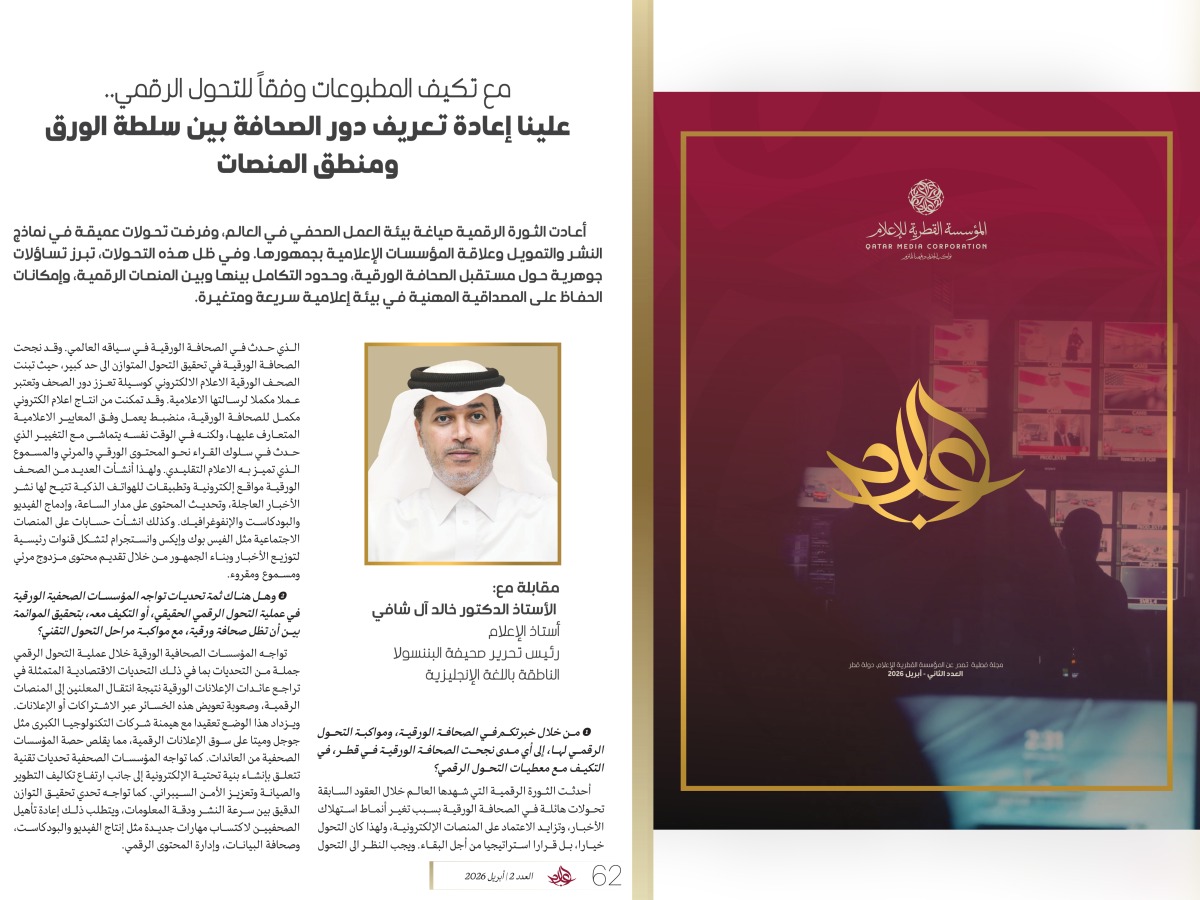
In an interview published in Al E’lam, Editor-in-Chief of The Peninsula Prof. Khalid Mubarak Al-Shafi offers a thoughtful examination of the changing dynamics between traditional and digital journalism in Qatar.
Doha, Qatar: In one of the most informed and strategically grounded interviews published in Al E’lam (QMC Magazine, 2nd Edition, April 2026), Editor-in-Chief of The Peninsula Prof. Khalid Mubarak Al-Shafi offers a thoughtful examination of the changing dynamics between traditional and digital journalism in Qatar.
Drawing on extensive media experience, the interview explores the structural, technological, and editorial transformations shaping contemporary journalism, while emphasizing the enduring importance of credibility, professional standards, and public trust in an increasingly digital media environment.
The interview offers a substantive, professionally informed, and analytically rich examination of the evolving relationship between print and digital journalism, particularly within the context of Qatar’s media landscape. It succeeds in moving beyond surface-level observations to explore the structural, technological, economic, and editorial transformations shaping modern journalism.
The discussion demonstrates a strong grasp of both the opportunities and challenges created by digital media, while preserving a clear appreciation for the enduring institutional role of professional journalism.
One of Al-Shafi’s strongest qualities is depth of analysis. Rather than merely describing changes in journalism, the responses contextualize them within broader structural transformations in media consumption, audience behavior, technological disruption, and changing business models. The discussion repeatedly emphasizes that digital transformation is no longer optional but a strategic necessity for institutional survival, which provides a clear conceptual thread throughout the interview.
The interview also demonstrates a balanced understanding of digital journalism. It recognizes the opportunities offered by digital platforms, such as speed, multimedia storytelling, audience interaction, and data-driven editorial strategies; while also highlighting the associated risks, including reduced verification, algorithmic influence, economic pressures, and the spread of misleading information. This balance strengthens the credibility of the content and avoids overly optimistic or pessimistic assumptions about digital media.
Another notable strength lies in its forward-looking perspective. The sections discussing artificial intelligence, newsroom automation, verification systems, audience analytics, and future platform models provide a strategic vision of how journalism may evolve during the next decade.
The interview consistently reinforces the argument that the future of journalism will depend not on speed alone, but on credibility, analytical depth, and public trust.
Overall, this interview represents a model of high-quality media content, characterized by intellectual coherence and reflecting practical media expertise, as well as a profound strategic understanding of the evolving ecosystem within which journalism operates, encompassing both its traditional and modern digital dimensions.
The interview successfully achieved a notable balance between professional discourse and analytical depth, offering important insights and reflections on the complementary relationship between traditional and digital journalism, the challenges of maintaining editorial independence and credibility, and the implications of rapid technological transformation on the media landscape.