The monetary and other economic measures taken by Chinese authorities suggest that the government is committed to stemming capital outflows to stabilise its depreciating yuan, and prioritising currency stability over growth, noted QNB’s latest economic commentary on China.
QNB also noted that higher interest rates will slow growth and the perception of excessive use of capital controls bears the risk of creating financial volatility in markets.
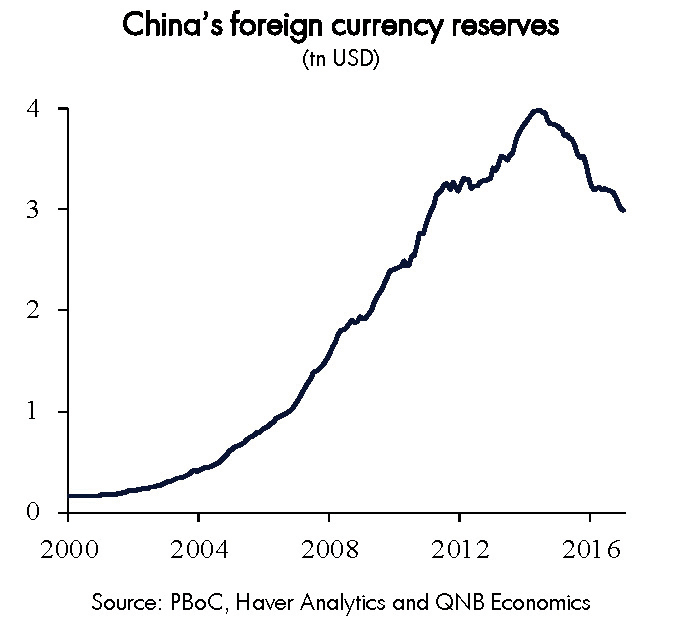
In January, China’s foreign currency reserves dipped below $3 trillion, their lowest level in five years and down from the $4 trillion peak reached in June 2014. The precipitous decline reflects the policy of People’s Bank of China (PBoC) to support the yuan by selling dollar reserves to prevent it from depreciating.
The key cause of the downward pressure on the yuan, and the incipient decline in reserves, has been surging capital outflows. Net capital outflows totalled $654bn in 2016 and $673bn in 2015, or approximately 6 percent of GDP. The authorities have responded by recently raising interest rates and tightening capital controls, which should staunch outflows going forward.
Four factors have driven the large capital outflows. First, China’s trend growth has slowed as it transitions from investment and export-led growth, requiring substantial domestic and foreign capital, to a less-capital intensive consumption-based economy. Real GDP growth has fallen in each consecutive year since 2010, when growth averaged 10.6 percent , to a rate of 6.7 percent in 2016.
Second, mounting financial vulnerabilities have diminished investor confidence over the long-term potential of the economy. Overcapacity plagues key industrial sectors such as steel and coal; corporate debt now exceeds 160 percent of GDP; and the housing market has turned frothy.
Moreover, the government has begun to gradually unwind its stimulatory policies and tighten lending rules in a bid to curtail these vulnerabilities.
These developments have reduced the attractiveness of capital inflows and consequently, outward direct investment exceeded foreign direct investment in 2016. Net direct investment outflows were 0.6 percent of GDP compared to net inflows of 0.6 percent in 2015 and 1.4 percent in 2014.
Third, higher interest rates in the United States have lured capital away from China. The US Federal Reserve has increased its policy rate by 50 basis points since December 2015 and an additional 50 basis point increase is expected in 2017. Monetary tightening has supported another dollar bull market. Since June 2014, the US dollar has appreciated by 24.7 percent against a basket of other currencies. Faced with diminishing returns at home and a squeezed currency,
Chinese investors have begun to diversify their portfolios and are gradually moving away from a long-held home bias. China posted net portfolio outflows of 0.6 percent of GDP in both 2015 and 2016 compared to a net inflow of 0.8 percent in 2014.
Fourth, concerns about the depreciation of the yuan led to outflows as corporates and banks sought to repay their foreign debt. In the aftermath of the financial crisis, China liberalised access to foreign debt markets. External debt jumped from less than 4 percent of GDP in 2010 to over 12 percent in 2015 as corporates and banks took advantage of low interest rates and a subdued US dollar.
However, after the government surprised markets by unexpectedly devaluing the yuan in August 2015, outflows to repay foreign liabilities accelerated on concerns of further devaluation. This dominated capital outflows in 2015 but slowed after the authorities tightened capital controls. External liabilities stabilised after 2015 and outflows to reduce foreign debts have abated.
Chinese authorities have responded to these developments by tightening restrictions on foreign acquisitions (particularly property) and imposing annual limits on the value of foreign exchange transactions and cross-border remittances. Furthermore, on January 24 and February 3, the PBoC raised a series of short-term interbank rates.
This was the first such increase in these rates since they were established in 2013. Although these are not the key benchmark rates, the move was seen as the beginning of a shift in the PBoC’s easing bias to a moderately tighter stance.