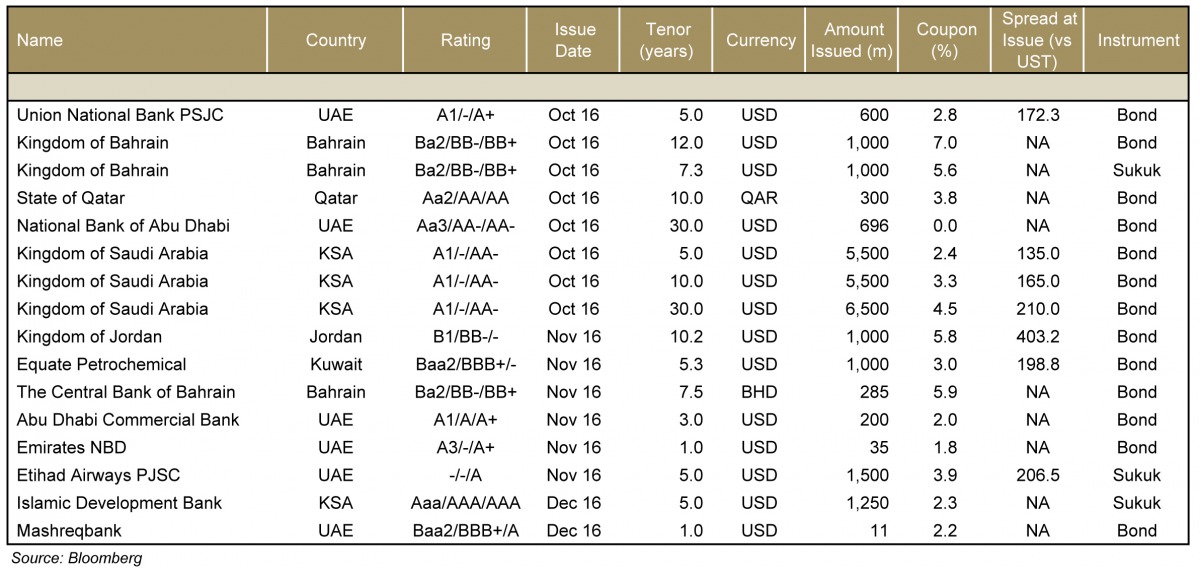
The steady rise in fixed income issuance in the region is expected to continue in 2017. The Middle East governments’ budget deficits are being partly funded through debt issuance. This dynamic is expected to continue to play a role for sovereign issuance activity into 2017, Hani Ibrahim, Head of Debt Capital Markets, QInvest told The Peninsula.
There has been a significant increase in the number and size of fixed income issuances in the region year- on-year with a near doubling in 2016 as compared to 2015. Bonds have however accounted for the vast majority of the issuances, whilst Sukuk issuance volumes have seen been largely flat year on year. A number of factors are attributed to this trend including the size and maturities of recent issuances, and the investor type in the region compared to outside the region, Hani said.

“The significant event during the last quarter of 2016 was the much-awaited $17.5bn triple tranche bond issuance from Saudi Arabia. This was the largest ever emerging market sovereign bond and was also joined during Q4 2016 by a number of other sovereign and financial institution transactions.”
The level of sovereign activity can be explained by the fiscal budget positions of Middle East governments. Corporate issuers on the other hand have tended to favour bank financing over bond or Sukuk due to the relative ease and lower disclosure requirements associated with loan transactions. There have been notable exceptions to this during Q4 2016 such as Equate from Kuwait and Abu Dhabi’s Etihad.
Hani said : “Due to their larger requirements, we have seen issuers demand both a larger size and a longer maturity of issuances. In order for issuers to achieve both of these aims, they have focused on investors from Europe and the US. Investors from the Mena region prefer instruments with shorter maturities of 5 years while international institutional investors regularly invest in longer maturities such as 30 year bonds.”
Taking the example of the Saudi bond issue, Hani added, regional investors accounted for 24 percent of the investors in the 10-year bond whereas it dropped to 9 percent in the 30 year-bond which was mainly distributed to US investors, illustrating the relative investor preferences.
QInvest can also see from the investor composition of Sukuk that banks tend to account for the majority of the investor base of a typical Sukuk. This is due to the fact that Islamic banks in particular have little, if any, alternatives to Sukuk to manage their liquidity and maintain a position in liquid assets as required by their regulators. This leads to an increased demand for relatively fewer Sukuk instruments as compared to bonds.
In addition, both the pension fund and fund management industries in the Mena region are underdeveloped and have limited resources, and even less of an allocation to fixed income.
“When we compare this situation against the significant size and sophistication of the pension funds and fund managers in Europe and the US, we see one of the key reasons why issuers have preferred bond issuances as they allow the issuer to access the significantly larger financial resources of this investors class," Hani said.