By Brian Love and Sophie Sassard
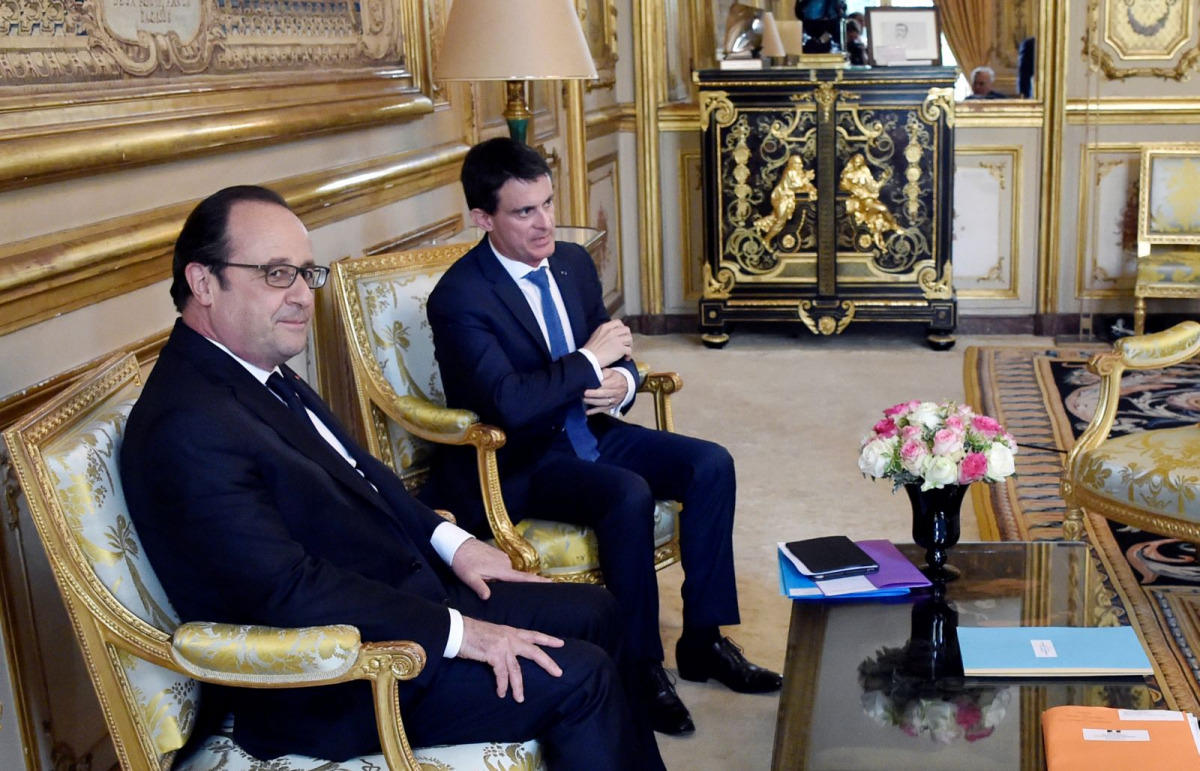
PARIS/NICE: Crowds jeered France’s leaders at a tribute on Monday to victims of last week’s truck attack in Nice and an opinion poll showed a sharp drop in confidence in the ability of President Francois Hollande’s government to combat terrorism.
Before and after a minute of silence held to pay respects to the 84 dead, many of the thousands gathered in the south-coast resort city of Nice chanted “resign, resign” at Manuel Valls, the Socialist prime minister. Others yelled “Hollande, resign”.
The poll published in Le Figaro newspaper showed 33 percent of respondents were confident in the current leaders’ ability to fight terrorism, down sharply from confidence levels of at least 50 percent in the wake of two major attacks last year.
“The government promises us things but nothing sticks,” Nice city resident Antony Fernandez told Reuters. “What have they done up to now to make us feel safe? And yet what do we expect? Every six months we’re going to mourn for more dead?”
The latest poll came at a moment when, less than a year from a presidential election, political opponents have fast abandoned the initial restraint that usually prevails on such occasions to sharply criticise Hollande and his government.
Ex-president Nicolas Sarkozy, who is competing in a November primary for the ticket to run as presidential candidate for France’s mainstream centre-right parties, said overnight Hollande’s government had failed to do all it could.
“I know there’s no zero risk, I know perfectly well that we don’t pull each other apart before the victims have even been buried,” Sarkozy told TF1 TV.
“But I want to say, because it’s the truth, that everything that should have been done over the last 18 months ... wasn’t done,” he said without proposing what could have been done better.
In Thursday’s attack, delivery man Mohamed Lahouaiej Bouhlel ploughed a 19-tonne truck into crowds of revellers, killing 84. He was shot dead by police. The killings plunged France back into a state of grief, fear, and now political recrimination.
POLITICS UNDER SCRUTINY
The bickering between politicians contrasted starkly in speed and intensity with the restraint seen in the immediate wake of the attack on Paris last November and one in January 2015 on the Charlie Hebdo newspaper.
The government has struck back by denouncing opponents for breaking ranks so fast.
Speaking ahead of the nationwide minute-of-silence on Monday, Interior Minister Bernard Cazeneuve accused the government’s opponents of breaking ranks in an unseemly way.
“We’ve seen tirades emerge immediately and personally this is both shocking and sad ... it’s undignified in the current context,” he said.
Voters also denounced the lack of restraint among competing politicians while many of those killed in Thursday’s attack on the seafront Promenade des Anglais boulevard had yet to be identified or buried.
“I’d have liked the politicians to have the decency when the bodies were still on the Promenade not to start saying to it’s so-and-so’s fault,” said Stephane Bebert, who was at the ceremony.
As tributes drew throngs of people back to the scene of the carnage, police investigated, with some four of the six people arrested after the attack transferred early on Monday for questioning at the headquarters of France’s counter-terrorism department in the western edge of Paris.
PREMEDITATED ATTACK
Paris Prosecutor Francois Molins, who is in charge of the investigation, said the attack was premeditated. Bouhlel on June 28 had tried to get a 5,000-euro bank loan, which he was denied.
From July 1, he had also made internet searches for festivities in Nice and had driven the route of the attack two days prior to Bastille day.
Molins said the killer had recently developed an interest in radical Islam telling people he had grown a beard for religious reasons and that he could not understand why Islamic State could not have its own territory.
Bouhlel had also carried out daily searches from the start of July of jihadist propaganda websites showing violent images.
“While there are no elements in the investigation to suggest at this stage an allegiance to Islamic State nor links with individuals from the group ... he (Bouhlel) showed a certain recent interest in radical jihadist movements,” Molins said.
(Writing By Brian Love; Additional reporting by John Irish, Chine Labbe, Johnny Cotton; Editing by Andrew Callus)
Reuters