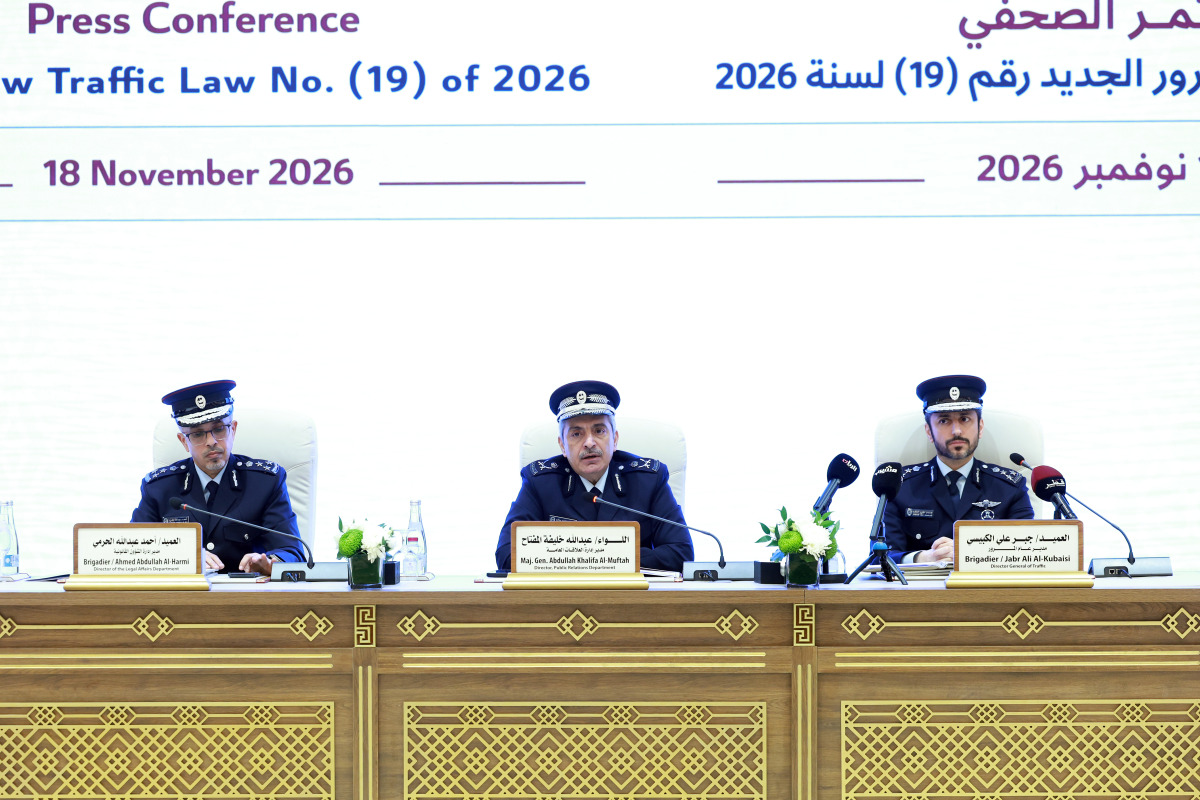
Director of the Public Relations Department Major General Abdullah Khalifa Al Muftah speaking during the press conference. PIC:RAJAN VADAKKEMURIYIL/The Peninsula
Doha, Qatar: Qatar’s new Traffic Law No. 19 of 2026 has introduced a series of provisions regulating electric scooters, vehicle registration and licensing, passenger safety and vehicle modifications, as part of efforts to enhance road safety and keep pace with developments in transportation.
Under the new law, electric scooters and similar vehicles must be registered with the licensing authority and the prescribed fees paid before they can be used on roads. Owners will be issued registration certificates, while each motor vehicle will be assigned a registration number.
The Ministry of Interior held yesterday a press conference to highlight the key provisions of the Traffic Law promulgated by Law No. (19) of 2026, its objectives, legal and implementation aspects, and the media and public awareness plan accompanying its enforcement.
The new law represents a significant legislative advancement in regulating road use, enhancing traffic safety, and protecting lives and property. It establishes clear responsibilities and obligations while keeping pace with developments in transportation, traffic management technologies and traffic enforcement.
The conference featured Director of the Public Relations Department, Major General Abdullah Khalifa Al Muftah; Director of the Legal Affairs Department, Brigadier Ahmed Abdullah Al Harami; and Director General of Traffic, Brigadier Jabr Ali Al Kubaisi, in the presence of media representatives.
The Director of the Public Relations Department explained that the conference marks the beginning of the media and public awareness campaign accompanying the law’s implementation.
He noted that the Department has developed a comprehensive plan to familiarise all segments of society with the law’s provisions in a clear and accessible manner, while ensuring legal accuracy.
The plan includes multilingual information and guidance materials, comparisons with previous legislation, frequently asked questions, infographics and short videos, alongside media interviews and programmes.
He added that the Ministry’s official channels and platforms will serve as a unified source of information and updates. In coordination with the General Directorate of Traffic and the Legal Affairs Department, the Public Relations Department will monitor public inquiries and online discussions about the law, update awareness materials, correct inaccurate information and provide the media with the necessary reference materials.
Addressing the legal aspects, the Director of the Legal Affairs Department stated that the law reflects Qatar’s vision and the directives of its leadership to improve quality of life and achieve sustainable development.
It supports the implementation of the Third National Development Strategy (2024-2030), particularly its fifth outcome, “High Quality of Life,” which aims to ensure a safe and stable society.
He explained that the law marks an important milestone in Qatar’s legislative development by updating traffic regulations and procedures, strengthening oversight and compliance with traffic rules, and establishing a modern, flexible legislative framework capable of adapting to future developments in transportation and mobility.
He also encouraged the public to familiarise themselves with its provisions, regulations and procedures.
The Director General of Traffic emphasised that the law reflects the significant development of Qatar’s road network and infrastructure, as well as the growing diversity of transportation options. It establishes a comprehensive framework defining the responsibilities of road users and the obligations of individuals and companies, regulating modern modes of transport and addressing behaviours that threaten road safety.
He further noted that the law aligns with the Ministry of Interior Strategy (2024-2030) and its objectives to enhance traffic safety, as well as Qatar National Vision 2030, which places people at the heart of development.
Traffic Law No. 19 of 2026 will come into effect on December 19, 2026, with a six-month grace period granted to owners of vehicles registered under the Traffic Law of 2007 to regularise their status in accordance with the provisions of the new law. Licences and permits issued before the new law comes into effect will remain valid until their respective expiry dates.
The new law introduces several key changes to the traffic sector, including regulating the movement of modern modes of transport, updating provisions governing vehicle registration and licensing, and regulating commercial activities related to the traffic sector. The law also introduces electronic procedures and traffic enforcement devices, while enhancing administrative measures for dealing with traffic violations.
The law stipulates that motor vehicle licences will generally be valid for one year from the date of issuance. However, private cars may be granted a three-year licence from the date they are first put into service, provided they are purchased from authorised vehicle dealerships in Qatar or meet the legally prescribed warranty and maintenance requirements, in accordance with the applicable regulations.
The legislation also prohibits writing, drawing or placing information, stickers, pictures, symbols or objects on a motor vehicle or any of its parts without prior written permission from the licensing authority. Such additions must not alter the vehicle’s external appearance, affect the clarity of its identifying information or obstruct visibility.
The law also restricts carrying passengers on motorcycles, bicycles and electric scooters.