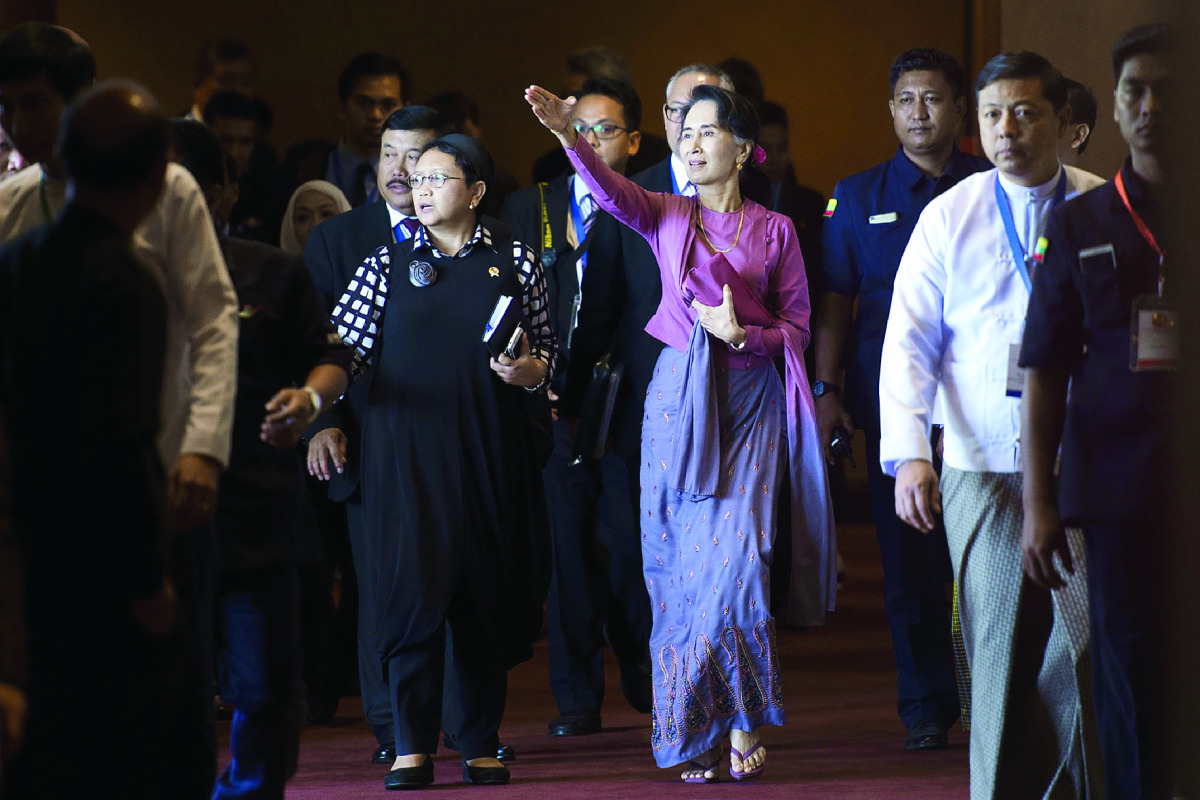
Indonesia's Foreign Minister Retno Marsudi (centre left) and Myanmar State Counsellor and Foreign Minister Aung San Suu Kyi attend the Association of Southeast Asian Nations (Asean) Foreign Ministers' meeting in Yangon, yesterday.
Yangon: Malaysia said yesterday that the plight of Rohingya Muslims in Myanmar was a regional concern and called for the Association of South East Asian Nations (Asean) to coordinate humanitarian aid and investigate alleged atrocities committed against them.
Malaysian Foreign Minister Anifah Aman was speaking at a meeting of the 10-nation bloc in Yangon called by Myanmar leader Aung San Suu Kyi after weeks of reports that the army has killed, abused and arbitrarily arrested Rohingya civilians.
Myanmar has denied the accusations, saying many of the reports are fabricated, and it insists the strife in Rakhine State is an internal matter.
In addition to fending off diplomatic pressure over the crisis, the Myanmar government has also invited a handpicked media delegation to visit the affected region this week.
Anifah said events in Rakhine State were a matter of regional security and stability, noting that about 56,000 Rohingya now live in Muslim-majority Malaysia having fled previous unrest in Myanmar.
"We believe that the situation is now of a regional concern and should be resolved together," Anifah told the meeting, according to a transcript of his speech provided by the Malaysian Ministry of Foreign Affairs.
Progress in improving the human rights of the Rohingya had been "rather slow", he said, noting the stream of reports about abuses being committed in Rakhine State.
Anifah, who appeared to leave the meeting early, also warned that IS militants "could be taking advantage of this situation".
Malaysia's intervention in the Rakhine crisis marks a break with Asean members' tradition of non-intervention in each other's internal affairs.
The bloc is also strained by its relations with China, with which several members are locked in maritime territorial disputes in the South China Sea. Asean faces an uncertain geopolitical outlook as Donald Trump prepares to become president of the United States in January.
Thai Foreign Minister Don Pramudwinai said "everybody was happy" with yesterday's meeting, which he described as primarily a briefing by Myanmar on the situation in Rakhine State.
Retno Marsudi, foreign minister of Indonesia, which has the world's biggest Muslim population, said Myanmar had agreed to provide regular updates to Asean members and had pledged that access for humanitarian assistance "will be open".
Suu Kyi "reiterated the government's serious commitment to the resolution of the complex issue and the need for time and space for the government's efforts to bear fruit," according to a statement from Myanmar's Ministry of Foreign Affairs.
A group of journalists chosen by the Ministry of Information to represent domestic and international media was set to visit Maungdaw, the main site of the conflict, yesterday.
Officials did not invite most media organisations that have reported on the alleged abuses.
Efforts to rebut accusations of army abuses were undermined by the release of a lengthy report from Amnesty International yesterday, accusing Myanmar of "a campaign of violence against Rohingya people that may amount to crimes against humanity".
The rights group cited satellite images and testimony from Rohingya in Rakhine State and Bangladesh.
Among myriad abuses, it alleged large-scale "enforced disappearances" of village elders and religious leaders in Maungdaw.
"While the military is directly responsible for the violations, Aung San Suu Kyi has failed to live up to both her political and moral responsibility to try to stop and condemn what is unfolding in Rakhine State," Rafendi Djamin, The Amnesty International's director for Southeast Asia and the Pacific, said in a statement.