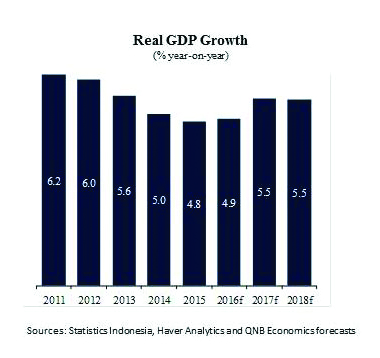
Indonesia’s growth is expected to pick up to around 5.5% in 2017-18 from 4.9% in 2016. Higher government investment as well as recent reforms to encourage foreign and private sector investment should push growth higher, said QNB in its weekly report released yesterday.
“Progress on the infrastructure investment programme is critical for Indonesia’s economic outlook. As a result of the programme and of other favourable tailwinds, we expect growth in Indonesia to pick up to around 5.5 percent in 2017-18 from 4.9 percent in 2016,” said QNB.
“We expect growth to be further lifted by recovering commodity prices and recent interest cuts by the central bank. Progress on the investment programme and rising growth should also support investor appetite and confidence in Indonesia,” it added.
Indonesia has long suffered from chronic supply bottlenecks that have congested the economy and dragged growth down below potential, sad the report. In 2014, hopes were raised that the new president, Joko Widodo, would be able to implement his mandate to revitalise investment in infrastructure and clear out some of the logjams. It has taken a while, but it appears that some of the new president’s efforts may be beginning to bear fruit.
Report noted that 13 economic reform initiatives have been pushed through since September 2015, central government capital spending grew 47 percent in the first half of 2016 compared to a year earlier and growth appears to have risen off a recent low of 4.8 percent reached in 2015.
Indonesia’s supply bottlenecks are the consequence of past underinvestment and the country’s challenging geography. Indonesia was at the epicentre of the Asian Financial Crisis in 1997-98, after which government investment faded and the nation’s infrastructure fell into a dilapidated state. Additionally, Indonesia is an archipelago of around 18,000 islands, creating huge logistical obstacles.
This adds considerable costs to doing business. It is 4–5 times more expensive to ship a container from Jakarta to West Sumatra than to Singapore while cement is ten times more expensive in Papua than Jakarta, said the report.
Furthermore, the country is blighted by heavy road traffic, congested transport networks and widespread power and water shortages. All this drags on growth.
Having been elected in 2014 on the mandate of revitalising investment in infrastructure, Jokowi has finally managed to push through a number of economic reforms over the last year, including around 160 new individual regulations.
According to the report, these include improvements to the business environment through streamlined licensing procedures; the creation of a “one-stop shop” for new companies; lower energy tariffs; and measures to improve access to finance for small companies. Some of the measures also target increasing trade in certain sectors by providing tax relief on the import and sale of goods as well as streamlining the number procedures required to import goods.
Finally, 29 areas of business have been opened to 100 percent foreign ownership, ownership limits have been raised in a further 29 industries and another 19 industries have been opened to limited foreign ownership for the first time.
As well as reforms, the government has stepped up infrastructure investment and has made progress on 30 priority projects worth $415bn, including roads, railways, ports, power plants and oil refineries. Public investment spending increased to 27 percent of the budget in H1 (first half of) 2016 from 16 percent in the same period of 2015.