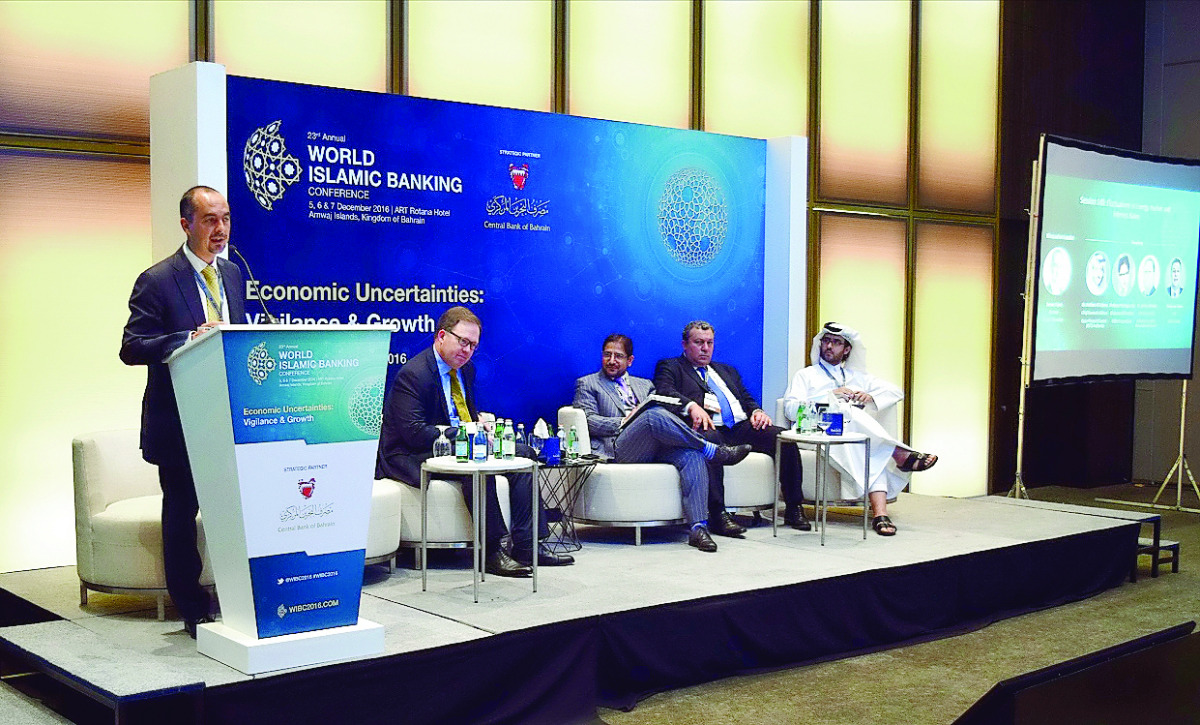
Dr Haitham Al Salama, Qatar Financial Centre (QFC) Authority’s Chief Economic Adviser participates in a panel discussion held as part of the WIBC 2016.
Oil prices are expected to stay around the $55-$65 per barrel in the near future, said Dr Haitham Al Salama, QFC Authority Chief Economic Adviser. He was speaking at the World Islamic Banking Conference (WIBC) 2016 in Bahrain.
He said GCC governments are investing the right efforts in the pathway to achieve economic diversification and maintain a healthy and sustainable economic growth.
“According to the latest analysis, oil prices are not likely to exceed $100 in the near future and are forecast to stay around the $55-$65 per barrel. Additionally, we will see a spike in the shale oil production, which will push the prices down and open the door for large oil producers to further evaluate their production levels. Prices will eventually go down as drilling technologies advance by time and lead to a lower cost of production of shale oil,” said Dr Al Salama.
Dr Al Salama spoke in a panel titled “Global Economic Trends” which focused on the fluctuations in energy markets and interest rates. The panel was chaired by Tariq Al Rifai, Chief Executive of Quorum Centre for Strategic Studies. “This puts further emphasis on the economic diversification efforts of oil producing countries, in particular, in the GCC. Collectively, we have long calculated this and worked towards diversification, this can be seen by the various national visions across the GCC,” he added.
Dr Al Salama further explained that GCC governments have taken quick and necessary measures to address the decline in oil prices, in an effort to create diversified revenue streams.
During panel session, Dr Al Salama discussed the future outlook of the Islamic finance sector in the region, stating: “Meeting the governmental demand for funding by both local and regional financial institutions in light of the decline in oil prices is essential. To keep up with this demand, Islamic finance will need to play a critical role, which is both a challenge and an opportunity that will be tackled by the regional banking sector.”
The WIBC, now in its 23rd edition, came under the theme “Economic Uncertainties: Vigilance & Growth”. The event aimed to equip leaders with breakthrough insights to navigate the complexity of the global financial system and enable Islamic finance to grow. Dr Al Salama spoke alongside Dr Jarmo Kotilaine, Chief Economist of Bahrain Economic Development Board, Professor Humayon Dar, Chairman and President of Edbiz Corporation and Ikbal Dardeia, Managing Director and Head of Investment Banking in Bank AlKhair BSC.