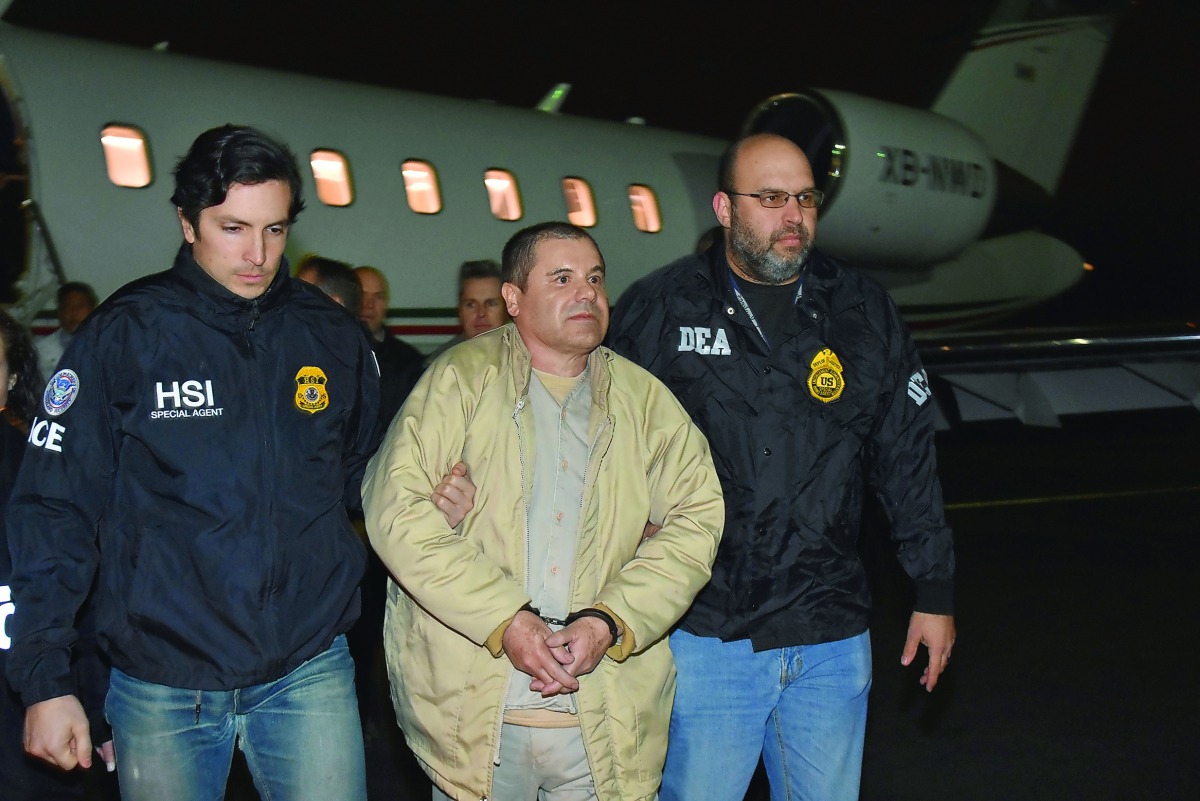
Mexico's top drug lord Joaquin “El Chapo” Guzman is escorted as he arrives at Long Island MacArthur airport in New York, yesterday.
New York: Joaquin “El Chapo” Guzman, one of the world’s most notorious drug kingpins, is finally headed for a court date the United States sought for two decades while he made brazen prison escapes and spent years on the run in Mexico.
Extradited yesterday to face US drug trafficking and other charges, Mexico’s most wanted man was expected to appear in a federal court in New York today.
The Drug Enforcement Administration flew Guzman to New York from Ciudad Juarez early yesterday, according to federal officials.
The US has been trying to get Guzman in a US court since he was first indicted in Southern California in the early 1990s. Now in his late 50s, he faces the possibility of life in a US prison under indictments in six jurisdictions around the United States, including New York, San Diego, Chicago and Miami.
He’s expected to be prosecuted in Brooklyn, where an indictment accuses him of overseeing a massive trafficking operation that sent billions of dollars in profits back to Mexico. It says Guzman and other members of the Sinaloa cartel, one of the world’s largest drug trafficking organisations, employed hit men who carried out murders, kidnappings and acts of torture.
Guzman, the cartel’s convicted boss, had been held most recently at a prison near Ciudad Juarez, a border town across from El Paso, Texas.
He was recaptured a year ago after escaping from a maximum-security prison for a second time, an episode that was highly embarrassing for President Enrique Pena Nieto’s government.
Mexican officials were seen as eager to hand him off to the United States. But Guzman’s lawyers fought his extradition, and attorney Andres Granados accused the government of carrying it out yesterday to distract from nationwide petrol hike price protests.
“It was illegal. They didn’t even notify us,” Granados said. “It’s totally political.”
Mexico’s Foreign Relations Department said a court had ruled against Guzman’s appeal and found that his extradition would be constitutional.
The extradition came at a charged political moment in the US, when Trump was sworn-in.
Carl Pike, a former DEA agent who spent the last part of his career helping the drug agency chase Guzman, said yesterday he was always confident that the drug lord would be sent to the US, but the timing was “interesting.”
“It’s one way of thanking Obama and another way of saying, ‘Mr. Trump, welcome to the arena,’ “ Pike said.
Derek Maltz, who headed the DEA’s Special Operations Division until his retirement in mid-2014, said the extradition reaffirms Mexico’s commitment to working with the United States and curbing the power of its drug cartels, and the timing could be seen as a good-faith effort by the Mexican government.
After breaking out of prison the first time in 2001, Guzman spent more than a decade at large, becoming something of a folk legend among some Mexicans for his defiance of authorities. He was immortalized in ballads known as “narco-corridos.”
Captured in 2014, Guzman then made an even more audacious escape, coolly stepping into a hole in floor of his prison cell shower and whizzing to freedom on a motorcycle modified to run on tracks laid the length of the tunnel. While again on the run, he secretly met actors Sean Penn and Kate del Castillo in a fall 2015 encounter that Penn later chronicled in Rolling Stone magazine.
Guzman was unapologetic about his criminal activities, saying he turned to drug trafficking at age 15 to survive. “The only way to have money to buy food, to survive, is to grow poppy, marijuana, and at that age, I began to grow it, to cultivate it and to sell it."