
By Satish Kanady
DOHA: Emerging Markets (EMs) are set to witness a huge capital outflow. An estimated $500bn is expected to flow out of the EMs this year. This would be the biggest outflow of capital from these markets since 1988, Moritz Kraemer, Managing Director & Chief Rating Officer, S&P’s Sovereign Ratings, stated yesterday.
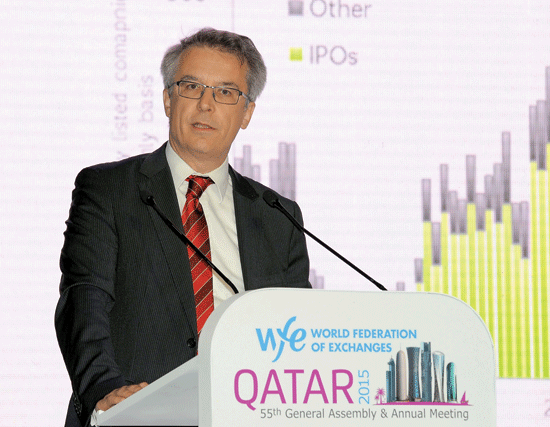
Delivering a key note address at the opening session of World Federation of Exchanges’ (WEF) annual meeting here yesterday, Moritz said ‘good luck’ is slowly running out of EMs.
The macroeconomic indicators of EMs are supporting the predictions of this huge capital outflow. The most recent IMF’s economic outlook expects the emerging markets will slow down. This is the fifth consecutive year, when the emerging markets will slowing relatively to the previous year. “And all this is happening at a time when advanced economies are actually gaining speed… This time is different for emerging markets,” Moritz noted.
“After the rise and rise of emerging markets for all these years, we need to ask what has got wrong with these economies. What could be done to bring back the sustainable dynamism to these economies. I would argue that the emerging market problem is how to do with the cyclical good running out”.
The underlying quality of policy making of some of the EMs have stopped, while some cases are on a reverse mode, he said. There was a time when demands for emerging markets were buoyant. Commodity super cycles had propped up the prospects of these economies. But now the table appears to have turned, Moritz said.
Citing the findings of a recent web cast survey on Emerging Markets, Moritz noted that 41 percent of the respondents believed that the sell-off in the EM assets is only the beginning and predicted a more weakness for these markets. 39 percent believe that Chinese growth will dip below 4 percent in long term. There is a huge surge in the borrowings by EM.
“Yes, good luck is running out of Emerging Markets,” he said.
Addressing the opening session, Ali Ahmed Al Kuwari, Group CEO, QNB said, the bank’s market share in Qatar’s capital market stands at an estimated $36.1bn. QNB contributes 9 to 10 percent of the country’s GDP. Qatar being the region’s second biggest company, QNB is the No 1 in the Mena region in terms of assets.
Giving an overview of the GCC market and QNB’s market positioning, Ali Ahmed noted the GCC stocks are very attractive in terms of valuation and the region’s macroeconomic fundamentals are strong. “It’s a market with strong economy without a tax regime and limited foreign exchange volatility. The region hosts world’s biggest oil and gas companies, strong banks and many major organisations”.
Qatar is the second biggest market in the region in terms of market cap. The combined market cap of GCC is nearing the one trillion mark, equal to the combined market cap of Brazil and Russia. Among GCC nations, Qatar and UAE attracted the most foreign investments, the major reason being the MSCI upgrade.
The Peninsula