
DOHA: QIIB’s net profit for the third quarter of this year (Q3, 15) reached QR657m, 5.1 percent up from the same period last year. The bank recorded a 16.4 percent growth in its financing portfolio compared to Q3, 2014. The earnings per share reached QR4.34, up from QR 4.13 a year ago.
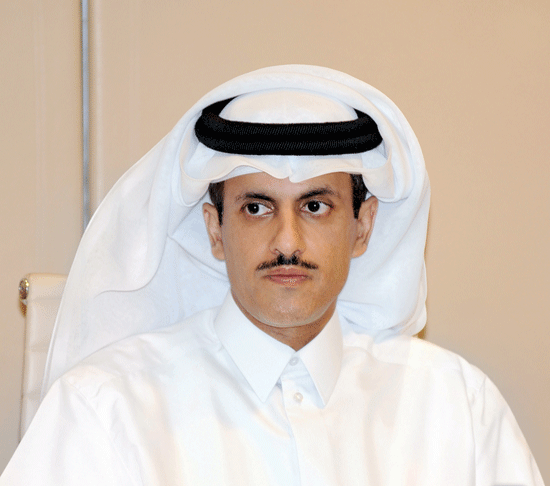
Announcing the financial results for the period ending September 2015, Sheikh Dr Khalid bin Thani bin Abdullah Al Thani, QIIB Chairman and Managing Director, said the bank’s impressive third quarter performance confirms the fact that QIIB is moving in tandem with the Qatari economy, ably supporting the national economy in various spheres.
Sheikh Dr Khalid said, “Qatar’s consistent economic growth and the continued progress of its various projects further motivate us to effectively contribute to the national economy. All the indicators and forecasts show a brighter future ahead for the Qatari economy. This makes us very optimistic and prompts us to set ambitious plans.”
“As we are keen to contribute to the growth of the various sectors, we have recently concluded several agreements and memoranda of understanding (MoU) with various national entities. These include the MoU signed with the Logistics Committee at the Ministry of Economy and Commerce, and the Economic Zones Company (Manateq) in order to secure the necessary financing for investors in the logistics area in the South-South Wakra, Birkat Al Awamer and Aba Al Salil under suitable financing options for up to 10 years.”
“Additionally, we have signed the financing portfolio of the Al Dhameen programme sponsored by the Qatar Development Bank, as it facilitates greater expansion of SME financing, which is significant given the importance of this sector in the Qatari economy,” he added.
Sheikh Dr Khalid said QIIB remains absolutely committed to the local market. The bank aims to get engaged in the local market effectively and benefit from the various market factors, which are mostly positive. “At QIIB, we will remain steadfast to facing the market competition and make use of the opportunities available by adhering to the risk management principles laid down by the QIIB Board of Directors.”
“At QIIB, we are making every possible effort to maximise shareholders’ returns and also increase profitability by optimising foreign investment opportunities, based on approved regulations, especially in terms of risk management.”
The QIIB Chairman and Managing Director lauded the bank’s Executive Management and employees for their continued performance and thanked them for enabling the bank to grow in a very desirable manner.
QIIB’s CEO Abdulbasit Ahmed Al Shaibei said the bank’s total revenues for the period ended on September 30, 2015 amounted to QR1.13bn compared with QR1.09bn for the corresponding period in 2014. QIIB’s total assets reached QR38.8bn at the end of Q3, 15 compared to QR37.9bn recorded a year ago.
QIIB’s financing portfolio grew at the end of the Q3, 15 to reach QR24.4bn compared with QR20.9bn at the end of the corresponding period of last year.
The CEO stated that the capital adequacy in accordance with the requirements of (Basel III) amounted to 16.52 percent, which reflects on QIIB’s resilience and the stability and efficiency of its financial management.
The figures disclosed by the QIIB go in line with the bank’s ongoing and continuous success and progress in various provisions of its budget. This is based on the strength of the Qatari economy and its ability to achieve remarkable growth across various sectors.
“The progress in the implementation of various projects in the country, whether they are the mega ones related to infrastructure, FIFA World Cup 2022 or the small and medium-sized projects, gives the banking sector the required momentum and raise expectations about economic prospects and overall growth figures.”
The Peninsula