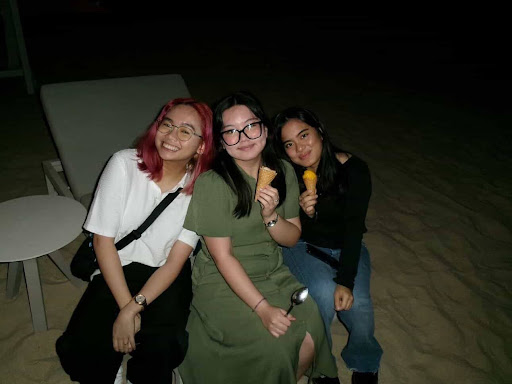
Gwyneth Estomo (GU’27), Lovie Francia (GU-Q’29), and Daphne Soriano (GU-Q’28) during an iftar on March 18, 2026.
DOHA: When Farkhunda Fazelyar (GU-Q’26) left Doha for a class trip to Cape Town, she expected an immersive academic experience. The war reshaped her trip almost immediately.
“The strikes started on the first day of the program,” she said. “I remember going through the District Six Museum when a Student Life staff member pulled the GU-Q students aside to tell us about the news.”
As tensions escalated and airspace closed across parts of the region, Fazelyar could not return as planned. Her short academic trip stretched into an additional week marked by uncertainty.
Since the attacks on Gulf countries began on Feb. 28, 2026, the Georgetown University in Qatar community has moved quickly to navigate uncertainty while maintaining care and continuity during a regional conflict.
“Throughout the week, we tried to stay updated through friends, the news and GU-Q updates,” she said.
Distance from home deepened the unease, but the GU-Q community reached across borders. Faculty and staff checked in regularly, while community members with personal or indirect ties to South Africa also reached out.
“Even community members who had family in South Africa or knew someone reached out to check in,” she said. “That meant a lot.”
For students in Qatar and across the region, daily life shifted quickly. The university offered international students the option to voluntarily depart as conditions continued to change.
Nicolae Cernomaz (GU-Q’29), who chose to leave, encountered disruptions across Gulf travel routes.
“Even when my flight in Riyadh got cancelled due to airspace closure in Saudi Arabia, I could return to the hotel and be provided accommodation until my flight was rescheduled,” he said.
“GU-Q places our safety as a top priority.”
Qatari students, in particular, played a key role in supporting their peers, offering guidance grounded in familiarity with the country and its systems. For many international students navigating sudden travel changes and uncertainty, that support provided an added layer of reassurance.
As travel complications mounted, the university moved classes online, and students and faculty adjusted in real time to maintain academic continuity.
“Although being at home and having online classes is hard, the Georgetown community continues to feel like a family,” said Marie Thum (GU-Q’28). “Aside from travel assistance, I’m deeply indebted to everyone who continues to provide incredible academic help in e-learning and social comfort.”
Faculty also became a source of stability within virtual classrooms. Bashayer Al Jumaily (GU-Q’29), who studies with Dr. Mehran Kamrava, professor of government, said his guidance helped students make sense of rapidly unfolding events.
“In the beginning of the war, he gave us a debrief of everything happening and reassured us a lot,” she said. “Hearing things from him gave us a sense of security.”
She said his personal reflections reinforced that reassurance.
For many students, the shift to remote life brought a quieter challenge: isolation. Days at home, away from classmates and routines, left some feeling cut off from one another.
In response, the community found new ways to gather. Departments organized virtual forums and informal initiatives to keep students connected despite the distance.