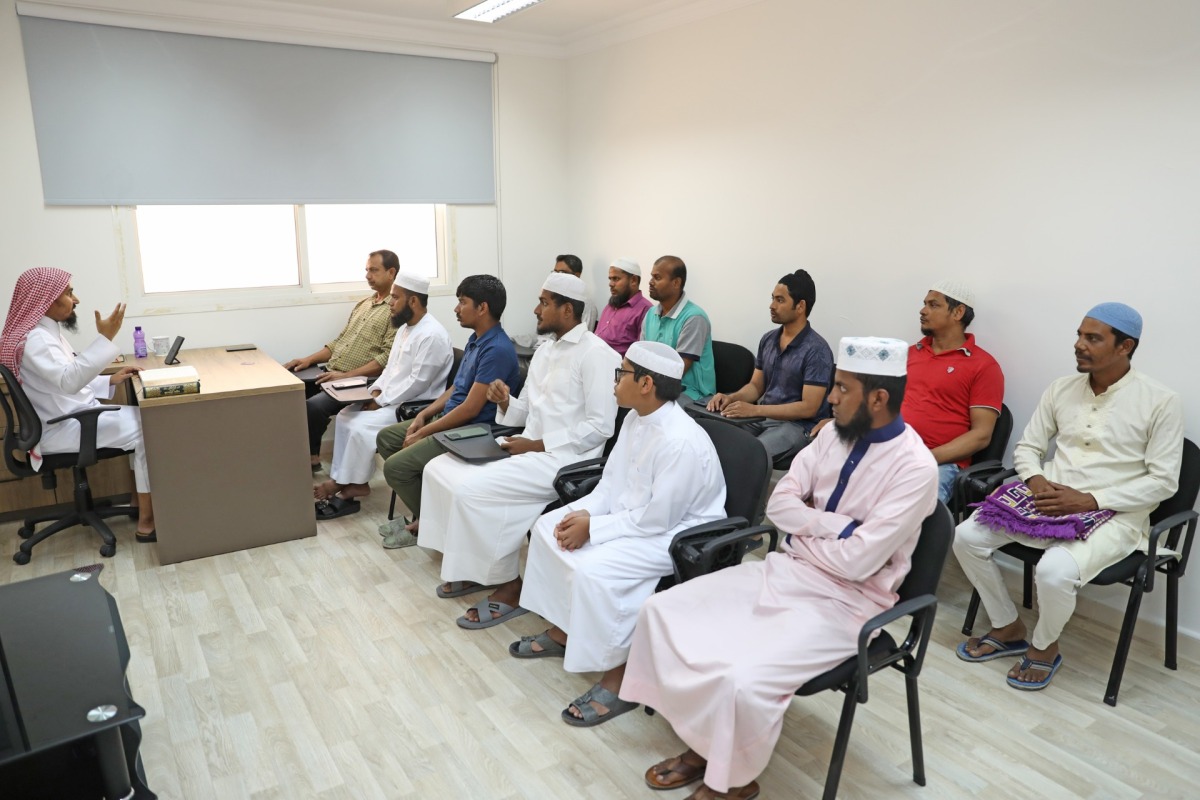
Doha, Qatar: The Al Khor Branch of the Sheikh Abdullah Bin Zaid Al Mahmoud Islamic Cultural Center, affiliated with the Ministry of Endowments (Awqaf) and Islamic Affairs, continues to implement comprehensive cultural, educational, and awareness programmes targeting non-Arabic speakers.
Its outreach covers all northern regions of Qatar, stretching from Umm Salal through Ras Laffan, Umm Baraka, and Al Zubarah, all the way to Al Ruwais.
The branch delivers a wide range of field activities and educational initiatives for workers at their workplaces and accommodations, taking into account their diverse cultural and linguistic backgrounds. These efforts align with the Ministry’s vision of reaching all segments of society across the country.
The programmes are conducted in coordination with the Ministry of Interior and the Ministry of Public Health, in addition to cooperation with Qatari farm and camp owners. Activities are implemented directly at workers’ job sites and residential locations, ensuring accessibility and maximizing their educational and social impact.
In this context, Dr. Saleh bin Ali Al Marri, Director of the Sheikh Abdullah Bin Zaid Al Mahmoud Islamic Cultural Center, emphasized the pivotal role played by the Al Khor Branch due to the unique nature of the areas it serves, the characteristics of its target audiences, and the working conditions in those regions. He also praised the constructive coordination with relevant authorities and the fruitful cooperation received from the local community.
He noted that the branch’s success is largely attributed to strong community partnerships, as many farm and camp owners proactively contact the center to organize educational and awareness programmes for their workers. This reflects a growing awareness of the importance of such initiatives and their positive impact on society.
The director explained that the branch implements several specialized programmes, including visits to correctional and rehabilitation institutions, as well as the “Healing and Hope” initiative, which targets non-Arabic-speaking patients.
The programme aims to provide psychological comfort and moral support during their treatment and recovery.
The branch’s field visits have also attracted considerable participation and engagement. Conducted in farms, camps, and workers’ accommodations, these visits include general awareness sessions, responses to participants’ questions and inquiries, and introductions to Islamic and Qatari culture, as well as local customs and traditions. Such efforts contribute to enhancing the integration of expatriate communities living in Qatar while fostering respect for the country’s cultural identity.
In addition, the branch organizes awareness programmes in mosques for non-Arabic-speaking Muslims. These programmes are delivered in five major languages: English, Urdu, Tamil, Malayalam, and Filipino. Translated Islamic books and copies of the Holy Quran are also distributed to participants.
Through these initiatives, the center continues to promote religious and cultural awareness while strengthening the values of coexistence, mutual respect, and community engagement.