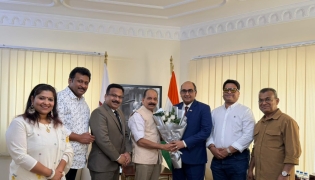
Members of the Indian community listening to Dr Manzoor Alam (RIGHT), Chairman of Institute of Objective Studies, at the Ibn Hajr Library in Bin Omran.
by MOHAMMAD SHOEB
DOHA: India is set to have its first international university to teach social studies and humanities with a focus on “conceptual and investigative research on the Quranic approach” to address human problems and problems of Muslims, said a New Delhi-based prominent social scientist and the chairman of Institute of Objective Studies (IOS), a leading think- tank, here yesterday.
The institute, which organised 14 international conferences across the country in 2011 marking the silver jubilee, has taken the initiative to establish an international university in New Delhi as part of efforts to address socio-economic and political challenges faced by the people, especially the minorities in the world’s largest democracy.
“The world today is going through a critical phase, and facing many big challenges. It has become nearly infertile or sterile in terms of producing big revolutionary concepts or ideas akin to ‘democracy’, ‘capitalism’ and ‘socialism’ for the last several decades. The need for establishing institutes promoting modern education with Quranic approach to restore moral and human values was long due, said Dr Manzoor Alam.
The university on an area of over 30 acres will be located in the outskirts of New Delhi at Palwal, the 21st district of neighbouring Haryana state in the north.
The non-profit International Objective University is expected to start its first academic session in 2014. It will put emphasis on disciplines such as economics, Islamic finance, law, comparative religion and studies, moral science and others.
So far IOS, established in 1986, has made significant contributions by conducting and promoting empirical and conceptual research related to ideologies and problems relevant to Indian polity, society, economy, religion and culture.
The Sachar Committee Report, published in November 2006 by the Indian government, finds its roots with the IOS.
The landmark piece of work, which testifies the pathetic conditions of Indian Muslims, with empirical data and statistical reports, sourced about 30 percent of information collected by the IOS.
The report, prepared under the chairmanship of Justice Rajender Sachar, has made recommendations to improve the socio-economic condition of Muslims.
For its achievements over the past 27 years, the IOS has received recognition from national and international organisations, including the Economic and Social Council of the United Nations.
“With the emergence of the so-called global village, the world has been witnessing thousands of new issues and challenges related to various fields such as cyber laws, space laws, moral crimes and bankruptcy of human values, etc.
“And I firmly believe that the convergence of modern education with Quranic teachings and true Islamic values can provide a sustainable solution with humane face,” added Dr Alam.
Leading a delegation, Dr Alam is in Qatar on the last leg of their tour to Gulf states to create awareness and mobilise resources for the university. He addressed members of the Indian community at the Ibn Hajr Library in Bin Omran.
Dr Alam highlighted key issues faced by Indians in general and Muslims in particular. He also invited the audience with Quranic references to participate in community building initiative, which will not only benefit the Muslim Ummah but also the whole humanity.
He advocated studying challenging subjects instead of opting only for engineering and medicine.
“Throughout history, in every era there have been some significant areas of studies. For instance, today, law is the rising subject in the US and Europe as a result of the ‘New World Order’,” he said.
Dr Alam, also President of Indo-Arab Economic Cooperation Forum and General Secretary of All India Milli Council — a pressure group protecting minorities’ rights — said that in democracy ‘adult franchise’ is a great power for people, especially the minorities, which should be exercised strategically.
However, describing lacunas of democracy, he said theoretically democracy is against the ‘rule of elite’ where leaders are not able to ignore the interests of people for a long time, whereas in practice the distinction has been blurred.
“There is a need for serious intellectual endeavour for conceptual and investigative research on the Quranic approach to address human problems and problems of Muslims.” The Peninsula