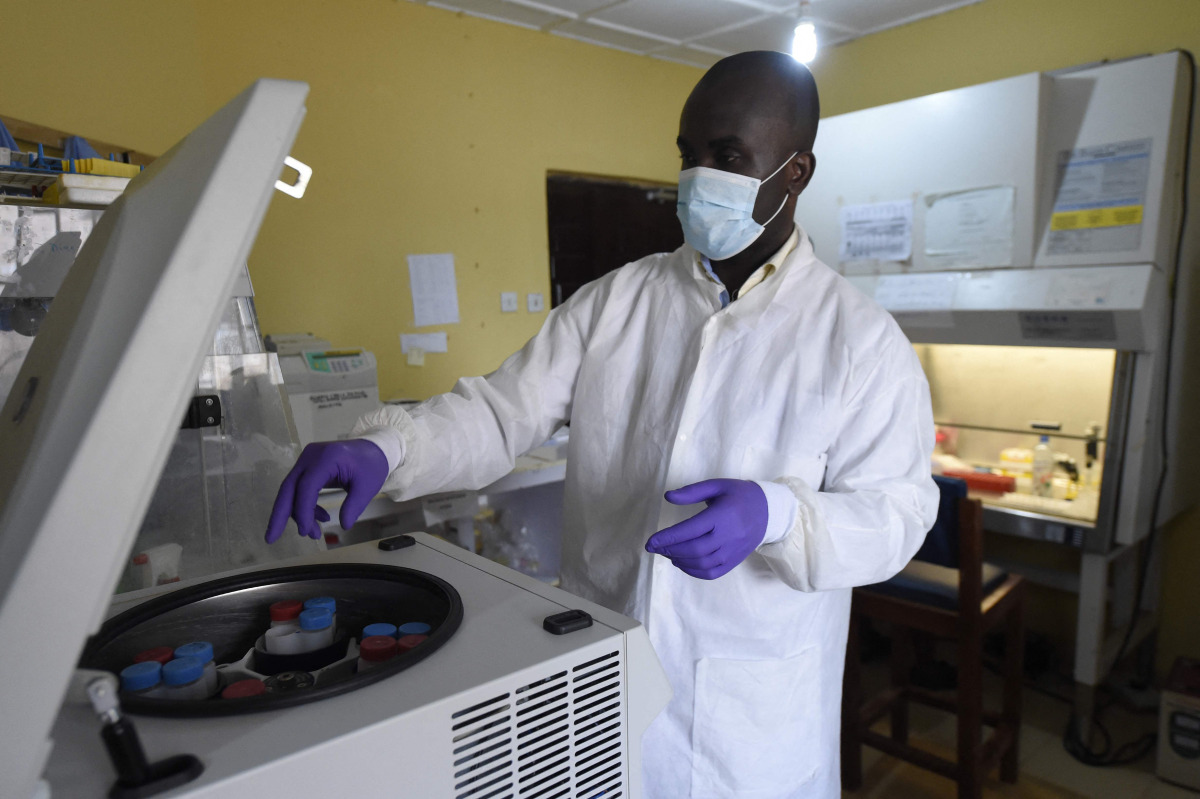
(FILES) A health official works in the laboratory extraction room of the Institute of Lassa Fever Research and Control in Irrua Specialist Teaching Hospital in Irrua, Edo State, midwest Nigeria, on March 6, 2018. (Photo by PIUS UTOMI EKPEI / AFP)
Lagos: The World Health Organization (WHO) warned Thursday that Africa's Ebola outbreak was more "complex" after cases spread to Nigeria.
Nigeria on Tuesday announced an imported case of the Bundibugyo strain behind a major DR Congo Ebola outbreak in a woman, a wife of a diplomat who had a history of travel to Uganda.
The continent's most populous nation is the fourth African country affected by the outbreak, which this week came to span the continent, with Kenya in the east reporting nine cases since October 6.
The outbreak began in the Democratic Republic of Congo and has become the deadliest in the country's history, killing more than 4,000 people out of more than 9,000 confirmed cases since mid-May, according to health authorities.
It is caused by the Bundibugyo strain of the virus, for which there is still neither a vaccine nor a specific treatment.
"We are facing a more complex outbreak landscape. Nigeria has confirmed an imported case of Ebola virus disease," Mohamed Janabi, regional director for WHO in Africa, told an online media briefing.
The patient in Nigeria returned to the capital Abuja on October 3 after being in Uganda since September 16, the WHO representative in Nigeria Pavel Ursu said.
She flew to Abuja on an Ethiopian Airlines flight and transited through Addis Ababa, an emergency meeting of the Nigeria Centre for Disease Control and Prevention (NCDC) heard on Wednesday.
The woman is originally from Uganda but based in Abuja, Africa Centres for Disease Control and Prevention Director General Jean Kaseya told AFP on Thursday.
He also said she did not go to the DRC, as suggested earlier by Ugandan authorities.
Officials are trying to piece together her travel history to establish where she could have been exposed.
"We're still investigating multiple scenarios of the possible source where she got the infection," Kaseya told journalists, including the possibility that there might have been contact at the airport with Kenya's first victim, who also left Uganda on October 3, the same day the woman left Uganda for Nigeria.