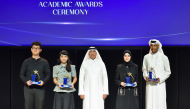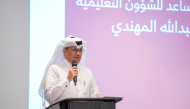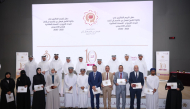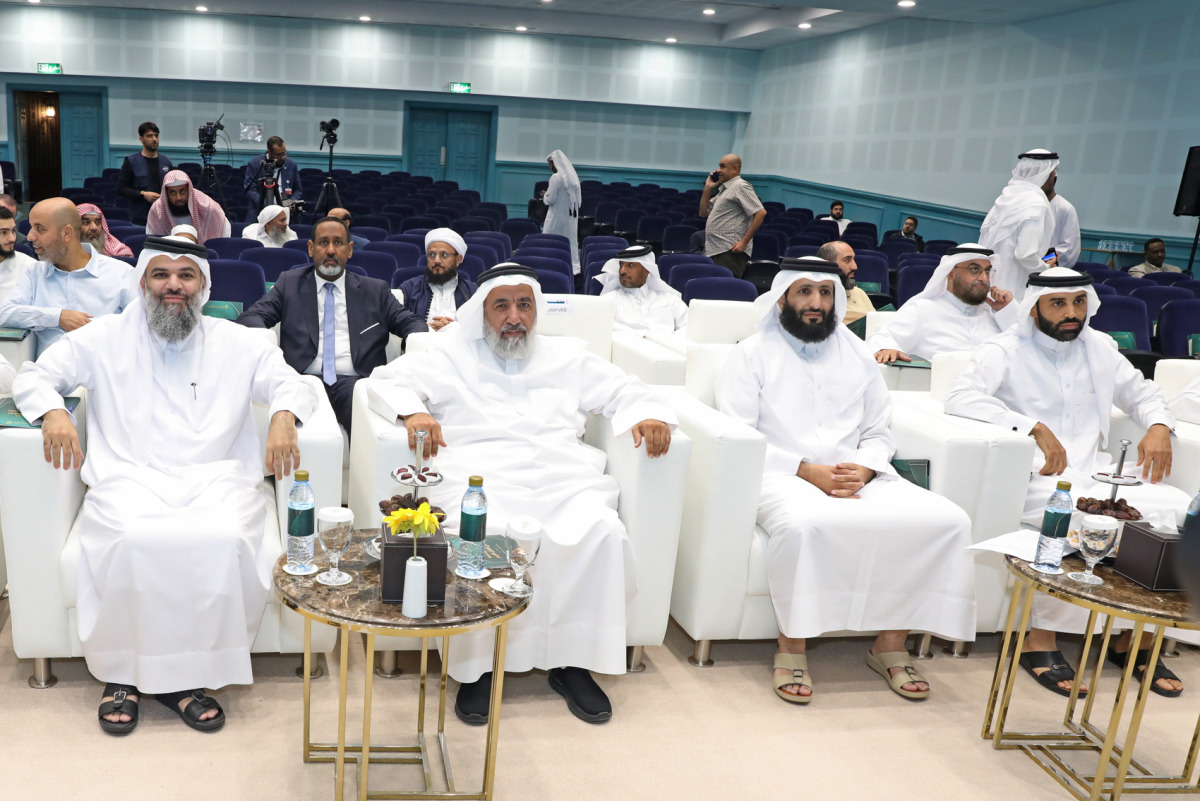
Doha, Qatar: In the presence of Minister of Awqaf and Islamic Affairs H E Ghanem bin Shaheen bin Ghanim Al-Ghanim, Sheikh Abdulla Bin Zaid Al Mahmoud Islamic Cultural Center held the “Academic Symposium on Establishing Standards for Translating the Meanings of the Noble Qur’an.”
The event was attended by Undersecretary of the Ministry H E Sheikh Khalid bin Mohammed bin Ghanem Al Thani; Director of the Sheikh Abdulla Bin Zaid Al Mahmoud Islamic Cultural Center, Dr. Saleh bin Ali Al-Akhn Al-Marri; the Ministry’s Shari’ah expert and renowned researcher Sheikh Mohammed Al-Mahmoud; along with a number of academics, including Dr. Ibrahim bin Abdullah Al-Ansari, Dean of the College of Shari’ah and Islamic Studies at Qatar University; Dr. Yousuf Al-Siddiqi, former Dean of the College of Shari’ah at Qatar University; Dr. Nayef bin Nahar Al-Shammari, Director of Wa’i Foundation; and the Islamic preacher (da’iyah) Ayed Al-Qahtani.
The symposium commenced with a blessed recitation of verses from the Noble Qur’an, followed by a speech by Dr. Saleh bin Ali Al-Akhn Al-Marri, in which he spoke about the importance of conveying the message of Islam to all the worlds (al-’alamin), highlighting the efforts exerted in translating the meanings of the Noble Qur’an and their profound significance.
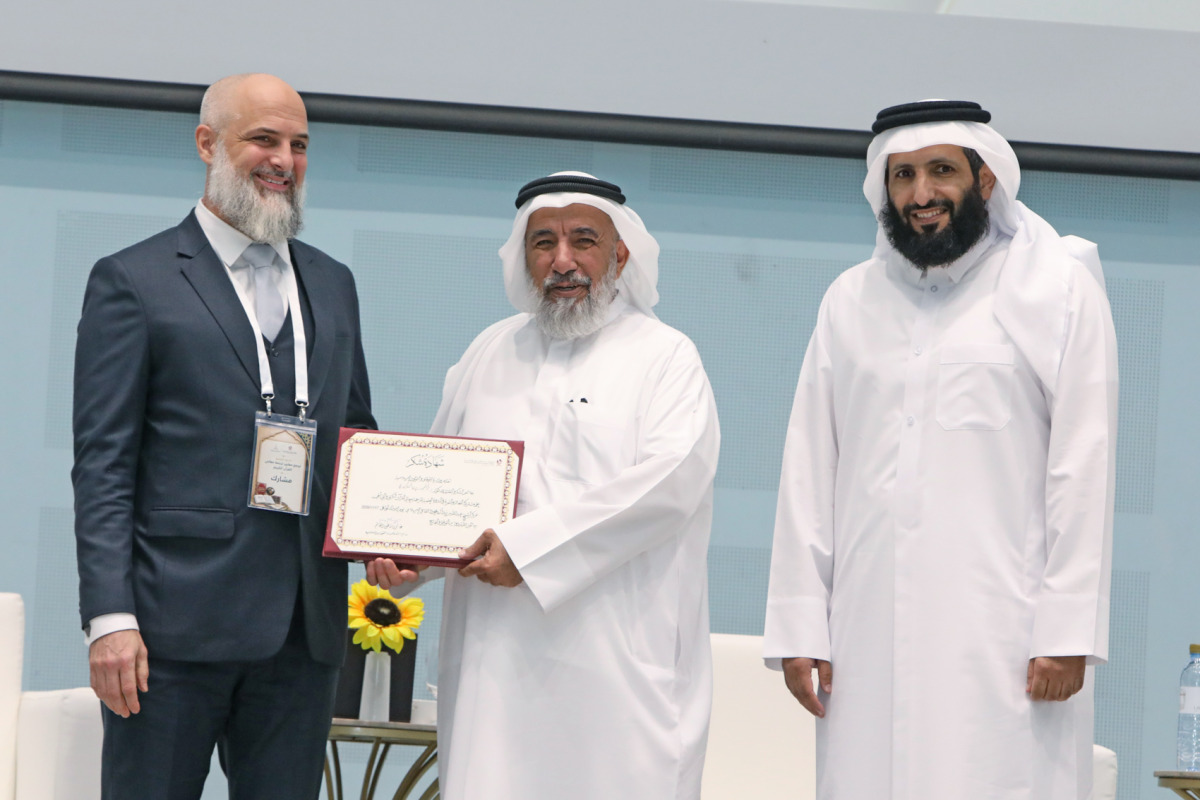
This was followed by an introductory documentary film showcasing translations of the meanings of the Qur’an and the efforts invested therein. Subsequently, the symposium panellists spoke in a session moderated by Dr. Yahya Hamad Al-Nuaimi from the College of Shari’ah at Qatar University, featuring Dr. Abdullah Al-Khatib from the College of Shari’ah at Qatar University, Dr. Joseph Lumbard from Hamad Bin Khalifa University, and Dr. Osama Tancredi from the Sheikh Abdulla Bin Zaid Al Mahmoud Islamic Cultural Center. At the conclusion of the symposium, the Minister honoured the participants.
During the academic symposium, Dr. Abdullah Al-Khatib explained that translating the Noble Qur’an itself is impossible because it is a miraculous scripture (mu’jiz) whose meanings cannot be fully encompassed and are inexhaustible, noting that exegetes (mufassirun) have written extensively on it, yet countless further meanings can still be derived. In this regard, he noted that A. J. Arberry acknowledged the impossibility of translating the Noble Qur’an, as did Marmaduke Pickthall.
Regarding the optimal stylistic approach, Dr. Al-Khatib stressed the importance of elevating the style rather than lowering it, ensuring it is a refined, literary style that remains uncomplicated, while requiring the translator to master English literary translation and command the language. He also explained the permissibility of translating the Most Beautiful Names of Allah (Al-Asma’ Al-Husna) with the addition of prefixes and suffixes that convey meanings of absolute perfection (kamaliyyah). Furthermore, he held the permissibility of translating the Divine Name of Majesty (Lafz al-Jalalah, “Allah”) as “God,” explaining that he previously did not deem this permissible, but revised his view lest non-Muslims misunderstand that our Lord is not the One Creator and Lord of all the worlds.
Dr. Joseph Lumbard spoke about translation and its importance in conveying the meanings of the Noble Qur’an to people, clarifying the impossibility of rendering the Word of Allah verbatim due to the inimitability (i’jaz) of the Qur’an. At the same time, he noted that translators can select the clearest, most appropriate, and most accessible meaning for the target audience. Highlighting the importance of style, he explained that Shakespearean English, for instance, is archaic and unintelligible today, whereas everyday colloquial style is banal; hence, there is a pressing need for a translation that is literary in character, structure, and lexical choice, while remaining intellectually grounded.
Simultaneously, he affirmed the permissibility of translating the Names of Allah with utmost caution in selecting the intended terms: for example, the Divine Name Al-Jabbar has several English equivalents, and care must be taken to avoid connotations suggesting injustice or tyranny; the Name As-Salam transcends being rendered merely as “Peace,” encompassing far more than that; and similarly Al-Mu’min—all of which are terms requiring sensitivity and precision. He also supported the permissibility of translating Lafz al-Jalalah as “God,” since non-Muslims who believe in a Creator use this term to denote the unique, One Creator, even though the word itself does not capture the exact singularity of the Arabic proper name Allah.
Dr. Osama Tancredi pointed to the importance of translation, affirming that translators can never convey a meaning in its entirety from one language to another—let alone the Noble Qur’an. Regarding translating the Mighty Book, he emphasised the importance of employing a refined literary language that is nonetheless not difficult for the Western recipient to comprehend.
On another front, he noted that the Most Beautiful Names of Allah signify His supreme attributes, and corresponding foreign terms conveying aspects of those meanings may be utilised. He concluded by favouring the translation of Lafz al-Jalalah as “God” with a capital “G,” as it denotes the Transcendent Deity, the Creator, Sustainer, and Provider, which reflects core meanings and connotations of Lafz al-Jalalah.
The Q&A session addressed a number of general themes, during which Dr. Yousuf Al-Siddiqi noted that constructing Qur’anic terminology is vital and should follow the methodology of the classical scholars of Islam (Nuzzar al-Islam), which focuses on the distinctive properties (al-khawass al-mumayyizah) of a thing rather than the essential (jawhari) and accidental (‘aradi) categories used by philosophers.