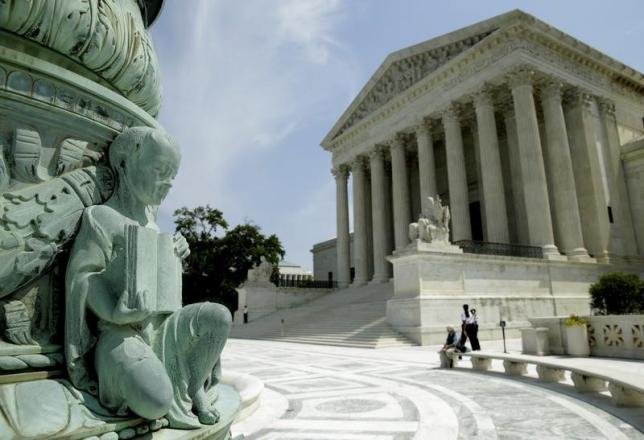
The U.S. Supreme Court on Thursday blocked President Barack Obama’s plan to spare millions of immigrants in the country illegally from deportation and provide them work permits.
Here is a chronology of the case, United States v. Texas:
June 15, 2012 - The Obama administration, through the Department of Homeland Security, initiates the Deferred Action for Childhood Arrivals (DACA) program, which suspends deportation for two years for people who entered the country illegally at least five years earlier, before they were age 16, and who were under age 31 as of June 15, 2012.
Nov. 20, 2014 - Obama, through unilateral executive action, initiates a new deferred-deportation and work-authorization policy for immigrants whose children are U.S. citizens or lawful permanent residents and who have been living illegally in the United States since Jan. 1, 2010. These people must pass certain background checks for possible past criminal convictions. The program is called Deferred Action for Parents of Americans and Lawful Permanent Residents (DAPA). The Obama administration also expands the earlier DACA program by eliminating the age-31 cap and increasing deferred deportation from two to three years.
Dec. 3, 2014 - Texas and other Republican-governed states sue the Democratic Obama administration in U.S. district court in Texas. They assert that Obama’s Nov. 20 executive actions, which bypassed the Republican-led Congress, violated the Administrative Procedure Act (APA) notice-and-comment requirements for new federal agency rules and violated the U.S. Constitution’s dictate that a president “take care” that laws are “faithfully executed.” In all, 26 of the 50 U.S. states eventually sign on to the lawsuit: Alabama, Arizona, Arkansas, Florida, Georgia, Idaho, Indiana, Kansas, Louisiana, Maine, Michigan, Mississippi, Montana, Nebraska, Nevada, North Carolina, North Dakota, Ohio, Oklahoma, South Carolina, South Dakota, Tennessee, Texas, Utah, West Virginia and Wisconsin.
Feb. 16, 2015 - U.S. District Court Judge Andrew Hanen in the border city of Brownsville, Texas issues an injunction blocking enforcement of the programs nationwide. The judge says the Obama administration had failed to offer notice and seek comments under the Administrative Procedure Act. Administration lawyers counter that the actions did not arise from official rule-making but rather from Homeland Security Department discretion on deportation priorities.
May 26, 2015 - After the administration appeals the judge’s decision, the U.S. Court of Appeals for the 5th Circuit, based in New Orleans, upholds Hanen’s injunction, pending an appeal on the merits of the case.
Nov. 9, 2015 - The U.S. Court of Appeals for the 5th Circuit rules for Texas and the other states, throwing out Obama’s DAPA and expanded DACA actions because, the court says, they were subject to notice-and-comment requirements under the Administrative Procedure Act.
Jan. 19, 2016 - The Supreme Court agrees to hear the administration’s appeal. The justices say they will review the Administrative Procedure Act issue as well as whether the program violates the “take care” mandate. A key question before the justices is whether Texas and the other states even have legal standing to bring the case based on a claim that Obama’s action would cost the states financially in certain public services such as the cost of issuing driver’s licenses to illegal immigrants.
Feb. 13, 2016 - Justice Antonin Scalia dies, leaving the Supreme Court with only eight members - four liberals and four conservatives - and the possibility of a 4-4 deadlock.
April 18, 2016 - The Supreme Court hears oral arguments in the case United States v. Texas. The justices seem divided along ideological grounds, with liberal justices sounding supportive of Obama’s action and the conservatives sounding skeptical, underscoring the possibility of a 4-4 split. A ruling is expected by the end of June.
June 23, 2016 - The Supreme Court splits 4-4 in its ruling, handing a defeat to Obama because the decision leaves in place the 5th Circuit decision disallowing his executive action.
(Editing by Will Dunham)
Reuters