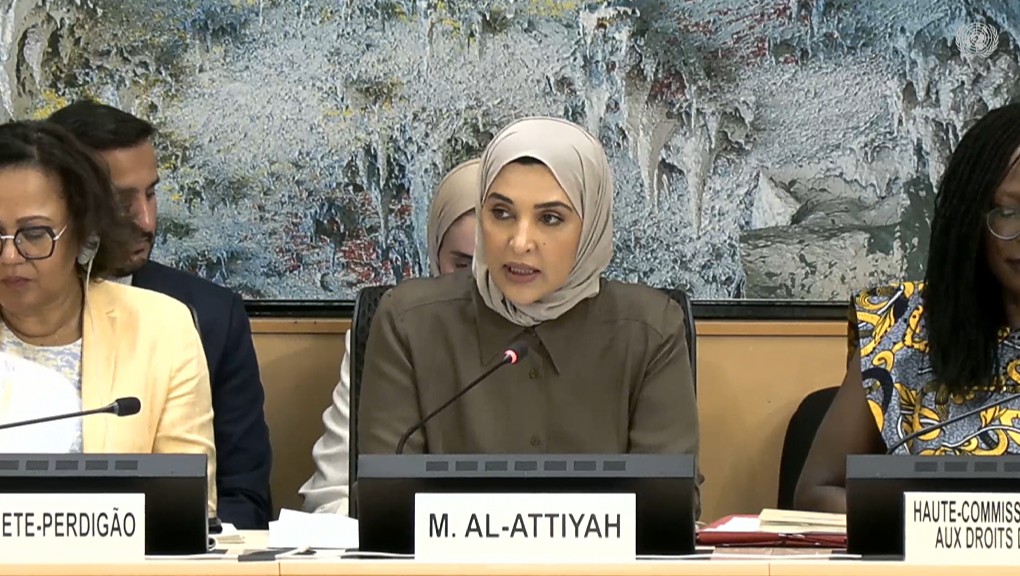
NHRC Chairperson H E Maryam bint Abdullah Al Attiyah speaking at the event.
Geneva: Chairperson of the National Human Rights Committee (NHRC), H E Maryam bint Abdullah Al Attiyah, underscored yesterday the importance of Human Rights Council Resolution (59/17) on ramping up efforts to empower women and girls in and through sport.
She described this resolution as a vital step toward fostering equality and broadening the engagement of women and girls, as well as leveraging sport as an effective empowerment tool and achieving sustainable development, particularly Goal 5.
Addressing a panel discussion on the intensification of efforts to empower women and girls in and through sport within the 62nd session of the United Nations Human Rights Council in Geneva, Al Attiyah highlighted that women athletes have proven their distinctive capabilities and have taken the lead in the domain of sport on the world stage.
She noted that, albeit the breakthrough achieved globally in this field, women and girls are still beset with challenges that hamper their full and equal engagement in sporting activities.
Foremost among these challenges, Al Attiyah pointed out, is that women’s sport hasn’t been adequately dealt with seriously, creating wage and opportunity gaps, limited investment and attention, and weak women’s representation in the uppermost echelons of leadership and decision-making.
She recalled that there are some social and cultural stereotypes that impair women’s full enjoyment of their right to sport, indicating that women and girls who are gripped by marginalisation or armed conflicts face additional challenges.
In these unstable situations, Al Attiyah clarified, limited resources and damaged infrastructure preclude opportunities for their access to sport and the benefit of sport’s positive impact.
The Chairperson further emphasised that sports facilities that are devastated by armed conflicts aggravate these challenges and preclude engagement opportunities and sustained sporting activities.
The official called for pursuing policies and programs that ensure equal opportunities and easy access to sport as a human right and an empowerment tool, through devising creative solutions that ensure vibrant sport practices in various conditions.
Women’s representation in leadership and sport governance echelons is material to their participation inside stadiums and in decision-making processes alike, Al Attiyah underlined.
She further called for having a secure and overarching sporting atmosphere in place through combating discrimination, violence, and harassment, as well as strengthening protection, accountability, and support mechanisms to ensure their equal and secure participation.
Over the course of the past decades, there has been remarkable participation of women in sport in the State of Qatar, Al Attiyah noted, recalling the creation of the Qatar Women’s Sports Committee (QWSC) in 2000, which helped broaden their participation base and create opportunities for engaging in multiple sporting activities and tournaments.