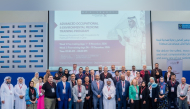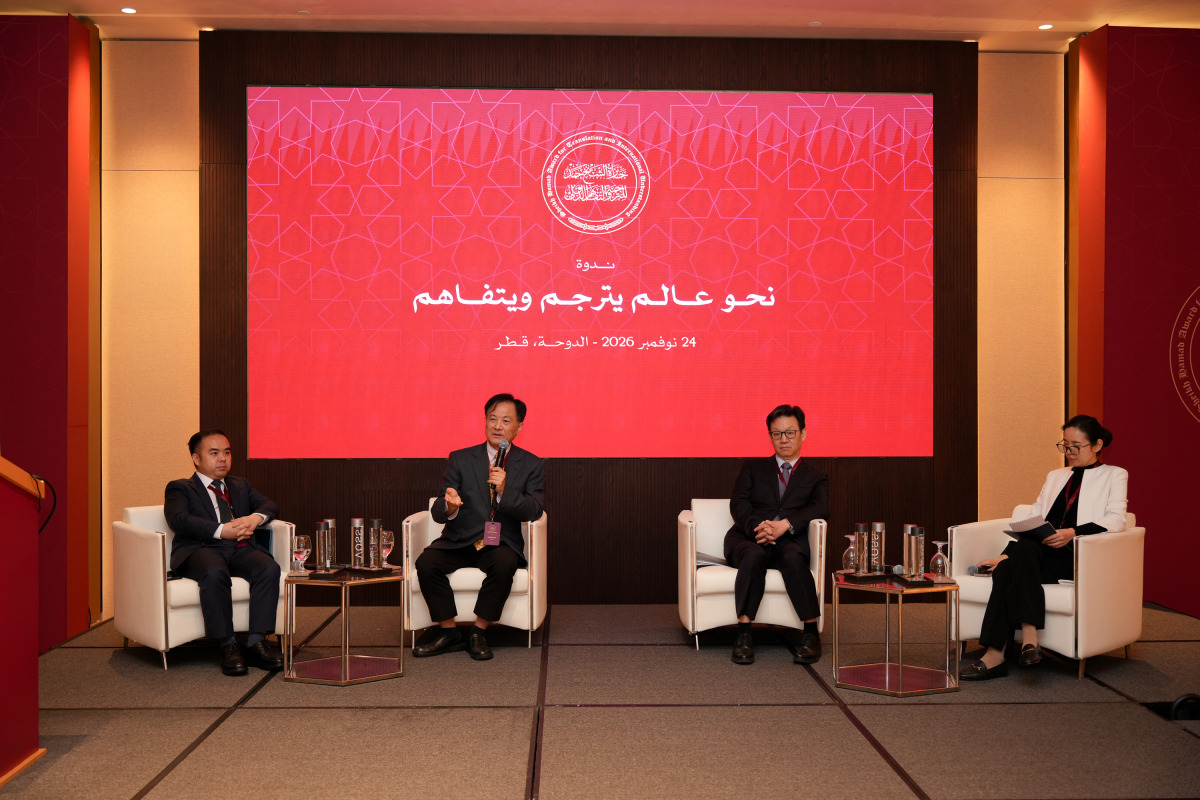
Doha: The Sheikh Hamad Award for Translation and International Understanding held a seminar on Tuesday exploring the role of translation in fostering knowledge exchange, promoting dialogue between cultures and strengthening mutual understanding among peoples.
Titled “Towards a World that Translates and Understands”, the seminar brought together academics, researchers and translators from several countries as part of the 12th edition of the award for 2026, ahead of the ceremony honouring this year’s winners.
The discussions focused on how translation can help overcome stereotypes and preconceived perceptions of other cultures, while addressing challenges facing knowledge exchange amid contemporary intellectual and technological transformations.
Opening the seminar, Executive Director of the Sheikh Hamad Award for Translation and International Understanding Labib Al Nahhas said the award continues to advance its mission and build on the foundations laid by its late patron, the Father Amir, Sheikh Hamad bin Khalifa Al Thani.
He noted that, through its accumulated achievements and cross-border cultural relations, the award had established itself as a platform for cultural diplomacy and a bridge of communication between peoples.
Al Nahhas welcomed participants from around the world, highlighting the significance of the seminar’s theme and emphasising that translation goes beyond transferring texts and knowledge to building bridges of understanding, promoting mutual recognition between cultures and opening broader horizons for human dialogue.
The seminar featured two sessions, the first examining translation between Arabic and Chinese in a multipolar world, while the second explored translation and perspectives on the world through experiences involving Arabic, Azerbaijani, Italian and Fulani.
The first session, moderated by Dr Yu Mai, Professor of Arabic Studies at Beijing Foreign Studies University, examined the development of translation between Arabic and Chinese and its contribution to knowledge exchange between the two civilisations.
Professor Wang Yuyong (Faisal) of Shanghai International Studies University presented a paper titled “The Arabisation of Chinese Classics in a Multipolar World”, tracing efforts to translate China's intellectual heritage into Arabic.
He observed that the emergence of multiple centres of global power did not necessarily mean a corresponding diversity in the circulation of knowledge. He highlighted the importance of direct translation and joint interpretation by Arab and Chinese researchers in overcoming stereotypes, calling for translation efforts to cover a wider range of intellectual schools and contemporary knowledge.
He also discussed the potential of artificial intelligence to improve translation tools, while stressing the need for human review of AI-generated translations.
Dr Li Shijun (Latif), also from Shanghai International Studies University, presented a paper titled “Milestones in the Translation Movement from Arabic into Chinese in China: From the Perspective of Area and Country Studies”.
He outlined the development of Arabic-to-Chinese translation across four generations, from its early foundations to contemporary efforts, highlighting the contributions of translators, academic institutions and joint translation projects in shaping Chinese understanding of the Arab world.
He noted a shift in translation from simply transferring texts to becoming a knowledge-producing practice that supports academic research and area studies. He called for improving translation quality and expanding its subject areas to strengthen the translator’s role in knowledge production.
The session concluded with a paper by Dr Cui Qingguo (Bassam) of Beijing Foreign Studies University, titled “The Translation Movement between Chinese and Arabic as a Reflection of China's Social and Intellectual Transformations”.
Using Chinese translations of One Thousand and One Nights and the meanings of the Holy Quran as examples, he examined how social and intellectual contexts, as well as translators’ identities, influence translation choices and approaches.
He also presented a new collective project to translate the meanings of the Holy Quran into Chinese, with the complete work expected to be published in 2027.
Cui stressed the importance of combining accuracy in conveying meaning with sensitivity to linguistic and stylistic characteristics and the demands of the contemporary era. He described translation as a specialised academic practice, noting that linguistic fidelity, while essential, is not the sole criterion for evaluating a translation.
The second session, moderated by Dr Sidina Sidaty of the University of Nouakchott in Mauritania, explored how translation shapes perceptions of the world and enables different languages and cultures to contribute to the production and circulation of human knowledge.
Professor Ahmed Sami Al Aidi opened the session with a paper titled “Translation and Knowledge Exchange between Arabic and Azerbaijani amid Linguistic Hegemony”.
He examined the influence of linguistic dominance on knowledge transfer, drawing on the experience of translation between Arabic and Azerbaijani and the historical role of Russian as an intermediary language.
He noted that cultural ties and the availability of linguistic expertise alone were insufficient to stimulate translation without institutional and financial support. He called for greater emphasis on direct translation and the expansion of translation fields to ensure more equitable participation by different cultures in knowledge exchange.
Professor Ahmed Al Sumai presented a paper titled “Viewing the Universe through the Translation of Umberto Eco’s The Name of the Rose”, examining the Italian novelist’s work through its different literary, historical, philosophical and semiotic dimensions.
He highlighted how readers’ cultural and intellectual backgrounds influence their interpretation of literary texts, citing similarities between an episode in the novel and a story from One Thousand and One Nights as an example of how different cultural references can generate new readings of literary works.
The session concluded with a paper by Senegalese academic Mohamed Said Bah, titled “Translation as a Forward-Looking Vision for Restoring the Value of Human Brotherhood in a Troubled World”.
He called for moving beyond the traditional understanding of translation as linguistic transfer and recognising it as a means of fostering mutual understanding among peoples and building shared human knowledge.
Drawing on historical examples of knowledge transfer between civilisations, he highlighted interaction between Arabic and Fulani in Africa and stressed the importance of recognising the contributions of different languages and cultures.
Bah also proposed rethinking the fundamental questions surrounding translation, beginning with “For whom do we translate?”, and called for a global charter of translation values to promote knowledge exchange and human solidarity.
The seminar highlighted translation's multiple roles in the contemporary world, from preserving and transmitting intellectual and literary heritage to producing knowledge and strengthening intercultural communication.
It also underscored the importance of supporting direct translation, expanding knowledge exchange and strengthening cooperation among translators, researchers and academic institutions.
The event forms part of the Sheikh Hamad Award’s efforts to promote translation as a bridge for knowledge exchange and human understanding, while encouraging cultural interaction between Arabic and languages around the world.