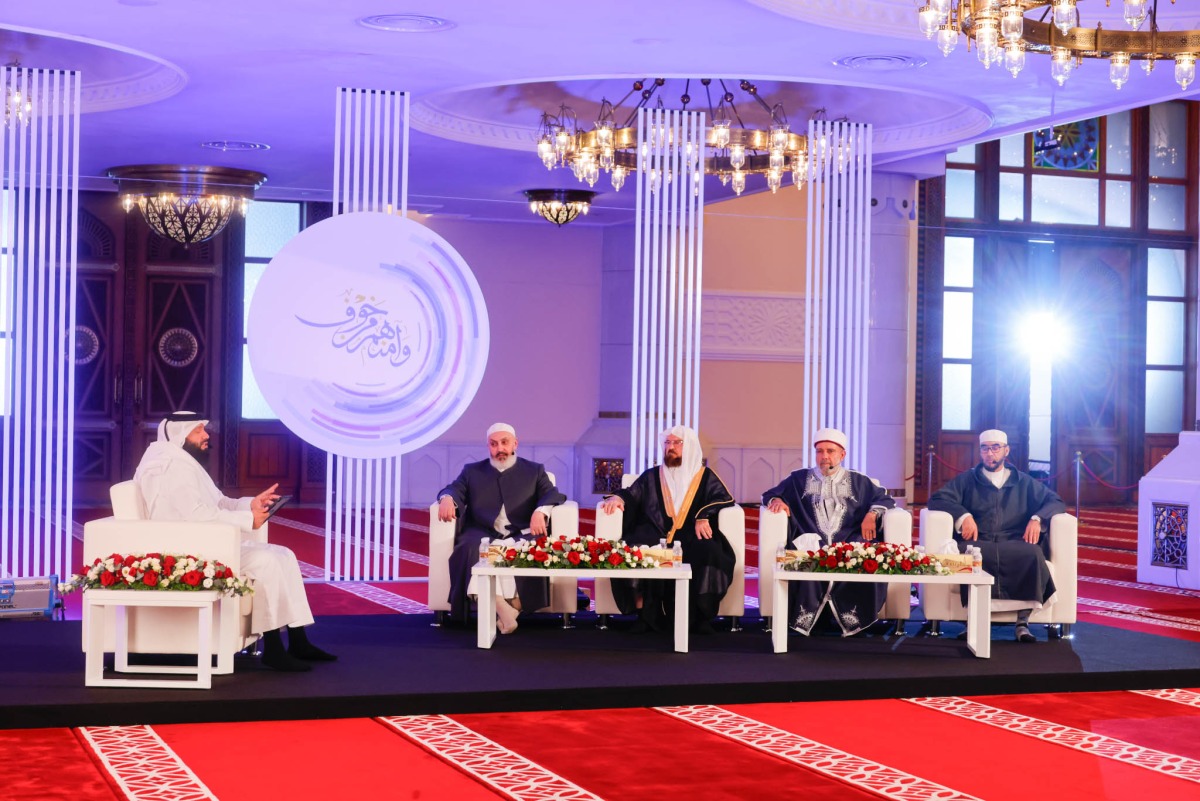
Panellists during the discussion.
Doha, Qatar: The twelfth season of the Ramadan program “Wa Aamanahum Min Khawf” (And He Secured Them from Fear) commenced with a thought-provoking session titled “Unity of the Ummah in a Changing World: A Study in Contemporary Challenges.”
The opening episode brought together prominent scholars to explore the Islamic foundations of unity and the complexities shaping Muslim societies today. The session was moderated by Sheikh Moath Youssef Al-Qasimi.
The session hosted Bilal Baroudi, Sheikh of Qur’anic reciters in Tripoli and Secretary-General of Dar Al-Fatwa in Lebanon; Salem Al-Sheikhi, researcher and member of the European Council for Fatwa and Research; Noureddine Al-Khademi, professor at the College of Sharia at Qatar University and former Tunisian Minister of Religious Affairs; and Ali Al-Qaradaghi, Secretary-General of the International Union of Muslim Scholars.
In his introduction, the program presenter underscored that unity in Islam is not a transient slogan or emotional appeal, but a firmly rooted religious principle grounded in shared revelation, common purpose in worship, and a unified methodological approach to understanding and applying faith.
Citing Qur’anic verses that call for holding fast to the rope of Allah and avoiding division, he emphasized that unity does not negate diversity, but regulates it within a comprehensive framework that preserves the Ummah’s mission and cohesion.
The discussion noted that in modern times, the concept of unity has undergone significant transformation. Political, intellectual and cultural influences have often shifted it from a disciplined juristic principle to a broad, and at times vague, rhetorical slogan. This shift, speakers observed, has contributed to conceptual confusion and inconsistent applications, weakening collective awareness of the Ummah’s authentic foundations of unity.
Addressing the first theme, Dr. Baroudi examined the Qur’anic principle that unity is rooted in adherence to a single straight path, not merely numerical gathering or emotional alignment. He highlighted how multiple competing references and ideologies have fragmented contemporary discourse, leading to the misuse of the term “unity” outside its scholarly and religious parameters.
Dr. Al-Sheikhi turned to the impact of globalization and rising individualism on Muslim identity.
He explained that cultural globalization has fostered fragmented sub-identities that may compete with the overarching identity of the Ummah.
In an era that increasingly centers the autonomous individual, detached from collective moral frameworks, the challenge lies in restoring a balanced understanding of belonging that harmonizes personal agency with communal responsibility.
Dr. Al-Khademi addressed the jurisprudence of difference, drawing on the Prophetic example of managing legitimate scholarly disagreement.
He distinguished between acceptable diversity rooted in sincere interpretation and deviation that leads to discord and division. Properly understood, he argued, methodological differences can enrich the Ummah rather than fracture it, provided they remain anchored in shared principles and mutual respect.
For his part, Dr. Al-Qaradaghi analyzed the role of traditional and digital media in shaping collective consciousness. In a rapidly evolving media landscape, he noted, platforms can either reinforce shared civilizational values or deepen polarization.
The responsibility of media institutions and content creators, he stressed, is to cultivate informed, balanced narratives that strengthen common ground rather than inflame division.
In the concluding segment, all speakers reflected on practical pathways to reinforce unity amid contemporary challenges. They agreed that meaningful change begins with reforming concepts and renewing awareness.
Re-anchoring unity in its authentic juristic and ethical foundations, investing in education and responsible media, and promoting a culture that distinguishes between principled disagreement and destructive conflict were highlighted as key steps.