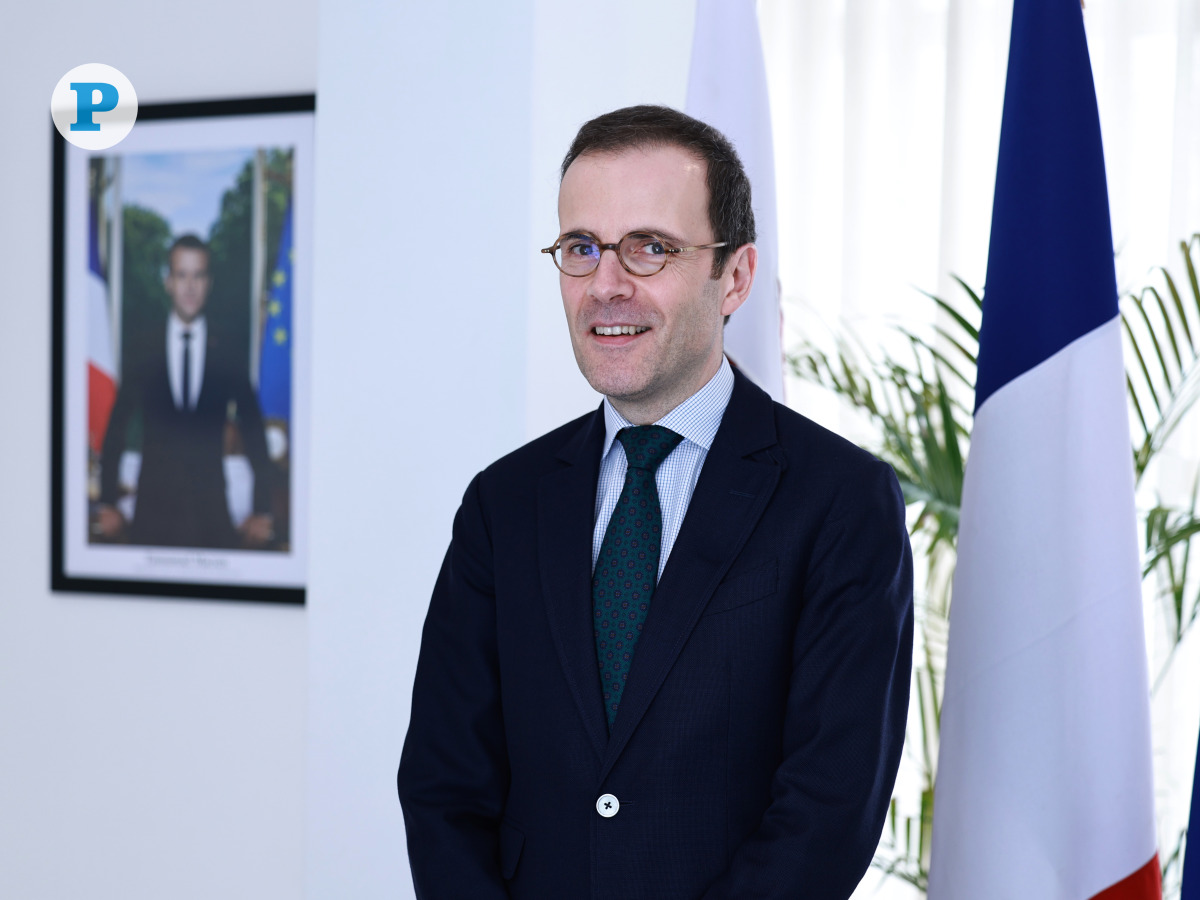
Ambassador of France to Qatar, H E Arnaud Pescheux. Pic: Rajan Vadakkemuriyil / The Peninsula
Doha, Qatar: Terming the recent visit of President of the French Republic H E Emmanuel Macron to Qatar as “a visit of friendship, of gratitude and of solidarity”, Ambassador of France to Qatar, H E Arnaud Pescheux, has said that France and Qatar are attached to a rules-based international order and committed to negotiated solutions.
“In four words: it was a visit of friendship, of gratitude and of solidarity. But also a visit of ambition,” Ambassador Pescheux said during a media interaction at his residence yesterday, highlighting the success of President Macron’s visit and the strength of the ties between France and Qatar.
President Macron paid a state visit to Doha from October 20 to 21. The Amir H H Sheikh Tamim bin Hamad Al-Thani and H E President Macron held an official talks session at Lusail Palace on October 20, while both leaders had also attended the 9th Annual One Planet Sovereign Wealth Fund CEOs (OPSWF) Summit on October 21.
Ambassador Pescheux said that H H the Amir and President Macron have maintained a relationship of trust and friendship for nearly ten years.
“Since 2017, they have never stopped talking and working together. They were and still are among the youngest leaders on the international stage, part of a generation that took on responsibility early, and that has not been spared: the Gulf crisis of 2017, COVID–19, Ukraine, Gaza and, of course, Iran.”
Throughout, he noted, they consulted one another so that the Franco-Qatari partnership would contribute, whenever possible, to political solutions in the service of peace and stability.
The Ambassador said that in a world going through unprecedented turbulence, France and Qatar follow the same strategic course. “Qatar is 'a peninsula within the peninsula'.
“It has built a national project of its own, with a clear idea of what it wants to be. France understands what that means. Both countries want to strengthen their sovereignty, increase their autonomy and preserve their identity, in order to contribute to a safer, more stable and better–regulated world. That is why they constantly reinvent the most relevant forms of cooperation in order to devise relevant responses to the crises shaking the world, allow our economies to grow in sectors where the future is decided and give our youth the means to shape their own way.”
He said that France will never forget the protection that the Qatari armed forces provided, at the height of military operations, to the 6,000 French nationals who live in Qatar and to the 2,000 who were stranded here.
On the regional war, he said, “Neither Qatar nor France chose this war. But France condemned the attacks of February 28 against Qatar and takes pride in having militarily stood by its side.
“In the days and weeks that followed, in a purely defensive way, it deployed joint patrols of Qatari and French Rafales in Qatari skies, detection and interception capabilities, and the Charles de Gaulle carrier strike group in the eastern Mediterranean and then in the Gulf of Oman.”
“Shoulder to shoulder, we demonstrated the strength of our military partnership. It was therefore natural that Iran should be at the heart of the two leaders’ discussions, under the political and energy angles alike.”
He said that Qatar is a mediating power, “a messenger-country greater than itself”. He added, “France is a balancing power and a permanent member of the Security Council. Both are attached to a rules-based international order and committed to negotiated solutions. The leaders had an in-depth conversation on the ongoing negotiations between Iran and the United States.”
The Ambassador noted that the economic consequences (of regional war) are felt everywhere. “In the Gulf, the obstruction of energy exports undermines development models. In developing countries, food security of already vulnerable populations is threatened. In developed countries, higher energy costs fuel inflation and erode purchasing power.”
He said that the first economic aim of the Gulf visit was therefore to secure French energy imports, in diesel and gas, with Qatar supplying two terawatt–hours of liquefied natural gas per month over the winter.
“Three other tracks were opened: first, helping to secure certain ships; second, an insurance mechanism to lower transport costs; third, diversifying infrastructure to bypass the Strait, with land, road and rail alternatives discussed with Saudi Arabia, Egypt, Iraq, Syria and others. The leaders agreed to continue exploring those options. France’s coalition defensive and pacific proposal to secure the freedom of navigation in the Strait of Hormuz remains also valid.”
The Ambassador of France further said that the leaders also discussed their shared ambition for the bilateral cooperation. “In reality, the two topics are in fact one: our response to the crisis draws its strength from our cooperation, and our cooperation grows stronger each time we face a crisis together. What makes the partnership special is that it makes each of us stronger through the other.” On the bilateral defence cooperation, he said that the recent military deployment could only succeed thanks to decades of strengthening interoperability, through structural, operational and industrial cooperation.
“Sharing the Rafale is probably its most powerful instrument. All the countries of the region seek greater autonomy and to develop their own defence capabilities. We are now strengthening this partnership along three distinct lines: first, modernising the Rafale fleet; second, signing a letter of intent that selects KNDS and JCD for the Land Forces’ 8x8 programme; and third, opening discussions on further land-air capabilities, in detection and interception.”
On the economic ties, the Ambassador said that French champions have supported Qatar’s extraordinary journey. “Our energy groups, present here since the 1930s, well before diplomatic relations were established, and more recently in various fields – Egis, Saur, Suez and Thales, to give only last year’s examples, in infrastructure, water and defence. In an international economy shaken by the erosion of rules, marked by brutal competition and reshaped by disruptive technologies, Qatari investment supports strategic sectors identified jointly, under the Strategic Investment Partnership launched during the Amir’s State Visit to France in 2024: semiconductors, artificial intelligence, quantum computing. Together we will develop the sectors of tomorrow, to meet the challenges of tomorrow.”
The Ambassador also expressed his gratitude for hospitality and protocol extended to President Macron in Qatar. “It began with the escort of six Qatari Rafales upon the President’s entry into Qatari airspace and a Doha dressed in the colours of France, a gesture that touched us all. It continued at the Amiri Diwan, with its mounted escort, its 21-gun salute and the Ardah sword dance, and with a State dinner that gathered all those who matter to our bilateral relationship.”