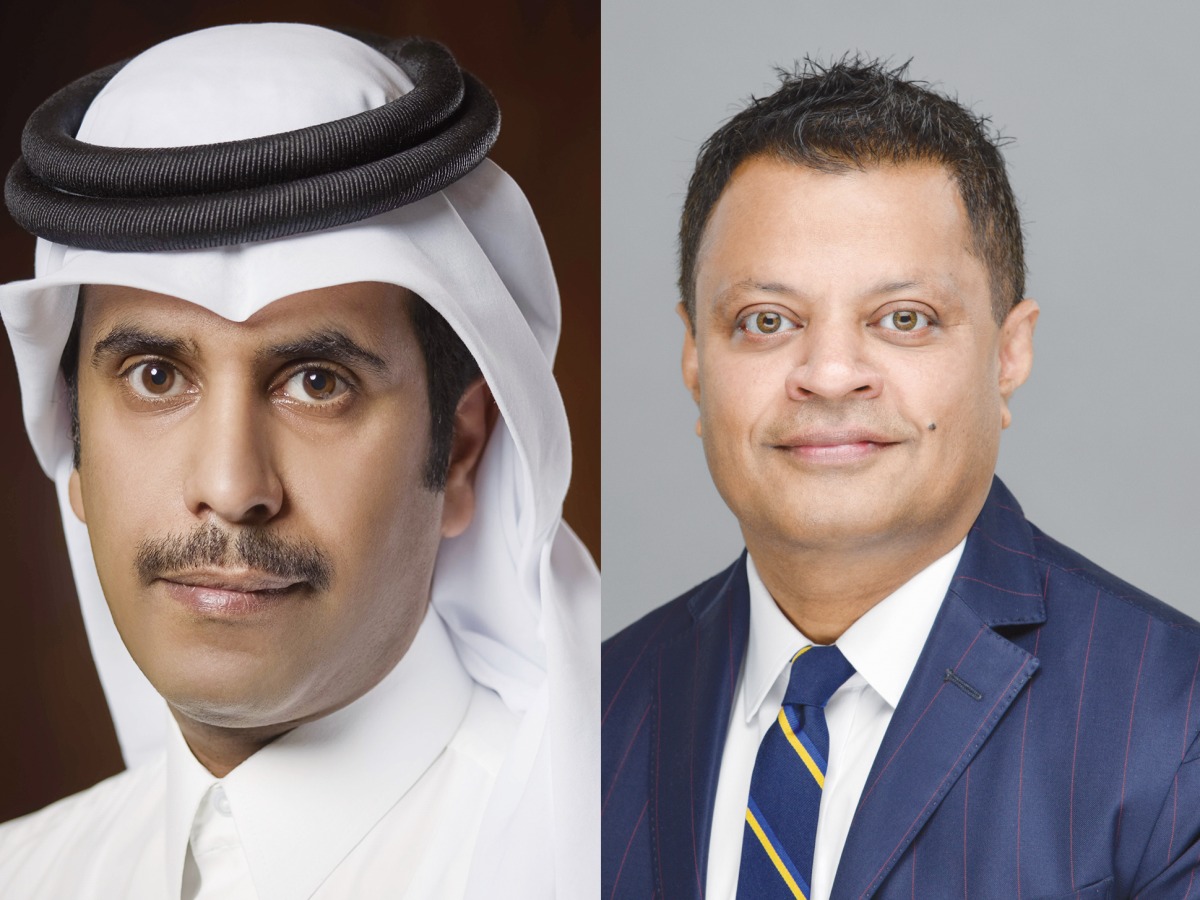
Sheikh Abdulla bin Fahad bin Jassem bin Jabor Al Thani, Chairman of GWC, (left) and Ranjeev Menon, Group CEO of GWC
Meet the logistics team working behind the scenes to stage the world’s biggest sporting event: the FIFA World Cup Qatar 2022
From 21 November to 18 December this year, Qatar will host the 22nd edition of international football’s showpiece event: the FIFA World Cup.
It will be the first edition of the tournament to take place in the Middle East and Arab world; and only the second in Asia, after the Korea Republic and Japan shared hosting duties in 2002.
A decade in the making
“We have been looking forward to the World Cup for more almost ten years now,” says Sheikh Abdulla bin Fahad bin Jassem bin Jabor Al Thani, Chairman of GWC, Qatar’s leading logistics company, and the Official Host Nation Provider for the FIFA World Cup Qatar 2022™. “It is an important moment for Qatar, showcasing everything the country has accomplished, and also for GWC. It is testament to our incredible progress over the past 18 years.”
“Being named the Official Logistics Provider for the FIFA World Cup Qatar 2022 was a momentous occasion for us, demonstrating how far we’ve come since 2004,” said Shaikh Abdulla.
“Hard work, strong belief in our values and unwavering commitment to delivery has helped us achieve this goal. FIFA recognised this commitment, along with our dedication to training and innovation, and trusted us to play a key role in organising the biggest single-sport event on the planet – and the most prestigious sporting event ever to be held in the Middle East and Arab world.”
The event will be a gargantuan accomplishment by any measure. The GWC team has been planning for the World Cup for eight years. And their journey will continue once the estimated 1 million visitors – to a country of just 2.88 million people – have returned home.
While the world is mesmerised by the action on the pitch, it’s the work behind the scenes that will leave a real legacy – for Qatar, the MENA region and the world.
Coordinating a country
Take all the people out, turn the stadium upside down and shake it. Everything that falls out, logistics will deliver.
This includes food and drink and the kitchens they’re prepared in; the seats fans sit on, the LED screens that guide them around the stadium, and the tickets they use to gain entry; the kits the players wear and the broadcast equipment needed to transmit the world’s biggest sporting event to billions of fans around the globe.
It’s a logistical enterprise with few equals that will draw heavily on GWC’s 3,800,000m² of infrastructure, spread across 19 logistical hubs, connected by 1,600 specialist vehicles and a 3,600-strong workforce.
And when it’s time to deliver the legacy mandate, Qatar has clear plans. There will be no ‘white elephants’, where venues were left to gather dust. Some Qatar 2022 stadiums will have seating removed to be donated to countries which lack sporting infrastructure, while other venues will be converted into facilities for the local community.
“Some seats will be auctioned, some will go to charity, some will remain, and some will be dismantled,” says Ranjeev Menon, Group CEO of GWC. The task of taking everything down is slated to last six months.
Staging the world’s biggest sporting event
When Qatar won the bid to host the FIFA World Cup in 2010, “It was a proud moment for the country,” says Menon. “There were tears in people’s eyes.”
The stakes were high, and GWC is a relatively young company. The last Official Logistics Provider for the FIFA World Cup™ was Kuhne & Nagel, a 100-year veteran of the industry. GWC was only established within the last two decades. Planning began immediately.
Safe and sustainable
A sign of the times and modern responsibilities, there are two additional considerations for GWC to account for: Covid safety, and sustainability. The World Cup is currently expected to be free of pandemic-related restrictions. But should that change, GWC is ready.
The same procedure was scaled up for the FIFA Arab Cup later in the year. “We had six stadiums with multiple games and a considerable number of fans,” says Menon. “It was a great opportunity to test our strength in terms of our infrastructure, and COVID compliance.”
Qatar 2022 is also being billed as the most sustainable edition of the tournament in history. “All the stadiums have been designed to reduce energy consumption by 30%-35% compared to similar developments. In addition, Ahmad Bin Ali Stadium was built with 90% recycled materials,” says Menon. For its part, GWC is consolidating in- and out-bound deliveries as much as possible, employing solar panels to power its infrastructure, regenerating water, and ensuring all packaging is biodegradable where possible.
Lasting impact
“The World Cup is an amazing opportunity to deliver a wonderful celebration of football, culture and hospitality,” says Menon. “But its most lasting impact will be in the wider economy. It is a catalyst for national development and innovation. The preparations have already accelerated Qatar National Vision 2030.”
It’s a goal that GWC is actively supporting, having recently opened its largest logistics park to date, a colossal 1,500,000m² one-stop-shop that caters specifically to small-, medium-, and micro-businesses. The site caters to all their commercial needs, as well as affording an opportunity to network with like-minded organizations. “We act as an enabler or catalyst between these small and medium companies, and the companies that will come in during the FIFA World Cup,” says Menon.
Once the cameras have left, the world will move on. But the connections and skills forged in the tournament’s herculean logistics will reverberate for years.