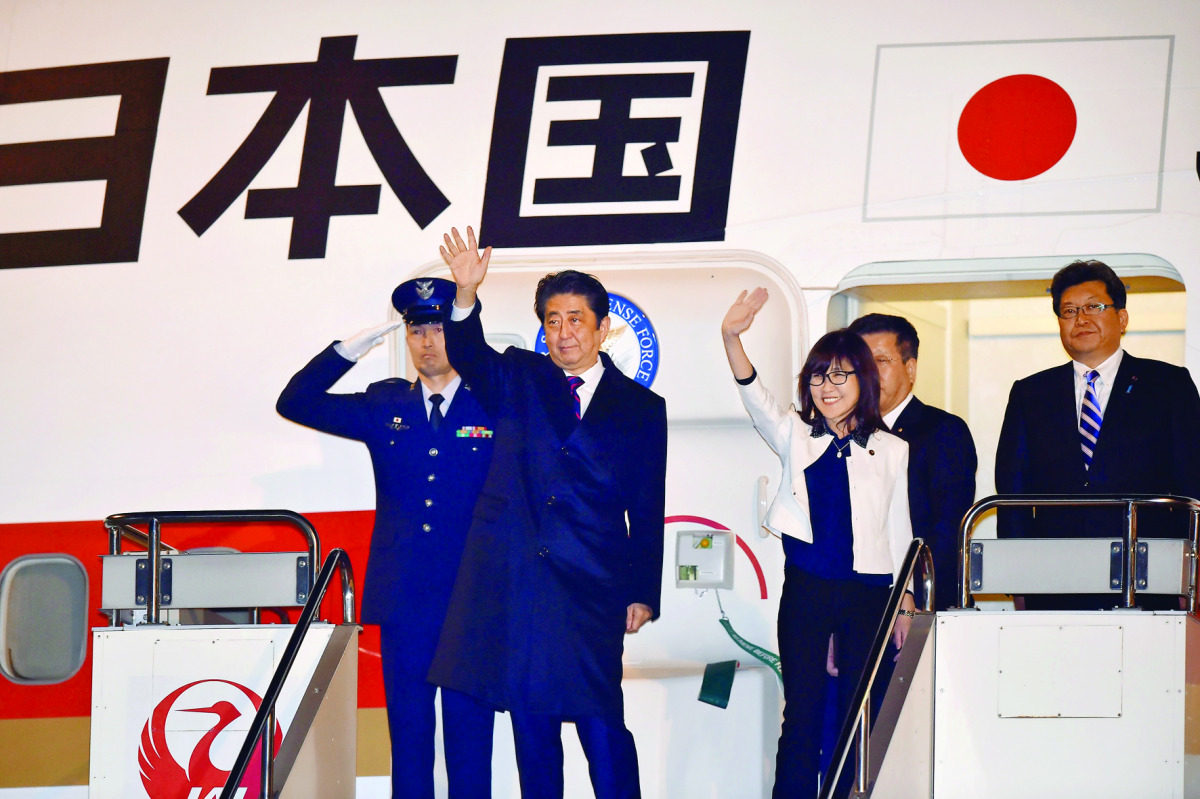
Japan's Prime Minister Shinzo Abe and Defence Minister Tomomi Inada (third left) wave as they depart for Hawaii at Tokyo's Haneda Airport, yesterday.
Tokyo: Japan and the US have agreed in principle on guidelines for limiting immunity from Japanese prosecution for civilian workers at American military bases, following a murder case this year on a southern Japanese island involving a Marine-turned-contractor, officials said yesterday.
Since July, the governments have been negotiating several points concerning US civilian contractors at American bases who are subject to protection under the countries' Status of Forces Agreement.
Japanese Foreign Minister Fumio Kishida said that the two sides have agreed on how to define what constitutes a "civilian contractor" at an American base and hope to sign the agreement "during President Barack Obama's term." He did not give further details.
The May arrest of the base contractor, accused of abusing and murdering a 20-year-old woman, renewed outrage on Okinawa, where resentment has been simmering over the island's heavy US troop presence.
That prompted Tokyo and Washington to try to establish a clearer definition of "civilian base workers."
In July, the two sides said base contractors, now described vaguely as having a "civilian component," will be classified in more specific terms, to exclude from preferential treatment those without skills and those who are residents of Japan, like the suspect in the April murder case.
Kishida said a clear definition of civilian contractors and adequate control of their data would help prevent criminal cases in the future.
About 50,000 US troops are stationed in Japan under a bilateral security agreement, more than half of them based on Okinawa. In addition, 7,000 Americans employed as civilian contractors were at US military bases in Japan as of March.
The Status of Forces Agreement, originally signed in 1960, gives US military personnel and civilians employed at American bases in Japan immunity from Japanese criminal procedures in accidents or crimes while on duty or on base.
It also allows the US military to hold suspects on base until formal indictment by Japan. Okinawan authorities say the rule denies them proper access to investigate crimes under Japanese law.
Abe leaves for Pearl Harbor
Prime Minister Shinzo Abe departed yesterday for Hawaii where he will visit Pearl Harbor with US President Barack Obama as the two countries highlight decades of post-World War II reconciliation.
Abe's visit to the site, which was bombed by Japan in a surprise attack in December 1941 that drew the US into World World II, was announced earlier this month.
It follows a journey Obama made with him in May to the city of Hiroshima where a US plane dropped the world's first atom bomb as the war drew to a close in 1945.
"I am visiting Pearl Harbor in Hawaii to commemorate victims as the prime minister of Japan, as the representative of the Japanese people," Abe said.
"We must not repeat the horror of war ever again. Together with President Obama, I would like to express to the world this pledge for the future and value of reconciliation."
The two leaders hope that their joint visits will underscore the alliance between their two nations forged in the years following the war.