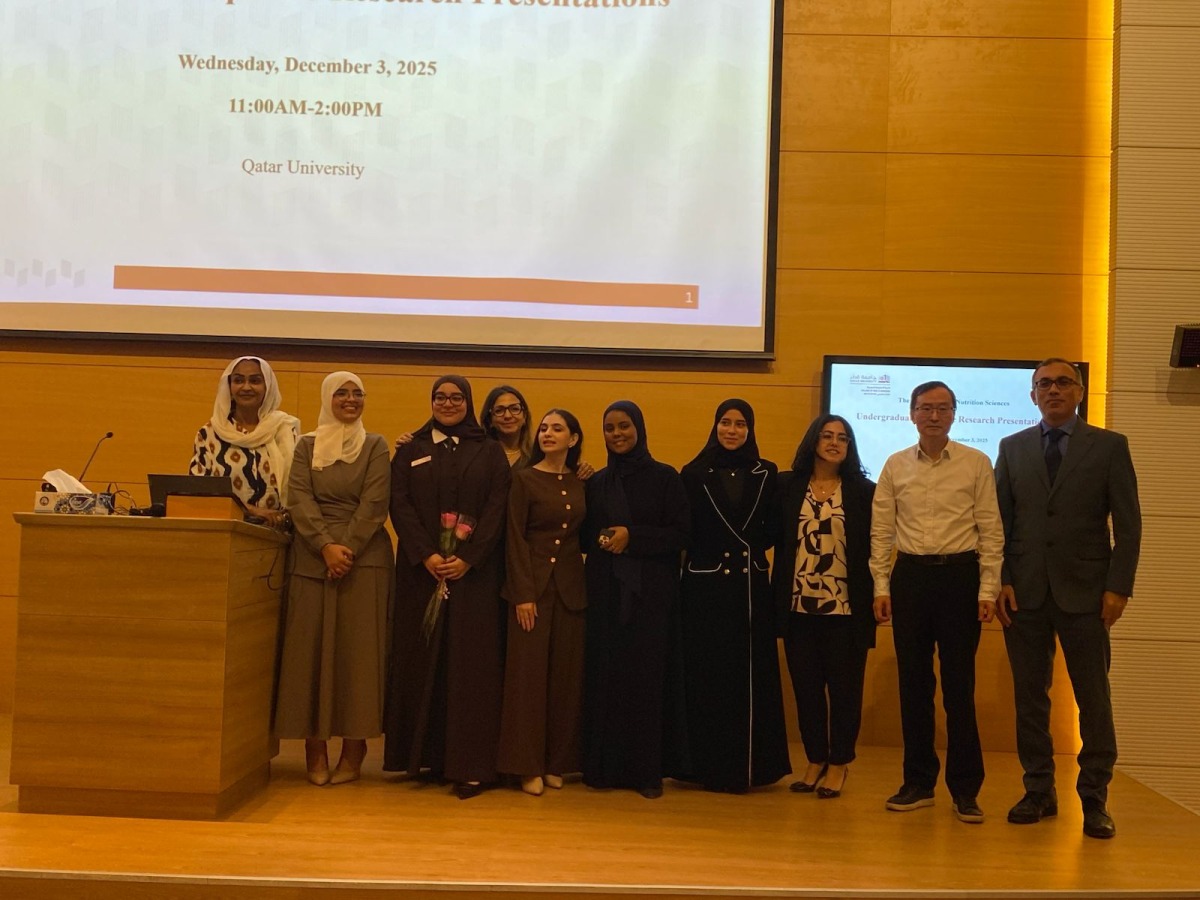
Participants during the event.
Doha, Qatar: The Department of Nutrition Sciences at the College of Health Sciences at Qatar University (QU) hosted the BSc in Nutrition and Dietetics Undergraduate Capstone Research Projects and Presentations, highlighting nine research projects completed by senior undergraduate students under the mentorship of department faculty.
The showcased projects addressed priority topics in nutrition, public health, food safety, and sustainability. One study conducted by Latifa Al-Sulaiti, Lolwa Al-Mulla, and Shaima Al-Mahmoud, under the supervision of Dr. Reema Tayyem and Ms. Hiba Chatila, analysed dietary patterns among adults with cardiometabolic diseases using QPHI–QBB data.
The findings indicated that fast-food and meat-heavy dietary patterns were associated with higher central obesity and adverse lipid profiles, while fruit- and vegetable-based patterns demonstrated protective effects.
In another project supervised by Dr. Layal Karam, students Najah Aldwamneh and Shahad Dergham demonstrated that essential oil compounds, including eugenol and linalool, effectively inhibited Listeria monocytogenes in camel meat, supporting sustainable and clean-label food preservation strategies.
A study led by Aisha Nasser Al-Emadi, Niama Ali, and Manal Hassiba, under the supervision of Dr. Maya Bassil and Ms. Hiba Chatila, found that Ramadan fasting was associated with improved dietary quality, modest reductions in body weight and fat mass, and preservation of muscle mass.
Additional research by Reem Al-Yazidi, Reem Al-Mohanadi, and Amina Al-Marzooqi, supervised by Dr. Layal Karam, reported that coriander essential oil and microencapsulated linalool exhibited strong and sustained antimicrobial activity against Staphylococcus aureus in sheep meat during refrigerated storage.
Under the supervision of Dr. Ala Rajabi, students Al-Dana Al-Ghamdi, Ghezayel Al-Marri, and Shahad Mohamed reported no independent association between regular fast-food consumption and dyslipidemia after adjusting for confounding factors. The study identified age, smoking, diabetes, abdominal obesity, and hypertension as key risk factors, while bariatric surgery demonstrated a protective effect.
Another project conducted by Lolwa Shams, Haya Buhazza, and Sara Al-Nasser, under the supervision of Dr. Zumin Shi and Joyce Moawad, showed that greater weight loss following bariatric surgery was associated with significant reductions in fat mass while preserving lean tissue. The findings also linked prudent dietary patterns to more favorable body composition outcomes.