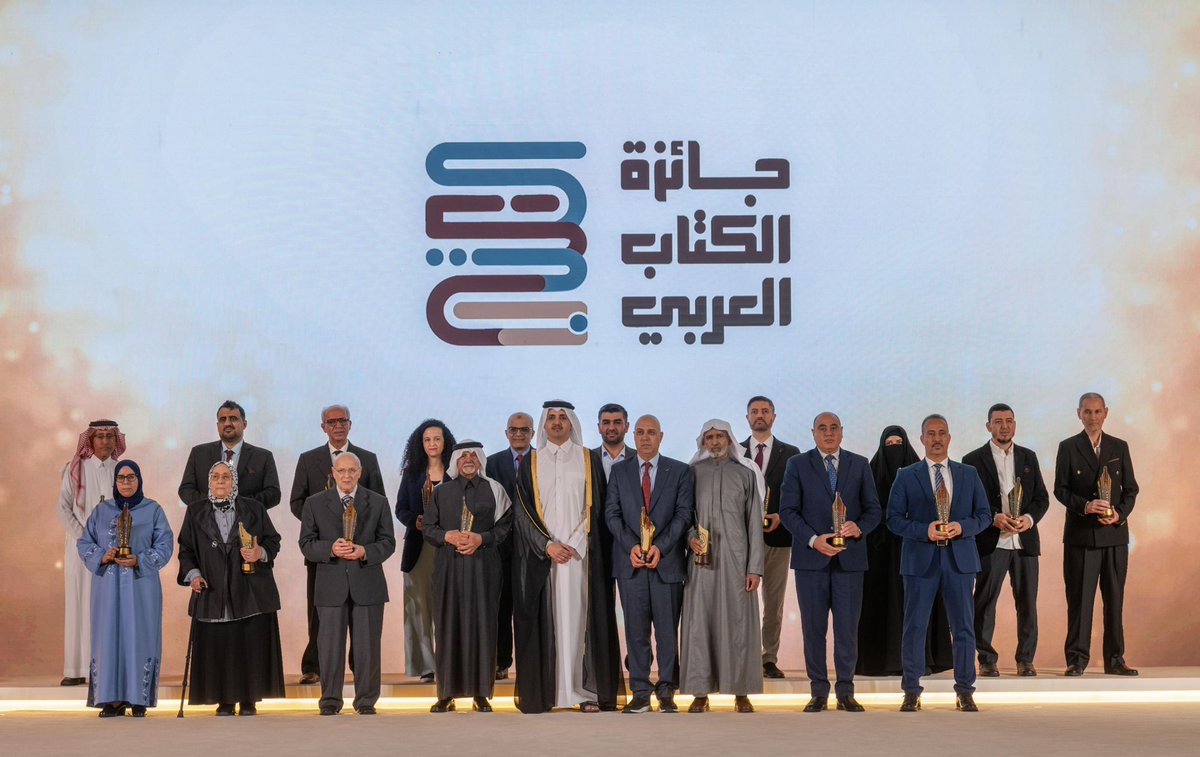
Doha, Qatar: The Chairman of the Board of Directors of the Qatar Fund for Development (QFFD), HE Sheikh Thani bin Hamad Al-Thani, honoured the winners of the third Arab Book Award during an official ceremony held Tuesday evening at the Grand Hyatt Hotel.
The ceremony was attended by a number of Their Excellencies, Sheikhs and Ministers, members of diplomatic missions accredited to the State of Qatar, and distinguished guests including scholars, academics, researchers, heads of cultural and scientific institutions and publishing houses, and a large number of Arab media representatives.

The Arab Book Award, launched by the State of Qatar in March 2023, focuses on books written in Arabic and aims to honor researchers, publishers, and institutions contributing to the Arab book industry.
This year, in the single-book category of Linguistic and Literary Studies, which focused on literary and critical studies of Arab heritage up to the end of the 10th century AH, Abdullah Al Rashid won first place, while Amer Abu Muharib came in second place. Khalid Abdul Raouf Al Jabr took third place.
In the field of Historical Studies, which this year focused on Arab and Islamic history from the end of the 6th century AH to the end of the 12th century AH, Nasser Al Rabat won second place. Ahmed Mahmoud Ibrahim also won second place (a tie).
HE Sheikh Thani bin Hamad Al-Thani also presented awards to the winners in the field of Sharia Sciences and Islamic Studies, which this year focused on biography and Hadith studies.
Ahmed Sanoubar won second place, while Muhammad Anas Sarmini received an encouragement award.
In the field of social and philosophical studies, which focused on intellectual and economic studies, Sawsan Al-Otaibi won third place. In the field of dictionaries, encyclopedias, and textual criticism (this year's competition was dedicated to the critical edition of linguistic texts), Yasser Al-Dumyati won for his encyclopedia.
His Excellency also presented the Arab Book Award to the winners in the Achievement category: Dr. Kian Ahmed Hazem from Iraq, Dr. Muhammad Suhail Taqoush from Lebanon, Dr. Mohammed Saleh Al Musfir from Qatar, Mukhtar Al Ghouth from Mauritania, Muqbil Al Tam A Ahmadi from Yemen, and Dr. Nadia Mustafa from Egypt.
The Juma Al Majid Center for Culture and Heritage in the UAE, Dar Al Ihyaa Publishing and Distribution from Morocco, and Dar Kunooz Al Maarefa from Jordan also won the Institutional Achievement Award.

In his moving speech, Secretary-General of the Award, Dr. Hassan Al Naama spoke about the Award's role in the advancement of Arab culture, describing it as a bridge for intellectual and cognitive exchange among the nation's scholars and a beacon illuminating the paths of literature, science, and art.
He also expressed his gratitude to the writers and scholars who contributed their knowledge to the distinction of this significant cultural project, praising the efforts of those responsible for the Award who work tirelessly to ensure its success and present it in its finest form, so that it may remain a symbol of enlightened thought and a Qatari national gift that bestows brilliance and joy upon the world, adding further beauty and refinement to the Arab landscape.
Professor of International Relations at Qatar University, Dr. Mohammed Saleh Al Mesfer expressed pride in honouring the winners, noting that the award celebrates the intellectual and creative efforts of Arab researchers and writers while encouraging the preservation of Arab cultural and intellectual heritage.
He emphasised that Arab literature serves as a tool for raising awareness and conveying cultural identity across generations, with the recognition motivating continued work and enriching Arab thought.
Al Mesfer also praised the role of the Arab Book Award in enhancing the status of Arab literature regionally and internationally, encouraging creators to continue producing works that enrich knowledge and culture. He noted that the award provides a prestigious platform to highlight the intellectual value of Arab books and serves as an incentive to honor serious studies and scholarly contributions.
The ceremony, held under the auspices of the Qatar National Commission for Education, Culture, and Science, began with an introductory film highlighting the key moments of this edition, including scientific seminars held both in-person and online, which addressed the challenges and prospects of the Arab book industry with leading Arab thinkers.
The event also featured field visits to several Arab countries, including Egypt, Saudi Arabia, and Kuwait, reflecting the award's commitment to expanding cultural dialogue, strengthening communication among scholars and intellectuals working in Arabic, and fostering cooperation with academic and cultural institutions for future collaboration in the Arab book sector.
The third edition of the award marked a milestone, fostering scientific and cultural collaboration with numerous local and regional institutions, and receiving over 1,000 entries from 41 Arab and non-Arab countries across all five knowledge categories.