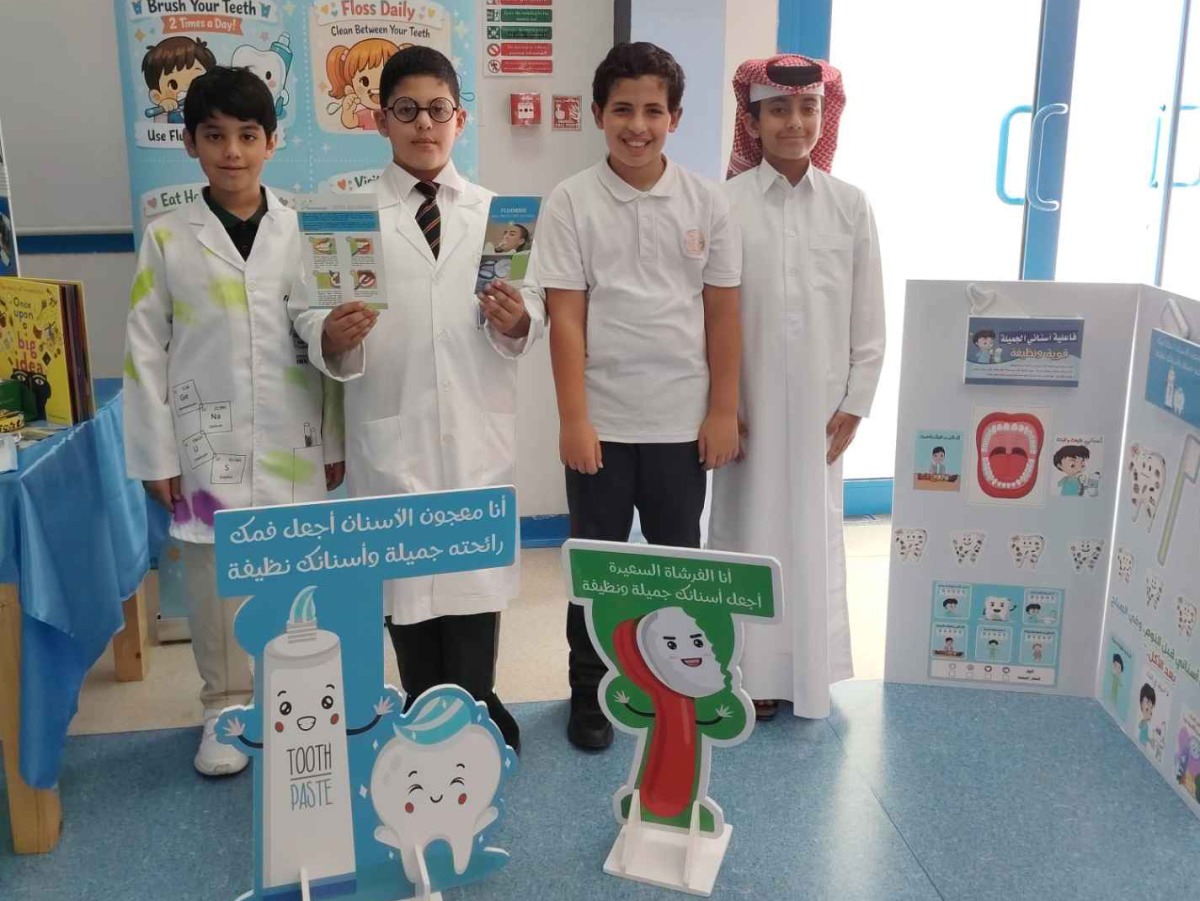
Students of Sherborne Qatar School for Boys during the Career Day.
Doha, Qatar: As part of strengthening community partnership and establishing preventive health concepts among students, the Oral Health Promotion and Prevention Department at the Primary Health Care Corporation (PHCC) participated in the Career Day event organised by Sherborne Qatar School for Boys in response to a parent’s request.
The Career Day is considered an important step that goes beyond a traditional school activity. Participation reflects the importance of integration within the educational triangle: family, school, and the healthcare sector.
Student Ibrahim Mohammed Al-Saqtri (Grade 5) embodied the role of a dentist in an interactive manner, which demonstrated that engaging students in explaining information to their peers enhances the retention of health knowledge.
Manager of Oral Health Promotion and Prevention at PHCC, Dr. Najat Alyafei stated that this type of activity links theoretical knowledge with practical application and instils positive health behaviours in students that remain with them over time.
She added that educational literature indicates that middle childhood (ages 6-12) is the most appropriate stage for building future interests.
Reports from the Organisation for Economic Co-operation and Development indicate that early exposure to professions within the school reduces confusion and hesitation when choosing a university specialisation later.
Therefore, starting from kindergarten through “imaginative play” develops imagination and initiative in children without pressure.
To ensure effective outcomes in building students’ futures, it is recommended to apply a progressive guidance model aligned with different developmental stages.
The pathway begins at the primary stage (Grades 4-6) through an interactive and simplified introduction to professions, then moves in the preparatory stage (Grades 8-9) to linking students’ personal interests with available educational pathways, leading to the secondary stage where informed decisions are made and university specialisation is selected based on a knowledge base and accumulated experiences gained through previous stages, whether in school or through family support at home.
Dr. Alyafei concluded by stating that organised career guidance not only helps students choose their future, but also directs them towards vital specialisations such as medicine and health sciences, which are needed by the country to strengthen national capacities. She emphasised the importance of the family’s role in encouraging children to explore professions through reading and simple discussions, making them more confident and capable of serving their community in the future.