Some large Euro Area economies are expected to increase fiscal stimulus, which should offset some of the slowdown and help strengthen growth, said a QNB Economic Commentary released yesterday.
In 2015-16, GDP growth in the Euro Area has averaged 1.8 percent, well above post-crisis potential growth which is estimated to be around 1.0 percent. The strongest tailwinds have been falling oil prices, a weaker euro and accommodative monetary policy. However, the winds are now turning and support from these forces is fading, leading to slower expected growth.
We examine the three main tailwinds in turn. First, falling oil prices boosted Euro Area consumption in 2015-16 as the region is a net oil importer. Average oil prices fell 46 percent in 2015 and are expected to fall another 16 percent in 2016. However, we forecast oil prices will rise around 22 percent in 2017 on strong demand growth and production cuts, particularly in US shale oil, in response to lower prices. As a result, rising oil prices are likely to become a drag on Euro Area growth from next year. Second, monetary policy was supportive of growth in 2015-16 as the European Central Bank (ECB) cut interest rates and expanded quantitative easing (QE).
However, the ECB may now be running out of firepower: its policy rates are close to their floor with the deposit rate cut to -0.4 percent in March 2016; there are mounting concerns about the effect of negative interest rates on banks’ profitability; and QE aims to lower long-term bond yields, but they do not have much further to go with the 10-year German Bunds currently yielding 0.2 percent and Italian 10-years yielding 2.0 percent.
Third, a weaker euro in 2015 made Euro Area companies more competitive, helping to drive up growth.
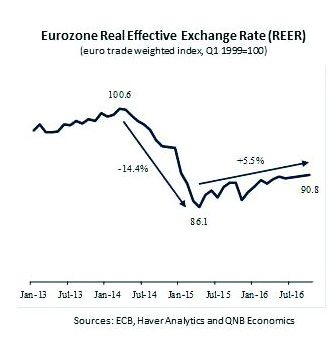
Not only did the euro depreciate significantly against the US dollar in 2015, it also weakened against its trading partners. The real effective exchange rate (REER), which measures the value of the euro against trading partners and also adjusts for inflation differentials, weakened 14.4 percent from March 2014 to April 2015, supporting net exports.
But, the REER has appreciated 5.5 percent since then and is, therefore, now part of the Euro Area’s slowing growth story. Although the euro has weakened significantly against the US dollar amidst the financial market frenzy that followed the US election, it has remained broadly neutral against a trade weighted currency basket.
With the Euro Area’s tailwinds fading, the region is likely to become increasingly reliant on fiscal policy to prop up growth. We expect a fiscal stimulus in 2017 for three main reasons.
First, fiscal space has opened up as the ratio of government debt to GDP in the Euro Area has fallen from a peak of 94.3 percent in 2014 to an estimated 91.7 percent in 2016 and is expected to continue falling. Lower interest rates and stronger growth have helped reduce the debt burden.
Second, 2017 is a big election year in the Euro Area with presidential and parliamentary elections in France and Germany and a general election in the Netherlands.
Governments usually use election year budgets to raise fiscal stimulus in order improve economic conditions for the electorate and increase chances of re-election.
As a result, we expect growth to come in at around 1.5 percent in the Euro Area in 2017 as the fading tailwinds are only partly offset by a pivot towards more supportive fiscal policy.