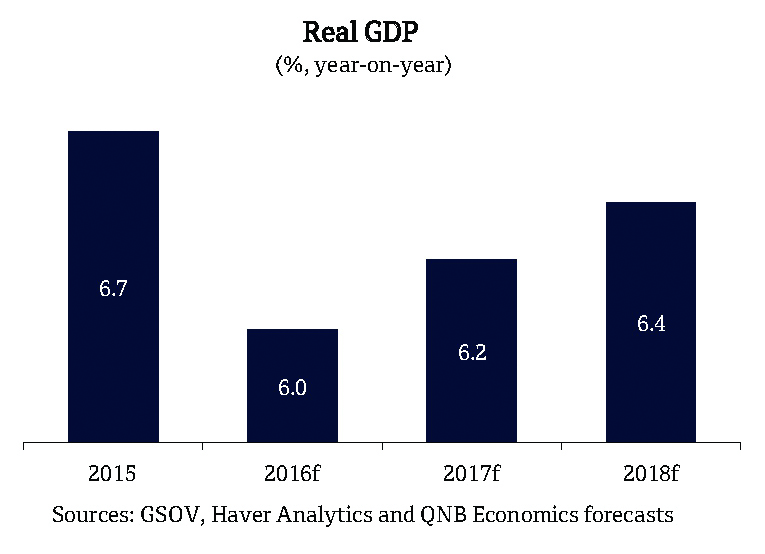
Despite uncertainty surrounding the future of the Trans-Pacific Partnership (TPP), Vietnam’s export outlook is positive having concluded trade deals with South Korea and the European Union. However, the country’s real GDP is expected to moderate in 2016 caused by a major agricultural drought, lower commodity prices squeezing producers and weaker external demand, QNB’s ‘Vietnam Economic Insight’ noted yesterday.
Vietnam’s real GDP is projected to pick up to 6.2 percent in 2017 and 6.4 percent in 2018 as demand for the country’s exports picks up again reflecting the influence of new trade deals as well as continued growth in investment and consumer spending.
TPP, a trade deal spanning twelve pacific-rim countries including the US and Japan, was widely heralded to be a major boon to Vietnam’s exports. However, the future of TPP now looks highly uncertain. This is expected to dampen Vietnam’s export outlook but concluded bilateral trade agreements with the European Union and South Korea in 2016, provide some offset.
In particular, increased trade from these agreements will boost demand exports in 2017 and 2018, supporting a rebound from weaker external environment in 2016. QNB estimates that these bilateral deals will add 0.6 percentage points per year to demand growth in 2017 and 2018. Moreover, we anticipate that Vietnamese exporters will increase their market share in their main trade markets as a result of central bank currency devaluation as well as China’s economic rebalancing, which is moving up the manufacturing value-chain and away from low value manufacturing that competes with Vietnamese exporters.
Inflation is expected to rise to 2.8 percent in 2016, supported by higher prices for food, housing and currency depreciation. In 2017, inflation should reach 3.7 percnet and remain stable thereafter in 2018, reflecting a pickup in global commodity prices, the recovery in house prices and strong domestic demand
QNB expects the deficit to widen in 2016 to 6.1 percent of GDP from 5.9 percent in 2015 on slower growth in revenues on account of weaker export growth and continued investment and social spending.
The deficit budget is expected to be stable around 6.1 percent in 2017 and 2018 as revenue growth from higher commodity prices and stronger economic activity will be matched by continued expenditure growth to meet investment and social spending objectives
As a result, the public debt is expected to reach 62.2 percent of GDP by 2018.
The country’s current account surplus is expected to widen in 2016 to 0.8 percent of GDP primarily as result of slower import growth. But the current account should recede to around 0.4 percent in 2017 and 2018, as oil prices climb, making imports more costly, and thereby partly offsetting export growth.