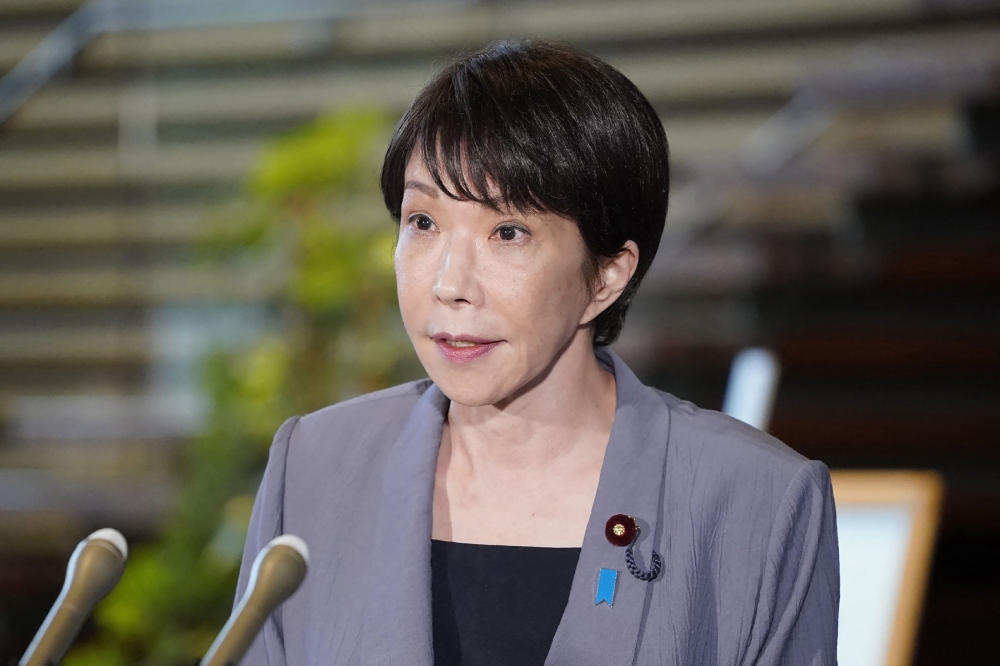
Japanese Prime Minister Sanae Takaichi speaks to the media at the Prime Minister痴 Office, in Tokyo after a 7.1-magnitude earthquake hit southern Japan on July 28, 2026. (Photo by JIJI Press / AFP) / Japan OUT
Tokyo: A major earthquake collapsed buildings and sparked fires in Japan's southwest, Prime Minister Sanae Takaichi said on Tuesday, with broadcaster NHK saying that at least 50 people were taken to hospital.
Television footage on NHK showed several blazes, damaged bridges, a derailed cargo train and cracked roads after the tremor on Kyushu island. The broadcaster reported at least 12 collapsed houses.
The quake at 4:27pm (0727 GMT) had a magnitude of 7.1, according to the Japan Meteorological Agency, but reached the highest possible level of seven on Japan's Shindo scale of shaking.
The US Geological Survey (USGS) measured the quake -- one of hundreds that strike Japan every year -- at 6.8. The vast majority cause little damage.
"We are still assessing the extent of injuries and property damage, but I have been informed that there have already been several injuries," Takaichi said.
"Power outages and fires are happening in some areas, and roads and bridges have been damaged and buildings collapsed," she said.
The JMA initially issued an alert for a possible tsunami of up to one metre (three feet), but withdrew the warning at around 6:10 pm.
"This earthquake occurred inland, and no tsunami activity has been observed so far. For this reason, we hope to lift the tsunami advisory at a relatively early stage, depending on future sea level conditions," a Japan Meteorological Agency spokesperson said.
No immediate abnormalities were recorded at nuclear power plants, the Nuclear Regulation Authority said.
About 45,000 households and facilities have no power in the Kumamoto region, according to local utility Kyushu Electric Power.
The firm added that three nuclear reactors operating in the region at the time were functioning normally.
Shaking is continuing
A local NHK staffer wearing a helmet reported live on air that the shaking was continuing around half an hour after the quake, with the newsroom rocking so violently that it was difficult to remain standing.
"Shaking is continuing as I speak. Including myself, there may be some people who feel their hearts racing," the staffer said.
"When the quake asiastruck, the shaking was so big that I could not stand up. Please be aware of possibility that shaking might continue after this."
Kumamoto was hit by two devastating earthquakes in 2016 -- one of magnitude 6.5, followed two days later by one of magnitude 7.3 -- which killed 273 people and injured more than 2,800.