File photo
Doha, Qatar: At the start of the year, our view on China’s economic outlook was constructive. Although growth is expected to moderate slightly, a combination of strong exports, resilient domestic demand and ongoing productivity improvements were expected to keep economic expansion close to the government’s 5% target for 2026.
However, recent geopolitical tensions affecting global energy availability and prices have challenged this relatively constructive outlook. Given that China is the world’s largest importer of crude oil, investors and analysts have raised concerns that sustained increases in global energy prices could significantly weigh on economic activity, QNB said in its economic commentary.
In our view, these concerns are overstated. While higher energy prices will inevitably raise China’s import bill, the Chinese economy is structurally better positioned than most other large economies to absorb such shocks. Three key factors explain this relative resilience.
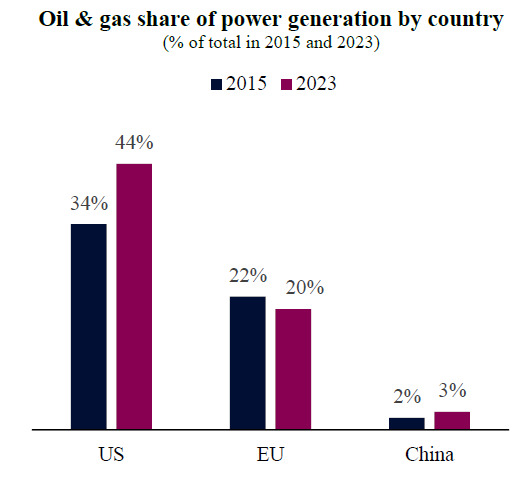
Oil and gas share of power generation by country (% of total in 2015 and 2023)
First, China’s manufacturing sector is more stable and less dependent on hydrocarbons (oil and natural gas) than that of most advanced economies. Electricity generation in China relies heavily on coal and increasingly on renewable energy sources rather than imported hydrocarbons. While China has been making efforts to reduce the overall coal contribution to the energy mix, coal remains the main source of power generation in China and represents a pillar for domestic energy security.
Approximately 90% of China’s coal consumption is supplied domestically, allowing policymakers significant influence over energy availability and pricing conditions. Moreover, the composition and structure of China’s gas imports also shelter it from volatile short-term prices. Nearly half of China’s natural gas imports arrive through pipeline deliveries from neighbouring countries, primarily Turkmenistan and Russia, under long-term contracts that span multiple decades. Importantly, part of China’s oil consumption is also embedded in export-oriented manufacturing.
Second, the structure of transportation and household consumption also reduces China’s exposure to oil price shocks. Vehicle ownership per capita in China remains significantly lower than in advanced economies. In addition, China has invested heavily in alternative transportation infrastructure, including extensive high-speed rail networks and large urban public transport systems. These investments reduce the importance of private vehicle use in both passenger and freight transportation.
Third, China has accumulated substantial crude oil reserves that provide an additional buffer against global price volatility. Although the government does not disclose official figures, most estimates suggest that strategic and commercial reserves amount to roughly 1.3 billion barrels, equivalent to around four months of import coverage.
Taken together, these structural features suggest that China’s economy is likely to remain relatively resilient even in a scenario of sustained energy market disruption.
All in all, although geopolitical shocks have introduced additional uncertainty into the global economic environment, China’s growth outlook remains broadly intact. The combination of a diversified energy mix, lower transportation dependence on oil and sizeable strategic reserves provides an important cushion against global energy volatility. These structural advantages suggest that China is better positioned than many of its peers to weather the current energy shock, while maintaining growth close to its policy targets.