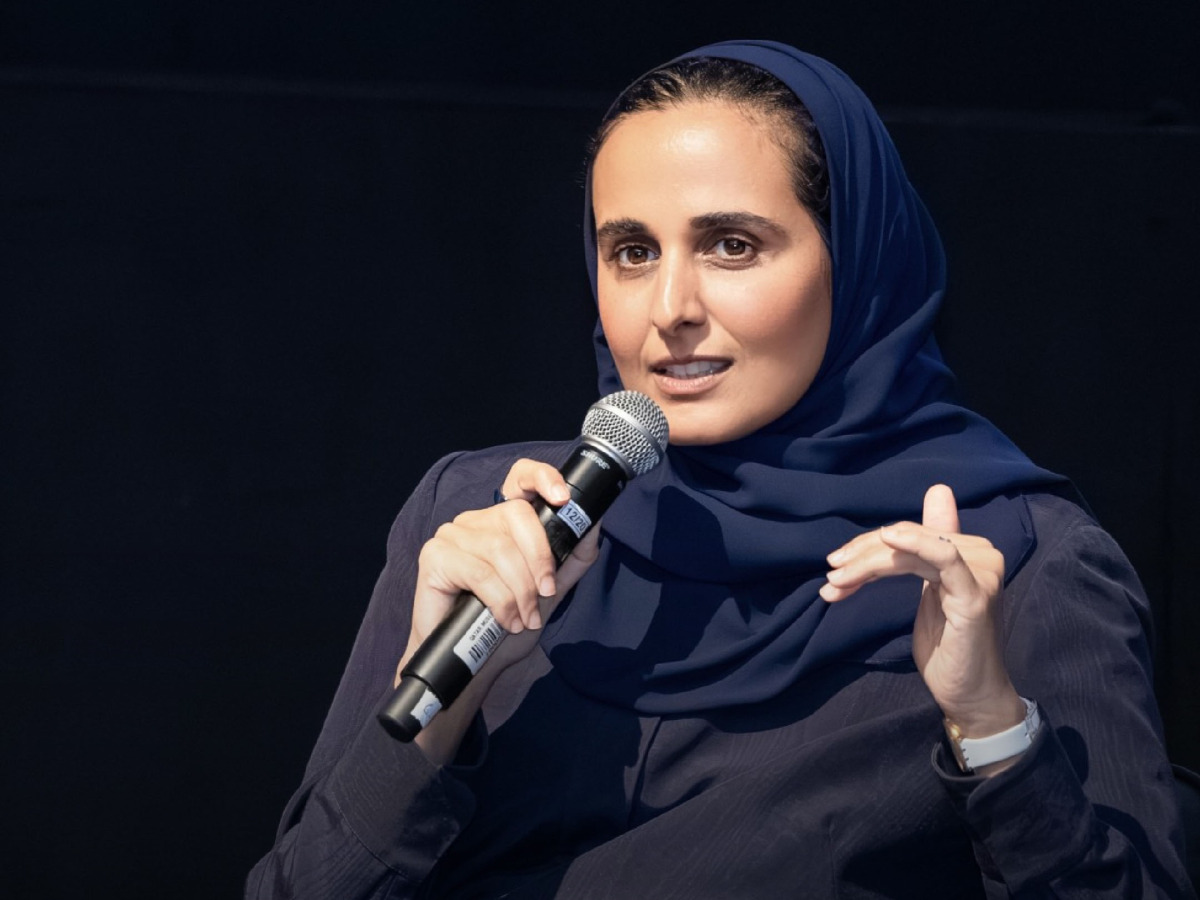
Chairperson of Qatar Museums H E Sheikha Al Mayassa bint Hamad bin Khalifa Al Thani
Doha, Qatar: Chairperson of Qatar Museums H E Sheikha Al Mayassa bint Hamad bin Khalifa Al Thani has underscored the importance of cultural investment, visionary leadership and community engagement in navigating global uncertainties, stressing that culture remains a powerful instrument for promoting dialogue, mutual understanding and sustainable development.
Speaking during a QC Talks panel discussion titled “Leading in Challenging Times” at the National Museum of Qatar (NMoQ) on Tuesday, Sheikha Al Mayassa said Qatar’s long-term cultural strategy has been instrumental in transforming the country into a knowledge-based society while strengthening its international cultural engagement.
The discussion also featured President and Director of Sharjah Art Foundation and President of Sharjah Museums Authority H H Sheikha Hoor bint Sultan Al Qasimi. It was moderated by Adrian Ellis, Director of AEA Consulting and Chair of the Global Cultural Districts Network (GCDN).
Sheikha Al Mayassa highlighted the importance of combining strategic planning with intuition, adaptability and the willingness to learn from mistakes when leading major cultural institutions.
“You cannot really build a strategy without intuition, and strategy is built with your intuition of thinking what your community needs,” she said.
She explained that Qatar Museums operates within a long-term strategic framework aligned with Qatar National Vision 2030, supported by regularly reviewed five-year plans.
“Every year, I review the five-year plan and start to add another year,” she said, emphasising the importance of empowering institutional leaders and trusting their judgement.
She noted that Qatar’s cultural development has benefited from a clear national vision established under the leadership of her father, H H Sheikh Hamad bin Khalifa Al Thani, and continued under Amir H H Sheikh Tamim bin Hamad Al Thani.
Reflecting on leadership challenges, Sheikha Al Mayassa encouraged young professionals to embrace experimentation and learn from setbacks.
“Life is an experiment. You have to have the courage to do things, to be different if you need to be, and to follow your intuition,” she said.
She also highlighted the role of cultural diplomacy in connecting communities, explaining that initiatives such as Years of Culture were developed to strengthen people-to-people relations ahead of the FIFA World Cup Qatar 2022.
“It’s not about an image,” she said, stressing that meaningful cultural engagement must prioritise people, education and community development rather than simply promoting national reputation.
She expressed concern about the influence of social media on younger generations, emphasising the need to provide meaningful role models and opportunities for young people to contribute positively to society.
Sheikha Al Mayassa said museums and cultural institutions must remain inclusive spaces where individuals from diverse backgrounds can exchange ideas and explore challenging subjects.
“I always say our museums are safe havens. Anybody is welcome to come here,” she said.
Addressing the balance between artistic expression and cultural sensitivities, she stressed that curatorial decisions must respect local heritage and values while encouraging constructive dialogue.
She cited the iconic giant teddy bear installation at Hamad International Airport as an example of how initially controversial artworks can eventually become widely embraced public landmarks.
Meanwhile, Sheikha Hoor emphasised the importance of community-centred cultural leadership, institutional accountability and preserving cultural heritage.
She said Sharjah’s cultural development had evolved through successive generations, building on initiatives established under the leadership of her father, H H Sheikh Dr Sultan bin Mohammed Al Qasimi.
Highlighting the importance of public responsibility, she said cultural institutions must ensure their programmes deliver meaningful benefits to communities.
“When you represent a public institution, number one is the public, you’re using public money,” she said.
She also stressed the importance of understanding local communities when developing exhibitions and international cultural projects.