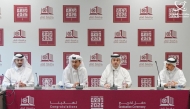
Doha, Qatar: National Human Rights Committee (NHRC) announced the convention of its fourth national forum titled "Human Rights at the Core of Combating Drugs: Challenges and Prospects for Sustainable Solutions", to be held on January 20 and 21, 2026, in partnership with the Ministry of Interior.
The forum will convene in collaboration with the Ministry of Social Development and Family, the Ministry of Education and Higher Education, and the Ministry of Public Health (MoPH), with the participation of the Public Prosecution, the National Planning Council, the National Cyber Security Agency (NCSA), alongside relevant UN offices, civil society institutions, and the media, NHRC highlighted in a statement on Monday.
The forum intends to address growing global challenges and tackle emerging patterns of narcotics-related crimes.
As such, Chairperson of NHRC, HE Maryam bint Abdullah Al Attiyah, said drug abuse violations and illicit narcotics trafficking are among the most menacing challenges affecting human rights globally, given their direct exponential impact on the right to life, as well as mental and physical well-being, alongside the right to a decent standard of living.
She stressed that narcotics engender a detrimental impact on the Sustainable Development Goals (SDGs), pointing out that the UN has given foremost priority to the issue of drug abuse violations and illicit narcotics trafficking, as they explicitly produce deleterious effects on developmental, socioeconomic, political, and security dimensions.
The UN has worked to strengthen global standards to address the emerging risks posed by narcotics through the adoption of four major treaties, chiefly the Single Convention on Narcotic Drugs, 1961, as amended by the Protocol Amending the Single Convention on Narcotic Drugs, 1972; the Convention on Psychotropic Substances, 1971; and the United Nations Convention Against Illicit Traffic in Narcotic Drugs and Psychotropic Substances, 1988, in addition to numerous other international instruments that constitute the cornerstone of the international drug control regime, Al Attiyah underlined.
Al Attiyah further noted that human rights bodies and treaties, mandate holders within the Special Procedures system, and the Universal Periodic Review mechanism contribute to developing responsive measures and reinforce a human rights‑based approach within narcotics policies, legislation, and drug enforcement practices, aiming to mitigate the harms arising from drug use, promote policies centered on investment in alternative development, and ensure the rights to health, equality, and non-discrimination.
On the regional stage, Al Attiyah highlighted that the GCC states place drug enforcement at the top of their priorities, with the GCC General Secretariat launching on June 26 the Gulf Anti‑Drug Strategy 2025-2028, establishing a unified framework for coordinated counter‑drug efforts across all GCC member states.
The Doha-based GCC Criminal Information Center for Drug Control is tasked with enhancing security cooperation among member states in the field of drug enforcement, advancing areas of coordination and integration to maximize the utilization of information, and strengthening cooperation with relevant regional and international organizations engaged in drug enforcement, Al Attiyah noted.
Al Attiyah further emphasized that the State of Qatar has crafted a holistic strategy to combat narcotic drugs and psychotropic substances, involving prevention, awareness, therapy, and rehabilitation, in addition to enforcing the law and advancing enforcement mechanisms, as well as maximizing surveillance at entry points, in alignment with the requirements of the nation's Permanent Constitution and Qatar National Vision 2030.
The Chairperson recalled a whole-of-government approach pursued by the nation's numerous ministries and competent authorities to strengthen awareness, prevention, therapy, rehabilitation, and inclusion.
She asserted that Qatar is a vibrant model of safety, broadly enforcing measures in drug enforcement and prevention, a move that contributed to the absence of any indicators of risk related to the use or trafficking of controlled substances in the country.
Global challenges trigger all countries to place drug enforcement among their foremost priorities, given the mushrooming activities of illicit narcotics and psychotropic substance trafficking networks, which are interlocked with the expansion of unethical uses of modern technology and exacerbate the fragility of the rule of law arising from conflicts and upheavals in certain regions of the world, Al Attiyah explained.
Al Attiyah further elucidated that, according to the 2025 World Drug Report issued by the UN Office on Drugs and Crime (UNODC), the number of narcotics users reached 316 million in 2023, representing approximately 6 percent of the global population.
Overall, this forum intends to bolster the human rights‑based approach in general legislation and policies, as well as various national measures relevant to drug enforcement and the illicit use of psychotropic substances.
It also seeks to establish a platform for national dialogue among ministries, institutions, public bodies, civil society, and all relevant stakeholders, to review the challenges, efforts, and measures related to the risks of narcotics and psychotropic substance abuse, in addition to exploring best practices and experiences in drug enforcement, at the national, regional, and global levels.