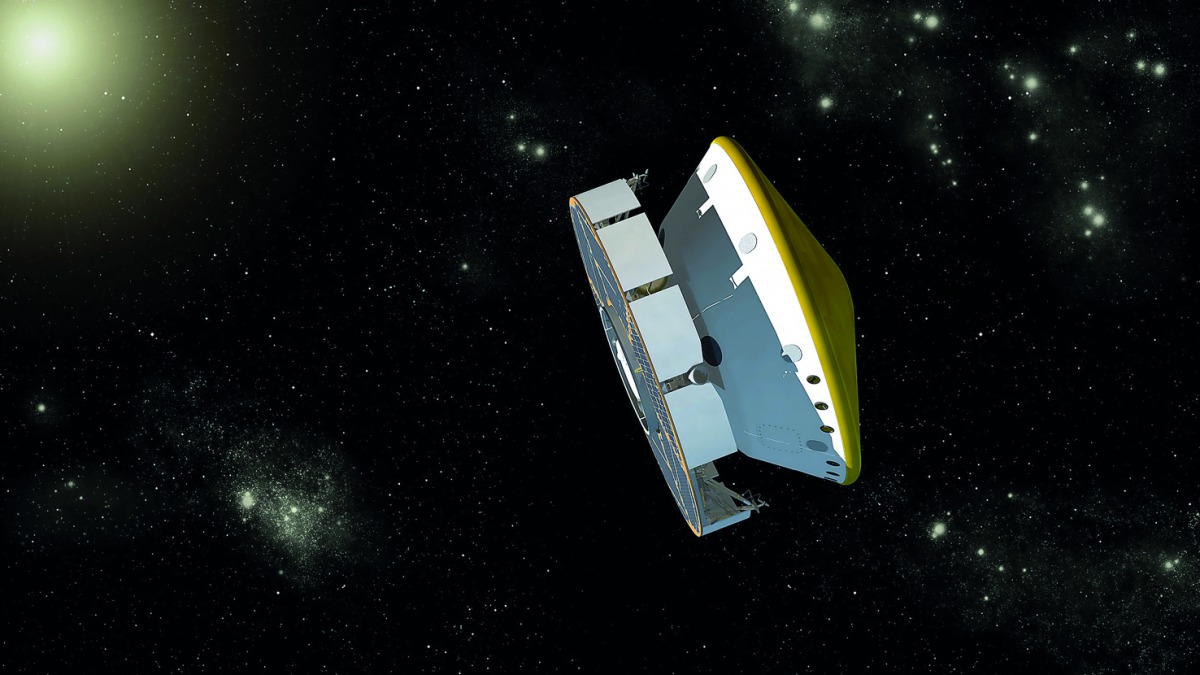
An artist’s concept of Nasa’s Mars Science Laboratory spacecraft during its cruise phase between launch and final approach to Mars in the illustration released yesterday.
WASHINGTON: A heat shield used in a Nasa spacecraft designed to send a six-wheeled rover vehicle to Mars in 2020 suffered an “unexpected” fracture during a structural test this month, causing the space agency to build a replacement, the space agency said.
“The situation will not affect the mission’s launch readiness date of July 17, 2020,” the National Aeronautics and Space Administration (Nasa) said in a statement issued recently.
The fracture occurred near the shield’s outer edge and spans the circumference of the component, Nasa added.
The $2bn mission will place the rover on Mars where it will drill in rocks and soil to look for signs of past microbial life. The mission will also look into ways to support a manned-mission to the planet.
The timing of the launch is key. In July and August of 2020 the positions of Earth and Mars are aligned in a way that will mean less power is required to reach the red planet compared to other times.
The heat shield on the Mars 2020 spacecraft would reach temperatures of about 3,800 degrees Fahrenheit (2,100 Celsius) as it speeds at more than 19,550 kph towards the Mars surface, Nasa said.
About 8kms above the surface of Mars, the heat shield is designed to pop off the spacecraft as it is slowed by parachutes. From the craft, a so-called “sky crane” will be deployed that will lower the tethered rover onto the surface.
The structure was originally tested in 2008 and was one of two heat shields manufactured in support of the Mars Science Laboratory mission, which successfully landed the Curiosity rover on Mars in August 2012.
The current heat shield will be repaired in order to support the pre-launch spacecraft testing while a new heat shield structure is readied for flight over the next year, Nasa said.
The Mars 2020 rover is designed to seek signs of habitable conditions on Mars in the ancient past, and also search for signs of past microbial life.