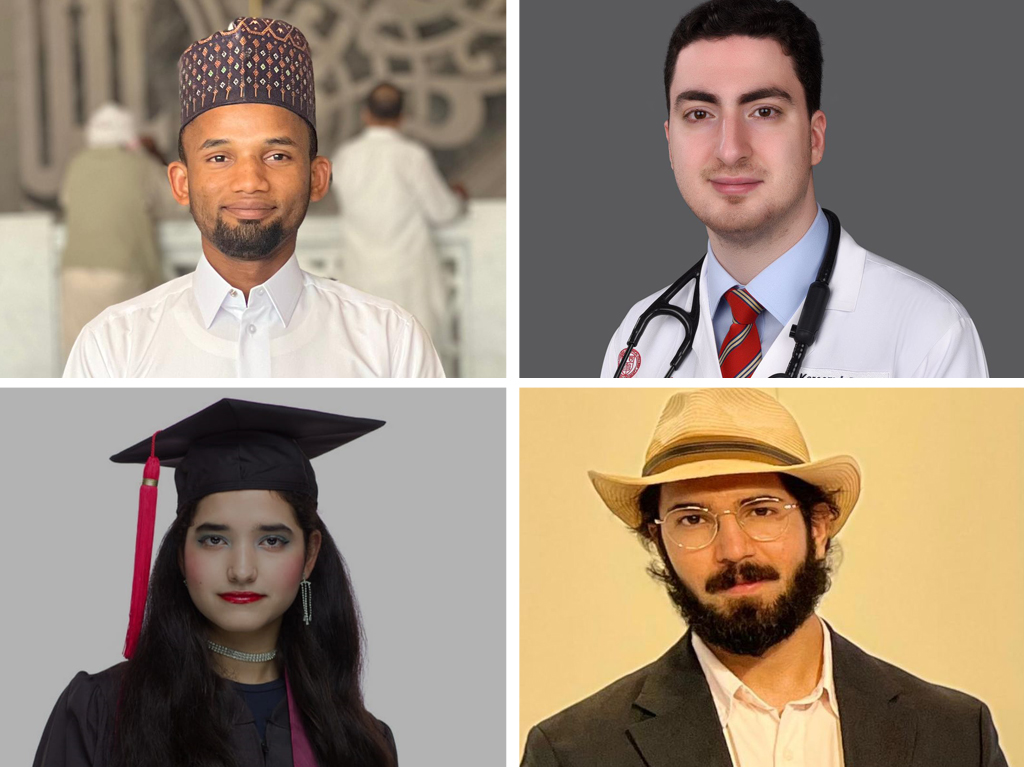
Clockwise from top left: Usama Aliyu, Kareem Fanous, Ameer Shamyl Ahmed and Aya Abdelhamid
Qatar Foundation students reflect on the support they received during times of uncertainty
Doha, Qatar: When regional tensions escalated, students across Qatar Foundation’s Education City found themselves navigating uncertainty, disruption, and concern. For many students, the greatest difficulty came in the early days, when the future felt unclear and routines suddenly shifted.
During this intense period, Qatar Foundation (QF) ensured to safeguard its community through clear communication and swift coordination, while ensuring academic continuity during a challenging period.
Usama Aliyu, a PhD candidate in Genomics and Precision Medicine at QF’s Hamad Bin Khalifa University (HBKU), described the initial moments as “deeply unsettling”. He said: “The biggest challenge was the initial panic and not knowing what might happen next and how it could affect our academic life and safety.”
Beyond personal concerns, Aliyu also carried responsibilities as a student leader, acting as a link between students and administrators.
“I was supporting others, answering questions, and providing reassurance, often without having complete information myself. Being the bridge between students and management during such a tense period required composure, clarity, and emotional resilience.”
With families of students watching events unfold from afar, Aliyu feels that studying abroad during a time of regional tension carries additional emotional responsibility.
“My main concern was reassuring my family that we were safe, despite what they were seeing on international news. At times, that meant being mindful of how much detail to share to avoid increasing their anxiety. Balancing their concerns while staying focused on my studies required emotional strength, but the strong support system at QF made that much easier.”
For Kareem Fanous, a final-year medical student at Weill Cornell Medicine–Qatar, QF partner university, the uncertainty came at a particularly critical moment.
“Being so close to graduation, there was constant concern about how the situation would evolve and impact the remainder of the semester,” he said.
Fanous explains that logistical changes compounded these concerns. “Rapid transitions to online learning and multiple evacuations from student housing highlighted how unpredictable the situation was.”
Despite these challenges, Fanous emphasized that Qatar Foundation’s response played a significant role in reducing anxiety and maintaining order, describing clear and frequent communication as “a recurring theme across student experiences”.
“Regular updates helped keep uncertainty at bay. And communication made the overall response feel organized and reliable. To feel supported is to know that safety and well-being are genuinely prioritized,” he said.
Ameer Shamyl Ahmed, a Pakistani student completing his Master’s degree in Islam and Global Affairs at HBKU’s College of Islamic Studies this year, shared that the support he received went far beyond operational measures.
Having lived in Qatar for two years, he noted that Student Housing at Education City demonstrated exceptional flexibility and care throughout the period.
“The implementation of emergency contingency plans allowed students to make informed choices about whether to remain on campus or relocate,” he said.
He also emphasized the value of community‑building efforts. “Initiatives such as creating gaming areas and organizing small gatherings, including group Suhour and Iftar during Ramadan, offered moments of comfort and normalcy during a challenging time.”
A similar sense of disruption was felt by Aya Abdelhamid, an Information Systems student at Carnegie Mellon University in Qatar and a Class of 2026 graduate. Born and raised in Qatar, Abdelhamid had spent most of her life immersed in a vibrant campus and social environment.
When learning suddenly moved online, the adjustment was difficult.
Abdelhamid echoed QF’s consistent presence throughout the transition. “What I really appreciated was how responsive QF was,” she said. “It never felt like we were left to figure things out on our own.”
She highlighted how academic access remained uninterrupted, with professors staying engaged and materials readily available online.
“Even beyond academics, just knowing there were support systems in place made a big difference during such an uncertain time,” she added.
For Abdelhamid, feeling supported went beyond academics. “To me, it meant feeling seen. Not just as a student, but as a person going through a difficult situation,” she said.
“Knowing that people were actively trying to make this easier gave me a sense of stability and care.”