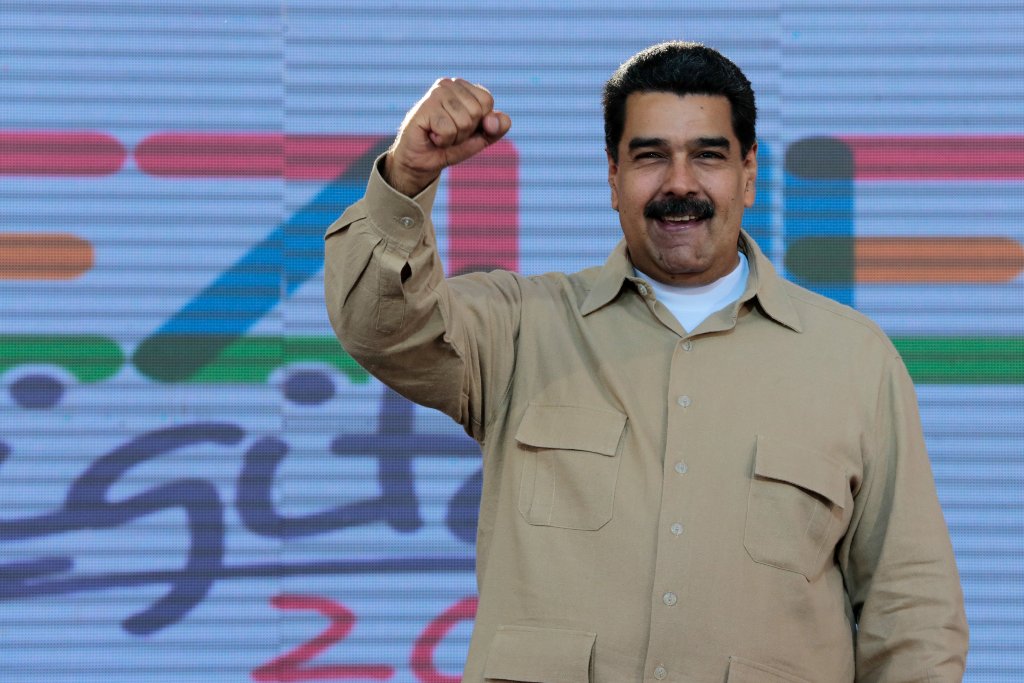
Venezuela's President Nicolas Maduro gestures during a meeting with supporters in Caracas, Venezuela March 31, 2017. Miraflores Palace
Caracas: Venezuelan President Nicolas Maduro faced the strongest criticism ever from within his own camp Friday as his attorney general condemned recent court rulings that consolidated the socialist president's power.
Attorney General Luisa Ortega broke ranks with the president live on state TV to denounce two Supreme Court rulings this week that effectively dissolved the opposition-majority legislature and revoked lawmakers' immunity from prosecution.
Ortega is seen as staunchly loyal to the socialist "revolution" launched in Venezuela by Maduro's mentor Hugo Chavez in 1999.
But with Venezuela -- once a booming oil producer, now mired in food shortages, political chaos and an epidemic of violent crime -- Ortega fired off the most severe public criticism yet from a high-ranking "Chavista" official.
The Supreme Court rulings are a "rupture of constitutional order," she said at an event to mark the release of her 2016 annual report.
It was a shocking departure from script for Venezuelan state TV, where the programming is strictly pro-government and Maduro often delivers long speeches or shows off his salsa dancing.
"It is my duty to inform my country of my deep concern over these events," said Ortega, drawing a long salvo of applause from the crowd.
She delivered her remarks while brandishing a copy of what she referred to as "Chavez's constitution," adopted the year the late leftist firebrand came to power.
Crisis talks, protests
The criticism came two days after the Supreme Court, which has staunchly backed Maduro through an economic and political crisis, assumed the powers of the National Assembly.
The legislature was the only pillar of power in Venezuela that was not under the control of the president and his allies.
The legislative speaker, Julio Borges, called on the military and other institutions to follow Ortega's example and speak up against Maduro.
"Now is the time to obey the orders of your conscience," he said.
Street protests erupted for a second day Friday in Caracas. Students marched on the Supreme Court, where they scuffled with soldiers.
Protesters also blocked streets in the working-class Petare neighborhood, and opposition lawmakers clashed with Maduro supporters downtown.
Two students and a journalist were arrested, activists said.
International condemnation continued pouring in, adding to the criticism already voiced by the United States, the European Union, Spain, Germany and a host of Latin American countries.
Colombia recalled its ambassador to Venezuela, joining Chile and Peru.
On Friday the six members of the Union of South American Nations in a statement called "for the swift restoration of democratic order in the country for the good of the whole Venezuelan people."
Many have said the Supreme Court's move amounts to a coup.
Venezuela rejected that accusation Friday, lashing out at its critics as "imperialists."
The head of the Organization of American States called for the regional group's permanent council to hold crisis talks on the situation.
South American regional bloc Mercosur -- which suspended Venezuela in December -- will also hold crisis talks Saturday, Argentina announced.
Power struggle
The opposition Democratic Unity Roundtable (MUD) won a landslide in legislative elections in December 2015.
But the court has overturned every law passed by the current legislature.
Venezuela has the world's biggest oil reserves, but the collapse in prices has sapped its revenues, prompting shortages of food, medicine and basic goods.
Maduro, who was elected to succeed Chavez in 2013, is not up for re-election until October 2018.
But his popularity has plunged amid the crisis, forcing him to fend off opposition efforts to call a referendum on removing him from power.
Protests called
Outside a supermarket in Caracas, Venezuelans were agitated at the news as they queued to buy food rations.
"If it's not a coup then it looks very like one," said mechanic Eduardo Rodriguez, a 58-year-old mechanic. "It looks very ugly to me."
The opposition has called for more street protests Saturday.
"We have to come out and defend democracy," said Sara Ramirez, 68, a building porter, waiting in line.
But others were sick of the political conflict.
"I don't support either side," said Yandry Diaz, 18, who works in a shoe shop.
"What they want is to have us in the street, fighting and killing each other so that they can hold power."