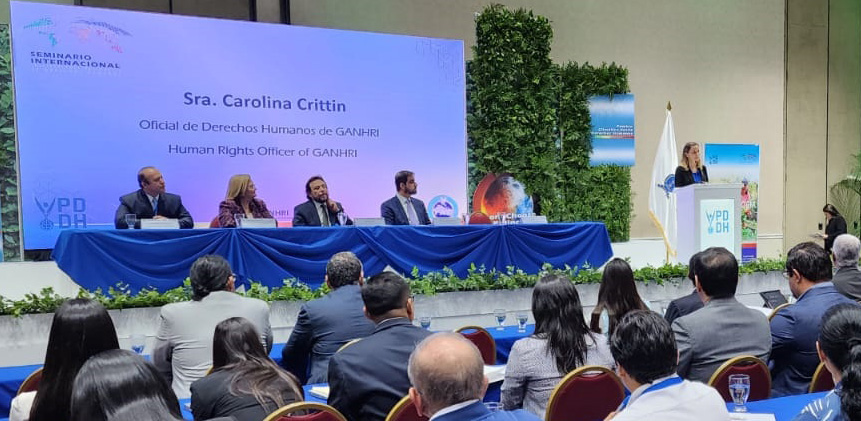
A cross section of officials and participants during the International Seminar for National Human Rights Institutions in El Salvador.
San Salvador: President of the Global Alliance of National Human Rights Institutions (GANHRI) and Chairperson of the National Human Rights Committee (NHRC) H E Maryam bint Abdullah Al Attiyah has underscored the desperate need for setting out a collaborative rights-based approach to climate change and crystallizing the increasing global demand for an international human rights instrument on climate change.
In her inaugural speech before the International Seminar for National Human Rights Institutions “Impacts of Climate change on Human Rights” hosted by the Human Rights Ombudsmans Office (PDDH) in El Salvador, Al Attiyah said such an approach must be handled through practical means, such as representing the rights of affected communities, integrating and protecting them in all relevant programmes, policies and operations to fulfill the pledge that was upheld at the center of the sustainable development plan.
She outlined that 2023 marks the midpoint for the sustainable development goals (SDGs) for 2030 which identified climate change as a major challenge in the goal 13 which is closely related to all sustainable development goals affecting people’s livelihood in each country and continent.
Al Attiyah added that climate change remained a threat to humanity, and although it impacts all countries, however, feeling its impact is mounting among communities which live in fragile and marginalized situations. She pointed out that addressing the adverse effects of climate change is a priority for the GANHRI and its members in multiple areas.
She noted that NHRIs represent a bridge that supports information exchange with their other peers at the international level, along with policy makers, civil society and other stakeholders, including the most vulnerable groups.
According to Al Attiyah, one of the major outcomes of advocacy provided by the GANHRI is the adoption of the resolution No. 51/31 by the Human Rights Council to promote human rights in the context of climate action and encourage national human rights institutions to continue strengthening their work in this regard.
She stressed the major role played by states and their core responsibility to protect all human rights defenders, adding that international human rights institutions should significantly contribute to promoting positive narratives on the critical role played by human rights defenders, protecting them and holding perpetrators of these crimes accountable.
Al Attiyah highlighted GANHRI’s efforts aimed at promoting efficiency and engagement in climate talks, pointing out that the alliance submitted a request to the United Nations Framework Convention on Climate Change (UNFCCC) last August to grant the GANHRI, NHRIs and regional networks an observer status to help the UN climate change operations capitalize on the unique expertise that can be virtually provided by national human rights institutions to discuss climate change and taking decisions.
She affirmed that the seminar is an opportunity to proceed with sharing expertise and approaches and learning from them in pursuit of addressing multiple complex challenges arising from climate change.