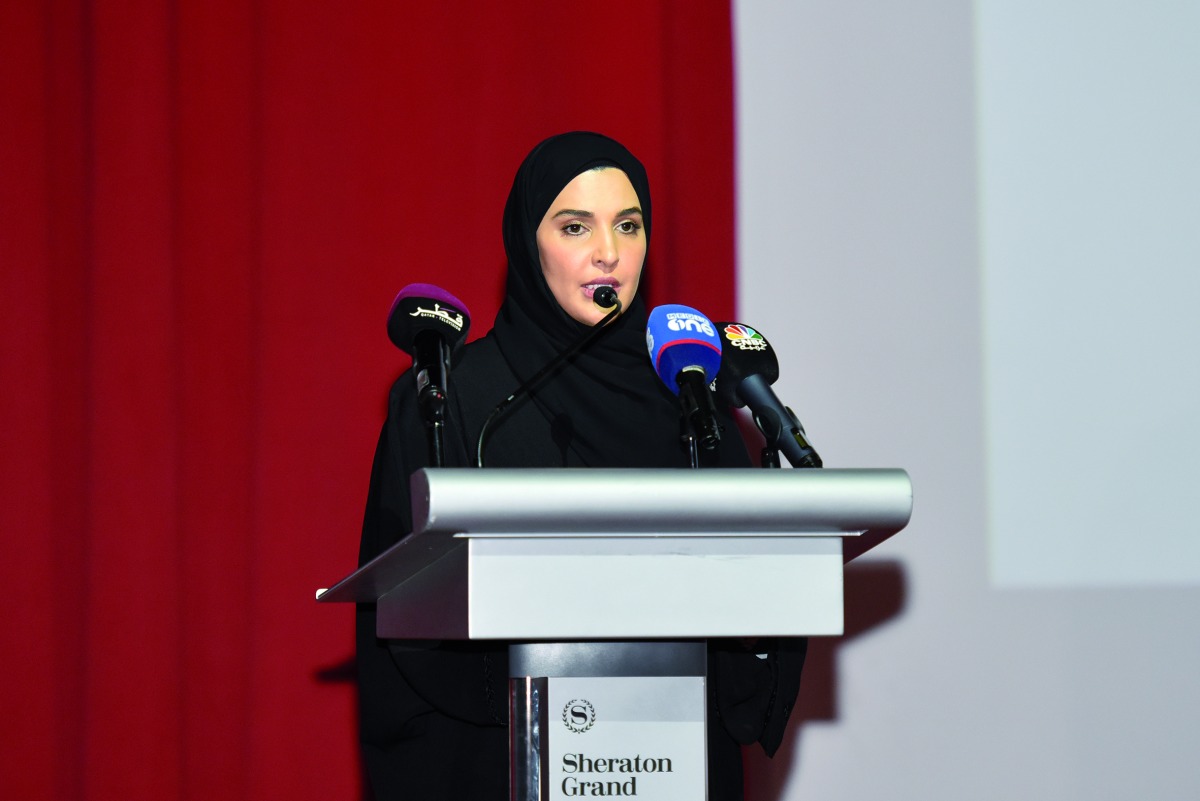
Chairperson of the National Human Rights Committee (NHRC) and President of the Global Alliance of National Human Rights Institutions (GANHRI) H E Maryam bint Abdullah Al Attiyah
Doha: Chairperson of the National Human Rights Committee (NHRC) and President of the Global Alliance of National Human Rights Institutions (GANHRI) H E Maryam bint Abdullah Al Attiyah, announced the launch of an open letter to the states parties to the United Nations Framework Convention on Climate Change and the Paris Agreement calling on them to promote climate action in line with their human rights obligations ahead of the 27th session of the Conference of the Parties.
This came during a virtual seminar organised yesterday by GANHRI in cooperation with the Office of the High Commissioner for Human Rights and the United Nations Development Programme (UNDP) in the framework of the tripartite partnership. It was held under the title “Protecting Environmental Human Rights Defenders and Promoting Meaningful Participation in Climate Talks — The Role of National Human Rights Institutions”, with the participation of representatives of organisations, partners and national human rights institutions.
She explained that in recent years, the UN human rights system had increasingly focused on climate change issues and the right to a clean, healthy and sustainable environment, noting the creation of new mandates, such as Ian Fry, Special Rapporteur on the promotion and protection of human rights in the context of climate change, and Michael Forst, Special Rapporteur on environmental defenders under the Aarhus Convention.
The UN Human Rights Council recently recognised the role of national human rights institutions in relation to climate action in its resolution 51/31 adopted at its 51st session.
Al Attiyah also added that the national human rights institutions have played pivotal roles in dealing with climate change and protecting environmental human rights defenders, noting that the symposium will address some of the experiences and their role advising countries on climate action that put human rights at the centre of their policies
She noted that in 2020, during the Annual Conference on Human Rights and Climate Change, all NHRIs adopted an outcome statement outlining a distinct set of actions and priorities for how to implement their unique mandates and functions to promote an informed and participatory human rights mechanism to address changes. Al Attiyah said the Global Alliance works closely with regional networks of national human rights institutions, partners in the UN and civil society, and also supports the participation of NHRIs in national, regional and international processes to strengthen the human rights-based approach to climate change, which will lead to more sustainable and effective climate action and policies.
She said as part of efforts to enhance visibility and participation in climate talks, a recent application was made to the UN Framework Convention on Climate Change for observer status, so that members can bring their human rights expertise into climate change discussions and decision-making.
During its sessions, the seminar discussed the issue of "protecting environmental human rights defenders and the role of national human rights institutions in promoting a human rights-based approach to action directed to combat climate change", and the topic of "significant participation of national human rights institutions and civil society in international and national forums and platforms concerned with climate talks."
The speakers stressed that, by working under the umbrella of the Global Alliance, NHRIs from around the world succeeded in establishing the NHRIs Cluster on Climate Change, which is hosted by the Global Alliance as a unique gathering that provides 34 NHRIs from all four regions an opportunity for discussion, debate, dialogue and exchange of knowledge and experience, as well as coordination of actions and activities.