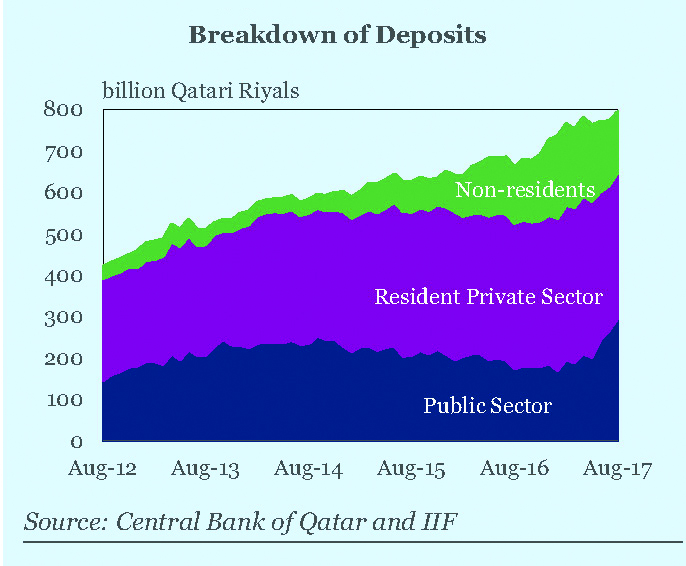
The Qatar Central Bank’s (QCB) liquidity injection into the local banks and increased public sector deposits have mitigated the impact the banks’ funding pressure in recent months. The public sector deposits in Qatari banks (estimated now at $80bn) grew by 70 percent from May to August 27, more than offsetting the decline in non-resident deposits, the Institute of International Finance (IIF) said yesterday.
The IIF, in its Emerging Market (EM) fund flow report, said non-resident deposits in Qatari banks fell from $51bn in May to $41bn in August 2017 in contrast to an estimated 60 percent increase in the first five months of 2017. Non-resident deposits in Qatar accounted for 19 percent of total bank deposits in August.
“We believe that further declines in non-resident deposits will be limited. Meanwhile, the authorities in Qatar have taken steps to boost bank liquidity”, IIF’s fund flow report noted. Non-resident capital flows to EMs are projected to rise to $1.1trillion in 2017 and $1.2trillion in 2018.
Despite the decline in non-resident deposits, Qatari banks’ total deposits still increased by 1.3 percent from May to July and the year-on-year increase in July is still very high at 12.7 percent. Growth in credit to the economy, however, has decelerated to 2.8 percent in July, year-on-year, largely due to the continued deceleration in non-hydrocarbon growth.
Resident capital outflows have remained large in the past two years despite the shift in the current account balance from a surplus of $49bn in 2014 to a deficit of $8bn in 2016. Both portfolio and other investment outflows continued to rise and public foreign assets in the form of SWFs peaked at $295bn in 2016.
Qatar’s fiscal deficits were largely financed by borrowing from the international market rather than tapping the SWF. According to IIF, seeking foreign funds in the current situation will be difficult and costly. But given the still-large size of public foreign assets, the authorities in Qatar will remain in a strong position to meet domestic funding requirements. Non-resident capital flows to EMs are projected to rise to $1.1trillion in 2017 and $1.2trillion in 2018.
Meanwhile, Reuters reported QCB sold QR1bn ($275m) of Treasury bills in a monthly auction yesterday, with yields barely changed from its previous sale.
The bank sold QR500m of three-month bills at a yield of 2.26 percent, QR350m of six-month at 2.47percent and QR150m of nine-month at 2.60 percent. Last month, QCB sold QR650m of three-month bills at 2.25 percent and QR350m of six-month at 2.49 percent.