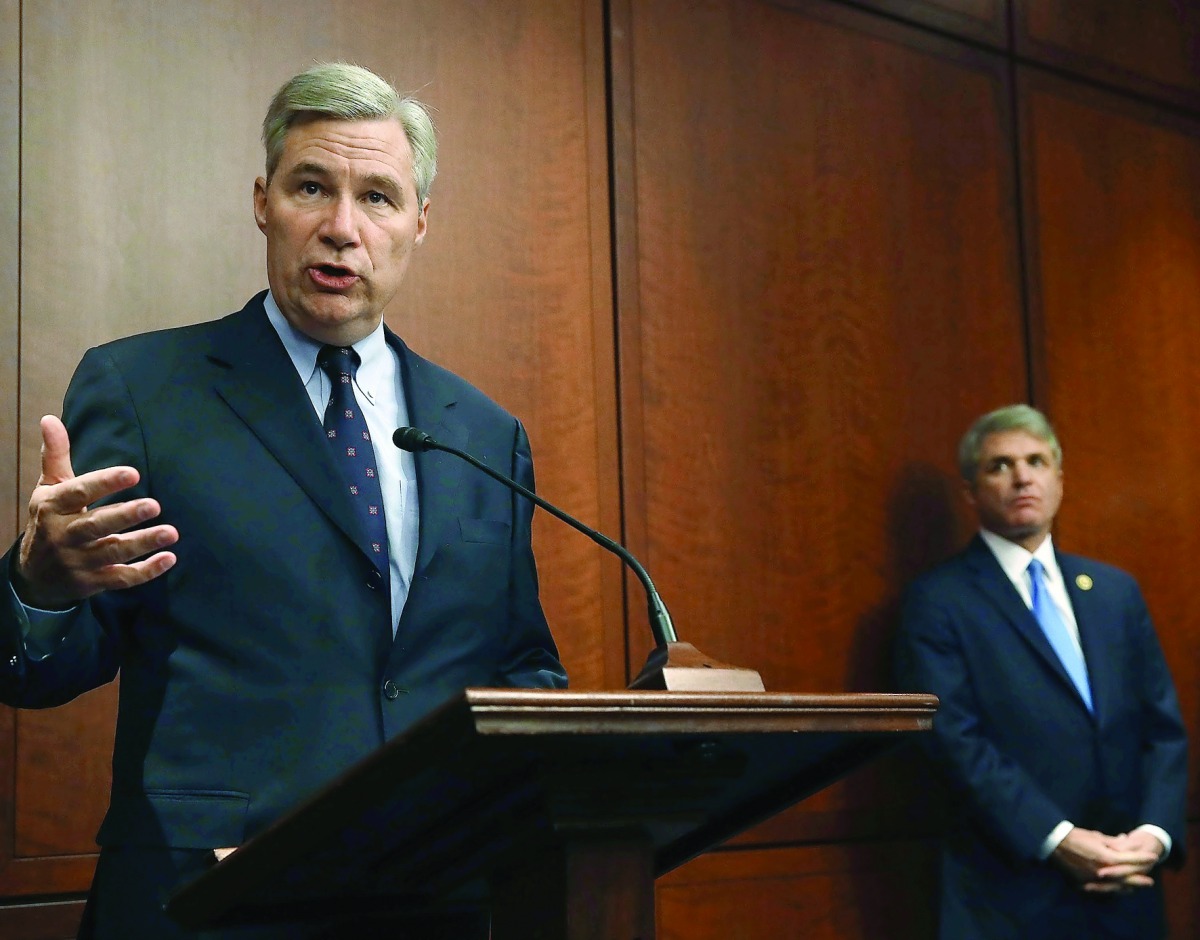
Senator Sheldon Whitehouse (left) and House Homeland Security Chairman Michael McCaul, speak about cybersecurity during news conference on Capitol Hill, in Washington, DC, yesterday.
Washington: US spy chiefs said yesterday hacking of Democratic Party computers was just one part of a multifaceted campaign by Russia to disrupt the American presidential election.
In a closely-watched Senate hearing, top intelligence officials presented a united front as they reiterated their conclusion that Moscow interfered with last year’s campaign and that its cyber-meddling poses a “major threat” to the United States—findings that President-elect Donald Trump has so far refused to accept.
“This was a multifaceted campaign. So the hacking was only one part of it, and it also entailed classical propaganda, disinformation, fake news,” Director of National Intelligence James Clapper told the Senate hearing.
While Trump continues to question evidence of Russian meddling, Clapper, National Security Agency chief Michael Rogers and Marcel Lettre, undersecretary of defence for intelligence, told the committee they are convinced that Moscow is aggressively targeting the United States in offensive cyberspace activities.
“We assess that only Russia’s senior-most officials could have authorised the recent election-focused data thefts and disclosures,” they said in a joint statement to Senate Armed Forces Committee.
“Russia is a full-scope cyber actor that poses a major threat to US government, military, diplomatic, commercial and critical infrastructure and key resource networks,” they said.
In the first public hearing dealing with Russia’s alleged interference since the allegations first came out in October, Clapper said such cyber threats are “challenging public trust and confidence in information, services and institutions.”
“Russia has clearly assumed an even more aggressive cyber posture by increasing cyber espionage operations, leaking data stolen from these operations and targeting critical infrastructure systems,” he said.
Trump will be briefed today by heads of the CIA, FBI and DNI on evidence behind their conclusion on Russia election interference. And a declassified version of a report produced for White House on the case is expected to be released next week.
Without naming Trump, Clapper said he had fielded many queries from international colleagues over recent “disparagement” of intelligence community. “Public trust and confidence in intelligence community is crucial,” he said. Asked about Assange’s credibility, Clapper said his publication of leaked materials had “put people at risk.”
The three spy chiefs also said despite having agreed in 2015 to halt its own cyber attacks on the US government and companies, China also continues such activities, albeit it at a lower level. “Beijing continues to conduct cyber espionage against the US government, our allies, and US companies,” they said.