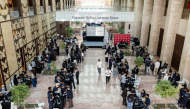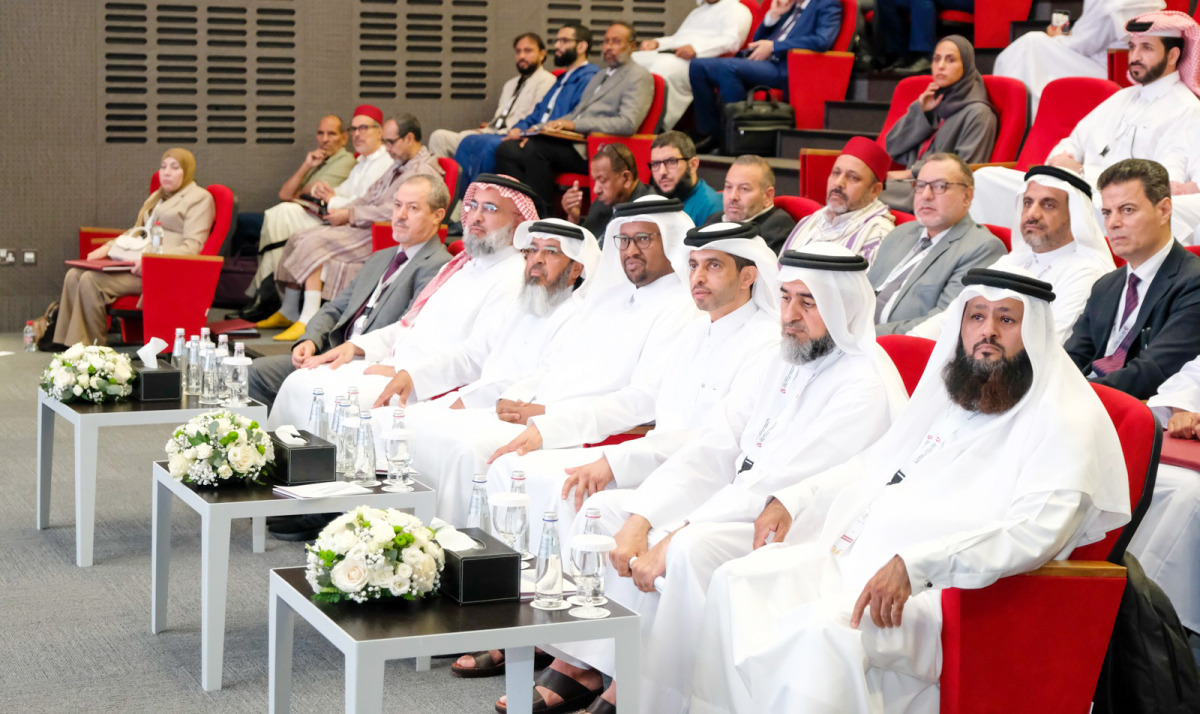
Participants during the conference.
Doha, Qatar: The second edition of the Quran and Human Knowledge Conference: Towards Sound Human Knowledge and the Book of the Ummah Writers Forum opened yesterday in Doha, bringing together researchers, academics and specialists from Qatar and abroad to examine the relationship between revelation and the human sciences.
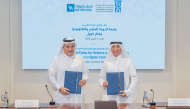
Held under the theme “It guides to that which is most upright,” the two day events reflect an institutional partnership between the Ministry of Awqaf and Islamic Affairs, represented by the Department of Islamic Research and Studies, and Qatar University, represented by the Ibn Khaldon Centre for Humanities and Social Sciences and the College of Sharia and Islamic Studies.
The conference seeks to strengthen scientific research and promote knowledge that combines Islamic scholarship with contemporary academic expertise, while addressing intellectual and knowledge challenges facing societies today.
Director of the Department of Islamic Research and Studies Sheikh Dr. Ahmed bin Mohammed bin Ghanem Al Thani, said the conference and forum reflect the ministry’s vision of strengthening the Quran’s intellectual and knowledge presence and transforming academic events into sustainable knowledge projects.
Dean of the College of Sharia and Islamic Studies at Qatar University Dr. Ibrahim Abdullah Al Ansari, praised the partnership, describing it as a leading national model for integrating institutional and academic efforts in support of research and knowledge production.
He stressed that bringing together scholarly efforts around the Quran and drawing on its guidance across different fields of knowledge represents an important form of impactful academic work. He noted that the Quran has historically served as a foundation of Islamic civilisation and inspired scholars in developing scientific and intellectual achievements across various fields.
Director of Ibn Khaldon Centre for Humanities & Social Sciences Prof Badrane Benlahcene, said the conference is based on the conviction that the Quran is a source of guidance and a knowledge reference capable of shaping perspectives, directing intellectual inquiry and reconnecting the sciences with their ethical, human and civilisational purposes.
The conference received nearly 2,000 research abstracts across its four main themes. Following several stages of academic review, 58 abstracts advanced to the full-paper stage, while 46 papers reached the scientific evaluation stage. Ultimately, 17 research papers by scholars from nine countries were selected for the final programme.
The participating countries are Qatar, Morocco, Algeria, Egypt, Türkiye, Yemen, Oman, Iraq and Sudan, highlighting the conference’s growing international reach and the increasing academic interest in the relationship between revelation and the human sciences.
The conference focuses on four main areas: the Quran and philosophy, the Quran and linguistics, the Quran and law, and the Quran and politics. Through these themes, it seeks to expand interdisciplinary dialogue and explore how Quranic perspectives can contribute to addressing contemporary intellectual and human issues.