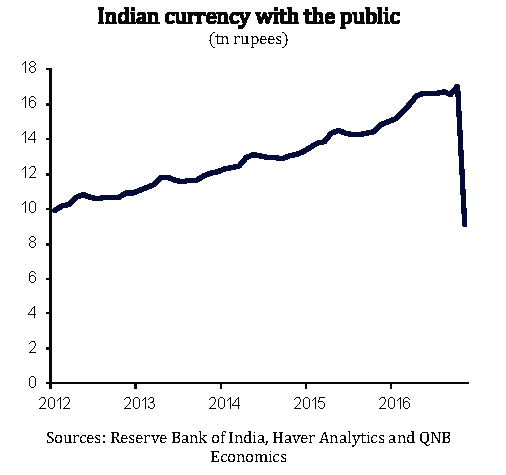
India’s demonetisation-triggered cash shortage has disrupted the country’s economic activity, and is estimated to shave around 1 percentage point off growth in the fiscal year ending March 31, 2017. But as the process of replacing old notes with new ones is completed and the impact of the cash crunch dissipates, growth is likely to rebound in the 2017/18 fiscal year, QNB noted in its weekly economic commentary yesterday.
The Indian government’s so-called “demonetisation” policy led to an immediate removal of 86 percent of cash from circulation. Holders of these notes had until the end of 2016 to replace them with deposits at banks. The amount of deposits allowed to be withdrawn in the form of cash has been restricted as the central bank has faced logistical constraints replacing the old notes with new ones.
Three reasons were behind the government’s decision to take such an extraordinary measure. First, the government aimed to reduce reliance on cash in transactions. India stands out as one of the most cash-dependent large economies. Cash in circulation amounts to 12 percent of GDP compared to an average of only 7 percent in other emerging markets.
The government’s attempt to reduce cash-dependency is related to its attempts to deepen the banking sector by enhancing its liquidity and increasing digitalisation. Second, the government wanted to eliminate the black market, which is heavily cash-based and accounts for 23 percent of GDP according to the World Bank.
This would boost its revenue by increasing the tax base and reducing tax evasion. Switching away from cash towards electronic means of payments, which allow recording of transactions, could help towards that end. Third, the government wanted to tackle the counterfeiting of Indian notes.
It remains to be seen whether the government will succeed in achieving its aims, but the cash crunch is expected to weigh on economic activity. Consumers hoard whatever cash they have and postpone any non-essential purchases. People also lose time queuing at bank tills and cash machines to deposit old notes or withdraw cash, reducing their productivity.
The shortage of cash has disrupted production, as firms struggle to pay for production inputs. And although demonetisation has led to a significant increase in deposits, improving liquidity in the banking system and reducing interest rates, this effect has not been large enough to offset the drag from cash shortages. The latest activity data confirm the slowdown in the economy. Composite Purchasing Managers Index (PMI) survey hit a 32-month low in November. Auto sales showed a sharp contraction. Other consumer durables were also hit by the demonetisation experiment. As a result, growth is expected to slow by 1 percentage point in the fiscal year 2016/17.
In addition, inflation has slowed to a near-multi year low of 3.6 percent in November as economic activity weakened.
How long will the economic slowdown persist for? The answer depends on how fast the authorities are able to replace the old notes with new ones to ease the cash squeeze; the extent of substitution of cash into other methods of payments; and the degree of the formalisation of the black economy, which would allow the government to increase its revenue and provide a fiscal stimulus. Based on these factors, QNB expects growth to rebound in the fiscal year 2017/18 as the central bank prints sufficient notes to restore the pre-demonetisation stock of currency and as people partially switch to non-cash means of exchange.