Personal interviews were also conducted with teachers, during which 272 teachers were interviewed, and only 182 teachers from various specializations were granted approval
Published: 07 Jan 2026 - 08:23 pm | Last Updated: 11 Jan 2026 - 08:54 pm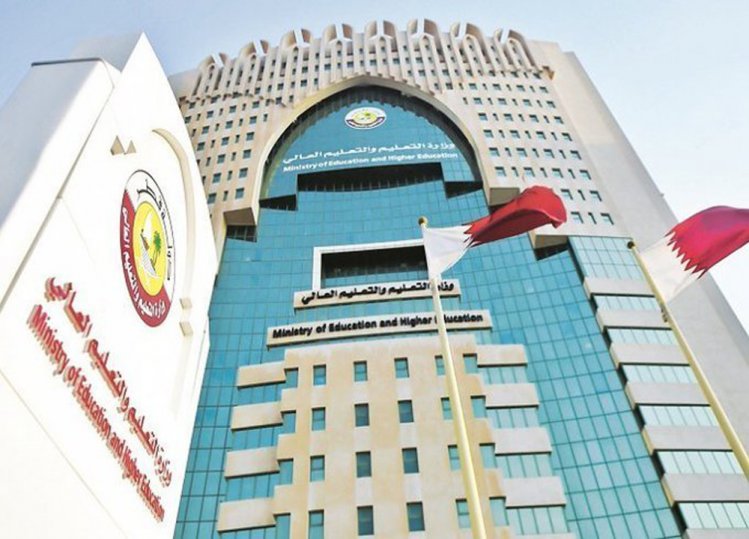
UPDATE:
Doha, Qatar: The Ministry of Education and Higher Education (MoEHE) revealed further details regarding the first official identification card for licensed private tutoring teachers.
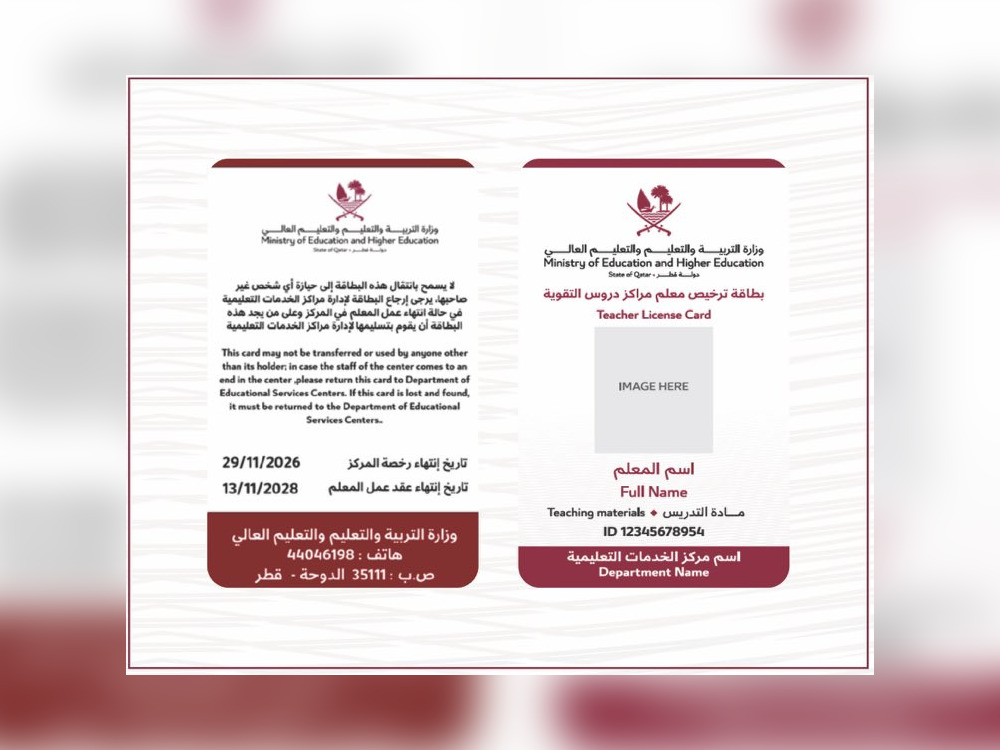
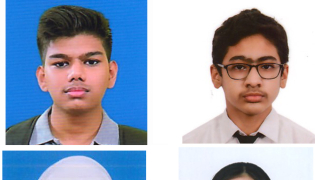
In a post on social media, the Ministry shared a graphic showing the proposed front side and back side of the card, with the front side featuring the teacher’s name, teaching materials, ID, and department name.
The back of the card features both the department license’s and the teacher’s work contract’s expiry date, as well as further details as shown in the image provided above.
-------------------
Doha, Qatar: As part of its ongoing efforts to regulate the private tutoring sector and enhance the quality of educational services provided to students, the Ministry of Education and Higher Education has announced the issuance of the first official identification card for licensed private tutoring teachers.
This step comes within a package of regulatory measures aimed at organizing the activity and protecting the rights of students and parents.
The Ministry explained that the identification card is an official document proving that the teacher has obtained the approved license. It will be used as an authorized means of identification when providing private tutoring, whether in licensed educational centers or in homes, thereby reinforcing compliant practices and enhancing transparency in this supportive educational sector.
The issuance of the card serves several regulatory and educational objectives, most notably ensuring engagement only with licensed teachers who meet approved professional and academic requirements, strengthening parents’ and students’ confidence in private tutoring services, curbing unregulated practices and random lessons conducted outside the legal framework, and enabling regulatory authorities to swiftly verify the legal status of private tutoring teachers.
The Ministry expects that the implementation of the identification card system will bring about a qualitative shift in the organization of private tutoring by tightening procedures, limiting the provision of services to licensed and approved frameworks, raising teachers’ professional and ethical commitment, and reducing complaints related to unqualified or unlicensed teachers.
The Ministry affirmed that dealing with private tutoring teachers will be limited to those who hold both a valid license and the approved identification card, noting that this step aligns with its ongoing approach to enhancing the quality of education, protecting beneficiaries, and regulating supportive educational activities within clear legal frameworks.
In this context, Iman Ali Al-Nuaimi, Director of the Educational Services Centers Department, stated: “The issuance of identification cards for licensed teachers at private tutoring centers complements previous stages that included verifying academic qualifications, professional experience, personal residency status, and employment contracts, in order to ensure that teachers work properly within tutoring centers.
Personal interviews were also conducted with teachers, during which 272 teachers were interviewed, and only 182 teachers from various specializations were granted approval.
Each center was given a one-month grace period to rectify the status of the remaining teachers before granting them a teacher’s license at the center. This is intended to ensure the quality of educational services provided to students and to build parents’ trust when dealing with private tutoring center teachers.”
This measure reflects the Ministry of Education and Higher Education’s commitment to developing the supporting education system and aligning it with the highest standards of quality and governance, in support of the goals of Qatar National Vision 2030 to build a knowledge-based society, enhance human capital, and ensure high-quality education that meets the aspirations of students and parents and contributes to the country’s sustainable development.