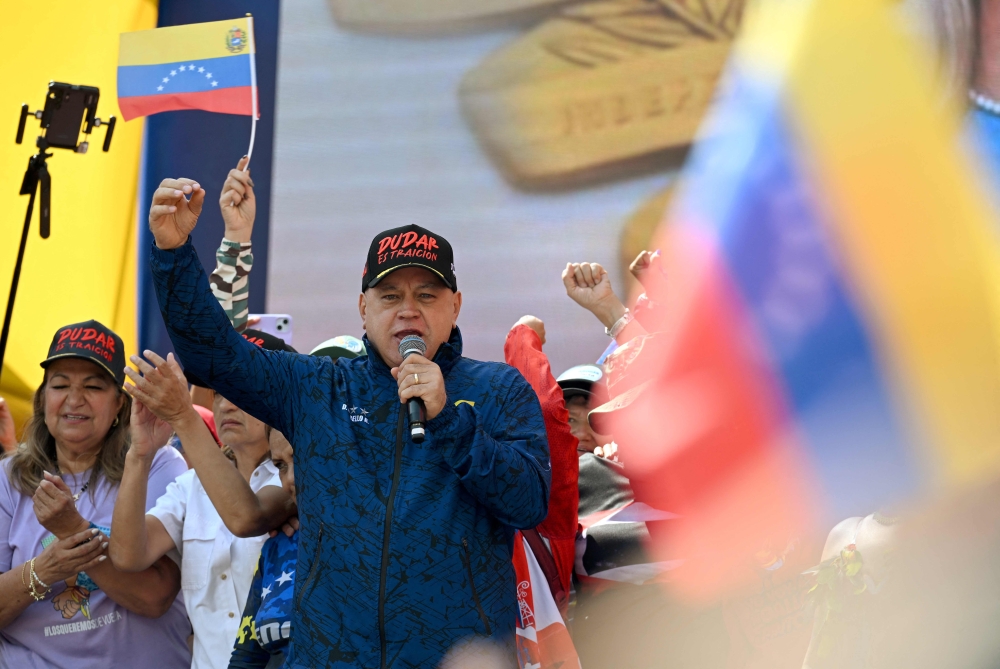
Venezuela's Minister of Interior Diosdado Cabello delivers a speech in support of ousted Venezuela's President Nicolas Maduro and his wife Cilia Flores in Caracas on January 6, 2026. (Photo by Ronaldo Schemidt / AFP)
Caracas: Few names in Venezuela conjure as much fear and reverence as Diosdado Cabello -- the man that Washington is offering $25 million to capture.
Loathed by opponents and cheered by pro-government "Chavistas," fast-talking with a wicked sense of humor, the former army captain has loomed over public life in the Caribbean nation for more than 20 years.
Now that US forces have removed his old boss Nicolas Maduro as president and put him on trial, Venezuelans are watching Cabello, the man widely considered Venezuela's second-most powerful figure.
After Maduro was deposed, he voiced defiance on behalf of the leftist government in the face of US pressure.
"The unity of the revolutionary force is more than guaranteed," he said.
Street militia boss
Several times a minister and secretary-general of the ruling United Socialist Party, Cabello is perhaps best known for setting up the feared "colectivos," a rifle-wielding, motorbike-riding militia that intimidates opponents.
"The government has not much control over them," said Brian Naranjo, a former US diplomat who met Cabello in the late 1990s.
He branded the colectivos "ideologically committed thugs and goons that can be deployed on the street to maintain order" -- though their supporters say they prevent crime.
Cabello's face is well known from his television show, "Hitting With A Mallet."
Cabello fills the show with edgy jokes about opposition figures, such as its one-time figurehead Juan Guaido -- "that rat" -- and current opposition leader Maria Corina Machado, whom he compared with a mythical Venezuelan bogeywoman, La Sayona.
"When the bogeywoman sees her, the bogeywoman starts crying," he cracked.
Coup comrade
Cabello was born on April 15, 1963, in El Furrial, then a mostly rural community in eastern Monagas state. He is married with three children.
After graduating from Venezuela's military academy, he joined the army, where he met Hugo Chavez, the future leader of the socialist "Bolivarian revolution."
He joined Chavez in a 1992 coup attempt to overthrow President Carlos Andres Perez.
He was imprisoned for that until being pardoned in 1994, along with Chavez and other officers involved in the uprising.
Once free, Cabello helped Chavez in the campaign that led to his presidential victory in 1998 and entered his administration the following year.
His critics accuse him of having amassed a vast fortune through corruption and front companies.
Chavez appointee
Cabello served briefly as acting president following a 2002 coup that briefly deposed Chavez, Maduro's predecessor.
"Commander Chavez appointed me interior and justice minister amidst all the mayhem," Cabello said in 2024.
"At that time, with the people beside us, we prevailed."
Cabello was reappointed interior minister in August 2024, giving him control of the security apparatus and intelligence services.
"He was brought back in by Maduro, after internal exile from the inner circle," said Naranjo.
Under Cabello, more than 2,000 people were detained during protests at Maduro's declaration of victory in that year's election, which was branded a fix by the United States and several of its allies.
Tensions in new government
With Maduro, "Cabello has been in and out of favour" over the years, said Naranjo.
In a murky political world, Cabello is rumored to be at odds with Maduro's successor Delcy Rodriguez and her powerful brother Jorge, leader of parliament.
Observers warn that tensions between the Rodriguez pair, Cabello and Defense Minister Vladimir Padrino Lopez threaten the stability of the current interim leadership.
"Diosdado Cabello has a lot of informal control, Vladimir Padrino has the formal control," said David Smilde, a US academic specializing in Venezuela at Tulane University.
"At any time they could turn on her... on the other hand, she is in a position that she could remove one of them."
Internal exile
Chavez passed over Cabello in naming Maduro as his successor for president.
"Before Chavez died, there was a battle between Nicolas Maduro and Diosdado Cabello," but the two eventually forged a unified front for stability, said Smilde.
Cabello clung onto his position of influence through the recent years of economic sanctions and international pressure, not least from US President Donald Trump.
The United States has posted a $25-million reward for his capture -- accusing him of drug trafficking and terrorism alongside Maduro.