
DOHA: The Trans-Pacific Partnership (TPP) has the potential to support global trade growth by reducing protectionism, revitalising global supply chains and setting the stage for further regional agreements, QNB’s weekly economic commentary noted.
The TPP is a regional trade agreement among 12 countries that account for 26 percent of world trade and 37 percent of global GDP. According to QNB research note, world trade has been sluggish in 2012-15, growing by an average of 3.2 percent a year compared with 6.2 percent in the previous 20 years. This is a concern as trade has huge benefits for the global economy. It supports a more efficient allocation of resources between countries that have diverse comparative advantages and encourages the spread of technology and know-how. The slowdown in world trade is being driven by a combination of weaker demand, changing global supply chains as the US and China onshore more manufacturing, and rising protectionism.
Protectionism has increased since the global financial crisis. The WTO has warned of “creeping protectionism” as governments have implemented new trade restrictions. The WTO has had little success recently in advancing a new global trade agreement to remove tariffs and other barriers to trade. The current round of the WTO talks, the Doha Round, has been ongoing since 2001, but is stalling as developing and developed nations have failed to resolve conflicts. With little progress being made on a comprehensive global trade agreement within the WTO, a series of regional and bilateral trade agreements, such as the TPP, are currently being negotiated outside the WTO which could help reverse the protectionist slant by reducing barriers to trade.
The TPP should also encourage more offshoring of production, revitalising global supply chains, benefitting global consumers through lower prices and making member countries’ producers more competitive. For example, clothes manufactured in Vietnam and exported to Australia receive their inputs from Malaysia (buttons) and Singapore (fabric) —both TPP members. Tariffs are currently applicable on all the inputs as well as the final exported product. Therefore, the removal of tariffs through TPP could reduce the cost of the product in Australia.
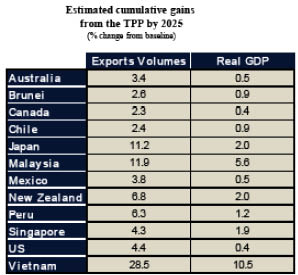
The greatest gains would be in emerging markets, such as Vietnam. Meanwhile, the benefits for an advanced economy such as the US would be less dramatic as tariffs are already low and the economies of the other TPP members are small in comparison to the US.
The benefits will take time to realise. The TPP still needs to be approved by national parliaments, which is unlikely to take place until 2017 at the earliest, with significant risks of failure or delays. Additionally, many of the changes required by the TPP will only be implemented gradually over the next ten years, particularly in areas that face high tariffs. Therefore, although the TPP could significantly revitalise global trade, it will take time to realise its full potential.
The Peninsula