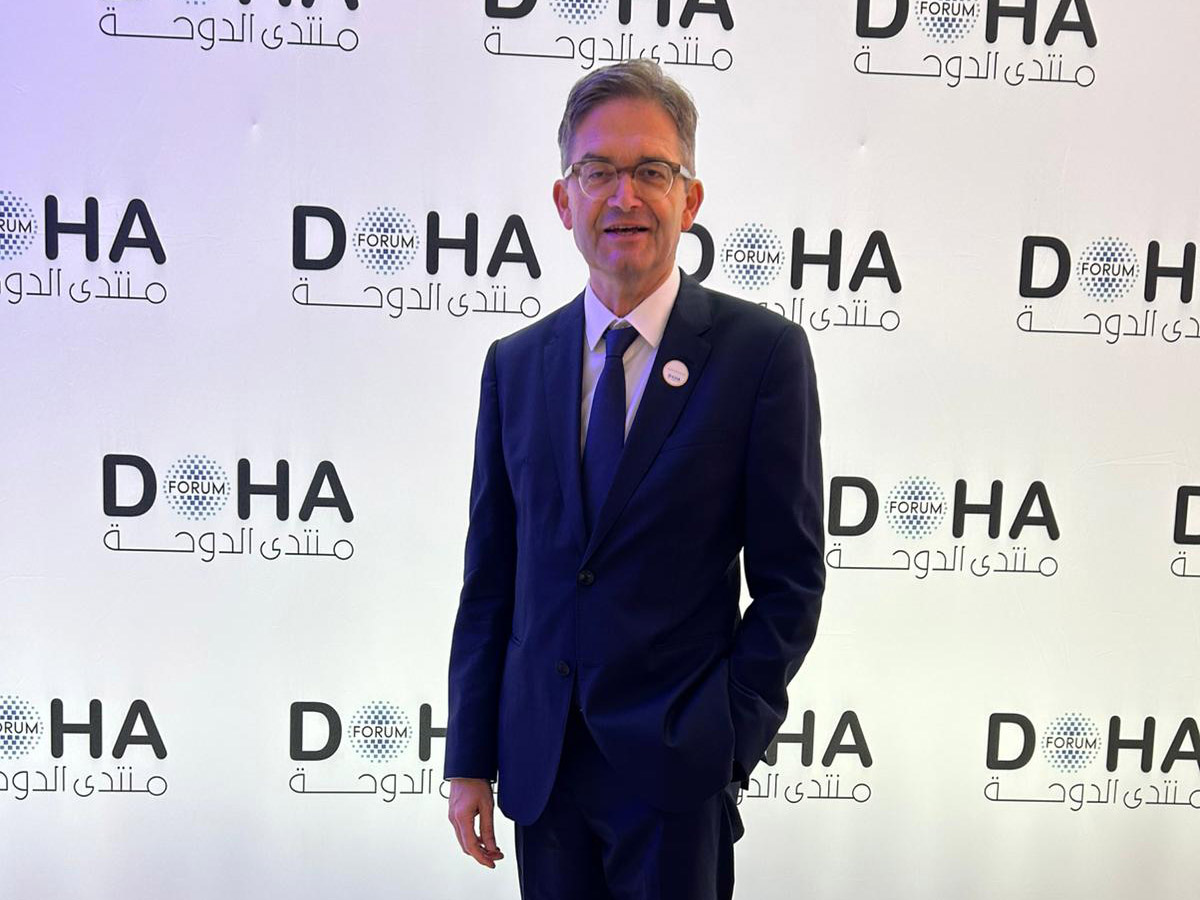
Germany’s Ambassador to Qatar H E Oliver Owcza
Doha, Qatar: Germany’s Ambassador to Qatar H E Oliver Owcza has hailed Qatar’s growing diplomatic influence and reaffirmed Berlin’s commitment to strengthening political, economic and cultural ties with Doha.
Speaking to The Peninsula on the sidelines of the Doha Forum 2025, the envoy outlined areas of expanding cooperation ranging from energy transition and trade to education and multilateral diplomacy.
Ambassador Owcza commended Qatar’s “remarkable” regional leadership following what he described as “unacceptable attacks on Qatari soil earlier this year,” noting that Doha’s swift diplomatic mobilisation—from the Arab League to the Security Council—demonstrated its capacity to unite key actors in moments of crisis. Germany, he said, strongly supported these efforts.
He stressed that Germany believes sustainable solutions to regional conflicts must emerge from within the region.
“The Doha Forum brings together influential actors in challenging times,” he said, adding that Qatar’s role as a dialogue facilitator aligns closely with Germany’s foreign policy objectives.
On energy cooperation, Ambassador Owcza highlighted the evolution of the German-Qatari partnership, especially as Germany steers toward a fossil-free future.
“We are an energy-consuming country; Qatar is an energy-producing country,” he said. Germany has already achieved 59 percent renewable electricity generation, driven largely by wind power, but continues to require LNG during its transition.
“The partnership must not be endless,” he said. “That is why it includes not only LNG procurement but also a broader exchange on future energy technologies.” He pointed to the climate talks launched in Doha as an example of growing collaboration in renewables and sustainability ahead of Qatar National Vision 2030.
The ambassador said both sides now aim to move “beyond pure trade” toward strategic joint ventures.
He revealed that recent high-level economic discussions showed promising interest, including in the security sector, with German industry prepared to deepen engagement.
Germany operates one officially recognised German school in Qatar, alongside a partnership school, collectively serving around 400 students. Graduates earn a German International Baccalaureate, qualifying them directly for German universities. Owcza also emphasised Germany’s efforts to welcome skilled professionals, regardless of nationality.
“Simplified opportunity visas are now available for applicants with strong vocational training and work experience,” Ambassador Owcza said.
On the possibility of German universities establishing campuses in Qatar, he said discussions continue but noted that nonprofit institutions face limited commercial incentive. On Gaza, the envoy expressed deep appreciation for Qatar’s pivotal mediation efforts, including its role in securing the release of hostages, among them German dual nationals.
Owcza said the two countries’ diplomatic efforts are complementary—Qatar’s mediation and Germany’s push for humanitarian access and respect for ceasefire parameters. To German companies eyeing Gulf expansion, the ambassador described Qatar as a highly welcoming market boasting world-class logistics, service standards and quality of life.
Conversely, he reiterated that Germany remains a prime destination for Qatari investors, offering political stability, a strong industrial base and a central location in Europe.
As the Doha Forum continues to champion multilateral dialogue, Ambassador Owcza said Germany values Qatar’s active defence of the rules-based international order and looks forward to further cooperation in addressing global challenges.