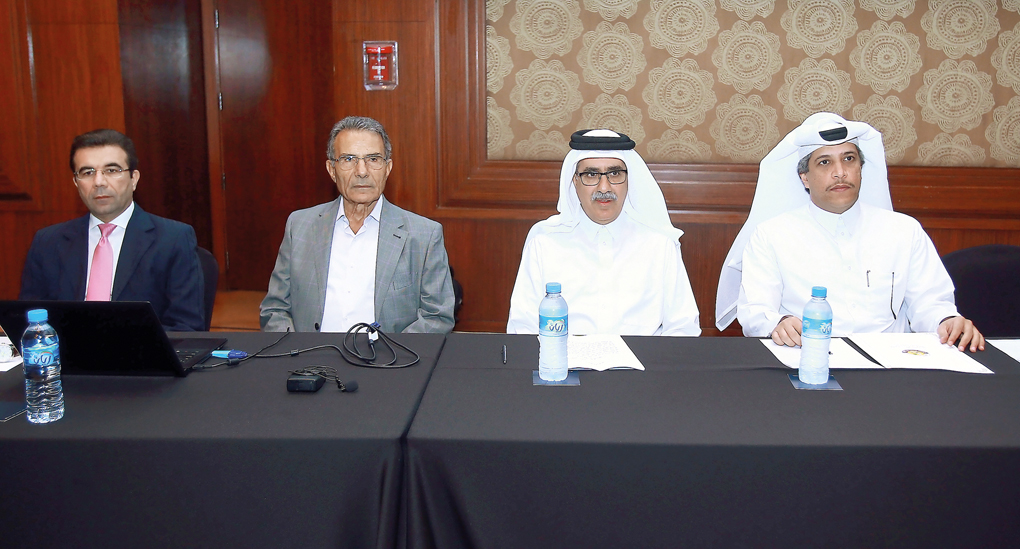
Ahmed Mohammed Al Shaabi (second right), Executive Director of the Common Services Sector at QCB, and Bahij Naji Al Khatib (second left), Director of the Training Department of the Union of Arab Banks, along with other officials, discussing the provisions
Qatar Central Bank (QCB) will be one of the first in the region to implement the accounting provisions in accordance with International Financial Reporting Standards (IFRS 9) from the next financial year.
IFRS 9 is a revised financial reporting practice replacing the earlier IFRS. It was promulgated by the International Accounting Standards Board (IASB), a US-based non-profit organisation whose primary purpose is to establish and improve generally accepted accounting principles. After the 2008 financial crisis, the IASB decided to revise their accounting standards for financial instruments to address perceived deficiencies which were believed to have contributed to the magnitude of the crisis.
QCB has been the regional leader in terms of complying with international banking norms, practicing and promoting one of the best regulatory framework by adopting modern standards.
QCB, in association with the Union of Arab Banks (UAB), yesterday opened a three-day workshop training programme on the regulatory treatment of accounting provisions in accordance with IFRS 9.
Ahmed Mohammed Al Shaabi, Executive Director of the Common Services Sector at QCB, in his speech on behalf of the Governor of the QCB, H E Sheikh Abdullah bin Saud Al Thani, stressed that the QCB has been the regional leader in issuing operational guidelines for banks operating in Qatar to adopt this standard from the beginning of 2018.”
The workshop discussed the proposed policy by the Basel Committee on Banking Supervision on the regulatory treatment of accounting provisions and the reflection of these provisions on the regulatory capital. It will also highlight the most important practical considerations in the application of IFRS 9.
Al Shaabi said that the workshop will address one of the most important issues that currently attract the attention of the financial institutions and supervisory authorities regarding the application of Auditing Standard No.9 as of the beginning of 2018. He hoped that the workshop will yield the greatest benefit possible and that the trainees will achieve maximum benefit from it.
Bahij Naji Al Khatib, Director of the Training Department at UAB, said that the workshop aims to enable participants to understand the current applications of the provisions and their composition, discuss the effect of recognising the provisions in the regulatory capital, understand the basic characteristics of the new methodologies to measure the decline in the value of financial assets in accordance with the IFRS 9. It will identify key elements of credit loss in accordance with regulatory authorities’ estimates, identify the underlying principles of the framework of the estimated credit losses, and understand current developments in how to calculate the estimated credit loss.
Al Khatib noted that in response to the proposals of the Basel Committee on Banking Supervision, the authors of the International Public Sector Accounting Standards (IPSAS) had completed the adoption of new criteria for provisions on financial assets that require an early recognition of any possible decrease in the value of those assets, rather than the old system, adding that this shift in the provisioning mechanism is an important step towards addressing the weaknesses that emerged during the global financial crisis, as the amount of provisions against credit losses was considered insufficient.