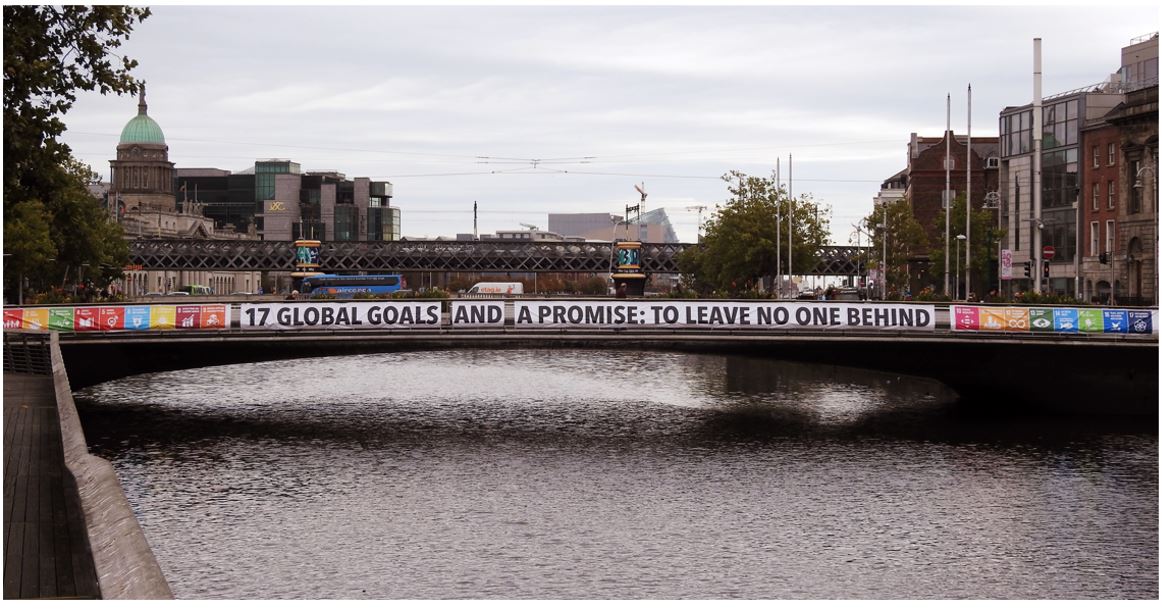
United Nations Sustainable Development 17 Global Goals banner displayed across Dublin’s Rosie Hackett Bridge over the River Liffey, Ireland.
Doha: Voluntary National Reviews (VNRs) could accelerate the fight against manmade climate change in the Middle East, the Al-Attiyah Foundation discovers in its latest Sustainable Development Report.
The 2030 Agenda for Sustainable Development from the United Nations General Assembly is an ambitious plan for world countries and all other actors to eliminate extreme poverty, reduce inequality, and protect the planet. It lays down a concrete call to action to undertake bold and transformative steps which are urgently needed to shift the world on to a sustainable and resilient path.
One of the primary aims of the 2030 Agenda for Sustainable Development is to connect climate action to its Sustainable Development Goals (SDGs) by analysing and comparing how climate actions formulated in Nationally Determined Contributions (NDCs) of the Paris Agreement correspond to the 17 SDGs.
As part of its follow-up and review mechanisms, the 2030 Agenda encourages member states to “conduct regular and inclusive reviews of progress at the national and sub-national levels, which are country-led and country-driven”, known as Voluntary National Reviews (VNRs).
VNRs are an essential part of the formal follow-up and review architecture of the 2030 Agenda. Presented every year at the UN High-level Political Forum on Sustainable Development (HLPF) during its three-day ministerial segment in July, these reviews are supposed to be voluntary, state-led, undertaken by both developed and developing countries, and provide a platform for partnerships, including through the participation of major groups and other relevant stakeholders.
The energy sector is one of the critical enablers of the 2030 Agenda and the major energy producers in the MENA region have all conducted at least one VNR, except Iran. VNRs of these countries are interlinked with their role as large energy producers, which offers potential for them to increase their positive multi-benefit contributions by mitigating or avoiding the negative impacts of their industry. For example, in a country like Iraq, where flaring of natural gas produced from oil and gas operations is rampant, methane capture units, CO2 capture systems, or other gas retrieval technologies could not only meet the subgoals of SDG 13 (take urgent action to combat climate change and its impacts), but of others like SDG 7 (ensure access to affordable, reliable, sustainable and modern energy for all) and SDG 15 (protect, restore and promote sustainable use of terrestrial ecosystems, sustainably manage forests, combat desertification, and halt and reverse land degradation and halt biodiversity loss).
In Qatar and other GCC countries, efforts for sustainable procurement of food imports can result in a reduction in methane emissions from food waste sent to landfills. Not only can this meet SDG subgoals under SDG 13 but also under SDG 15, among others.
Furthermore, VNRs allow countries to take stock of and assess the progress and shortcomings in their implementation of the goals, facilitate learning from national experiences and to promote accountability to citizens. Governments of GCC countries are in a unique position to establish regional cooperation in the preparation of their VNRs, to share common lessons, best practices, and cooperative goals to mobilise the implementation of the SDGs not only at a national level, but also across their region.
For an in-depth look at the VNRs, the Al-Attiyah Foundation’s Sustainable Development Report - titled The 2030 SDGs Voluntary National Reviews: Are They Enough? - is available as a free download on the Foundation’s official website at https://www.abhafoundation.org/