DOHA: Representing more than 60 percent of total issuances since 2010, Qatar remains the most active issuer of long-term sovereign sukuk in the GCC. Over the next few months, the governments of Qatar, Kuwait and Oman are likely to launch sukuk issuances, Moody’s Investors Service said yesterday.
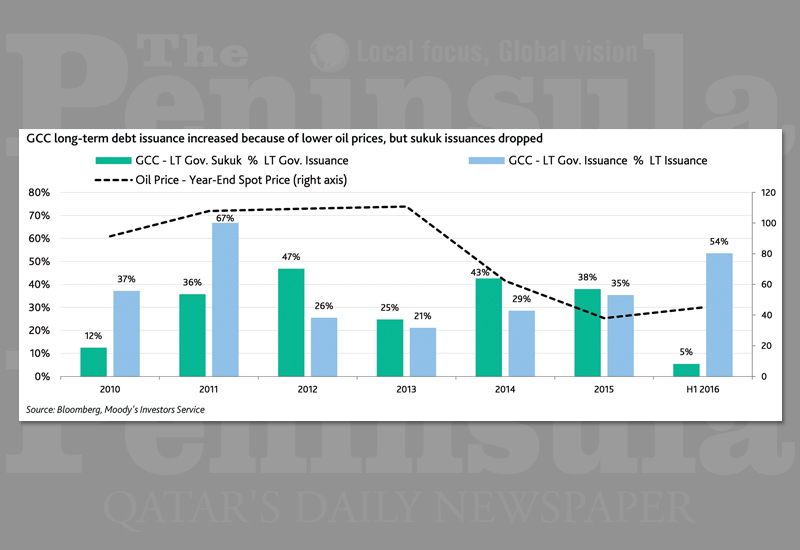
In the first half of 2016 (H1, 16), total GCC sukuk and conventional bond issuances reached an H1 record $36.7bn, compared to $39.5bn for full year 2015. The sharp increase in total issuances in 2016 has been driven by higher government issuances to finance large fiscal deficits in 2016, ranging from an estimated 3 percent of GDP in Kuwait , to 14.6 percent and 15.0 percent of GDP in Bahrain and Oman , respectively. GCC sovereigns issued close to $20bn of long-term debt in H1 16 (compared to $14bn for FY2015), representing 54 percent of total long-term debt issuance in the region. This includes Qatar’s $9bn conventional international bond in three tranches, with maturities of 5, 10 and 30 years, and Abu Dhabi’s $5bn conventional international bond divided equally into 5 and 10-year tenors.
However, Moody’s noted, only 5 percent of GCC government debt issuance in H1 16 comprised sukuk, compared to 38 percent in 2015. GCC government entities issued only $1.1bn worth of long-term sukuk in H1 16, compared to $5.3bn in 2015.. This includes Oman’s six-year Ijarah sukuk issuance of $500m n and Sharjah’s five-year sukuk issuance of $500m.
While global sukuk issuance volumes have more than halved from a peak of $149bn in 2012 to just under $70bn in 2015, international sovereign sukuk issuance has remained mostly stable throughout this period at an average of $25bn per year. Indeed, sovereign sukuk represented 50 percent of total sukuk issuance in the first half of 2016, and is set to reach around $28bn by year-end.
Moody’s said sovereign sukuk issuance is to remain broadly stable in 2016, against a backdrop of markedly lower total sukuk issuance. In contrast to the contraction in corporate sukuk issuance, sovereign sukuk issuance has remained relatively stable at $22bn as of September 2016, compared with $21bn for the first nine months of 2015. A robust pipeline of issuances planned for the rest of 2016 points to broadly stable sovereign sukuk issuance of around $28bn for the year as a whole. South-East Asia continues to lead sovereign sukuk volumes with regular long- term issuance, followed by the GCC.
Malaysia and Indonesia continue to regularly issue long-term sovereign sukuk while Gulf countries have favoured conventional debt structure to finance their deficit, says Moody’s Investor Services. On balance, Moody’s Investors Service considers that issuance levels will be in line with historical levels and may approach $28 billion in 2016.
“The robust pipeline of issuances planned for the rest of 2016 points to a stable flow of sovereign sukuk this year,” said Mathias Angonin, an Analyst at Moody’s.
“While the governments of Cote d’Ivoire, Senegal and Sharjah returned to the sovereign sukuk market in 2016, issuance volumes are primarily supported by more regular issuers, such as Indonesia, Malaysia and Turkey, whose annual borrowing requirements have featured Shariah-compliant instruments for several years,” said Gabriel Torres, a Vice President and Senior Credit Officer at Moody’s.